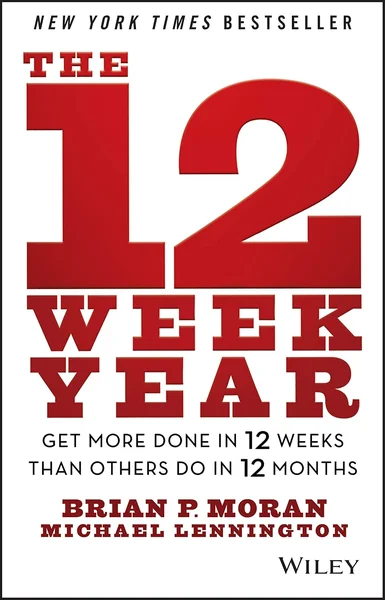
The 12 Week Year: Get More Done in 12 Weeks than Others Do in 12 Months by Brian P. Moran and Michael Lennington
by Brian P. Moran, Michael Lennington
At a glance
About the Author
Brian P. Moran, Michael Lennington1 book reviewed
The 12 Week Year
Get More Done in 12 Weeks than Others Do in 12 Months by Brian P. Moran and Michael Lennington
by Brian P. Moran, Michael Lennington
LuvemBooks Verdict
Best for: Professionals and organizational leaders who feel trapped in annual planning cycles and want a conceptually clear, practitioner-grounded framework for compressing their execution rhythm and rebuilding urgency around goals.
Worth it? Skip it? Read the full verdict →Preview the book

Ask LuvemBooks
Was this helpful?
- Is it worth reading?
- For professionals frustrated by the drift that annual goal-setting tends to invite, The 12 Week Year offers a structured and immediately actionable alternative with genuine conceptual clarity. The core idea — compress the planning cycle to replicate year-end urgency year-round — is easy to internalize and hard to dismiss, and reader commentary reflects real mindset shifts around goal commitment and discipline for those who engage fully with the system. The key caveat is that the book's tone reportedly turns promotional in its later sections, which creates friction in a framework that asks readers to sustain focus to the end. Readers already familiar with short-cycle productivity frameworks like OKRs or GTD may also find the underlying principles feel like familiar territory under a new label.
- Similar books
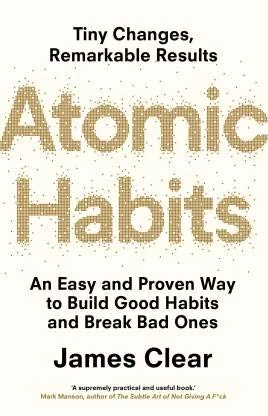
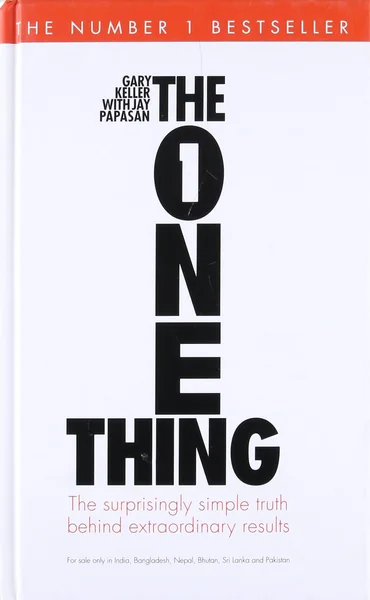
- Readers drawn to The 12 Week Year will find strong company in the broader productivity canon. Atomic Habits by James Clear approaches behavior change at the system level — building identity-based habits rather than chasing goals — and pairs well with Moran and Lennington's execution focus. The One Thing by Gary Keller and Jay Papasan makes a related case for radical prioritization and eliminating distraction, echoing the compressed-focus argument at the heart of The 12 Week Year. For readers interested in the deeper cognitive case for protected, distraction-free work, Deep Work by Cal Newport is a natural complement, as is Essentialism by Greg McKeown for those who want to apply a similar discipline to what they choose to pursue in the first place.
- Who should read this?
- The 12 Week Year is written for both individual professionals and organizational leaders — entrepreneurs, corporate executives, and anyone who finds that annual planning cycles invite drift and complacency rather than sustained execution. It is particularly well-suited to readers who feel most productive under deadline pressure and want to engineer that urgency into their year-round workflow. Readers already fluent in OKR or GTD frameworks may find the core ideas less novel, and those seeking a template-heavy workbook rather than a philosophy-first guide should calibrate expectations accordingly.
- What are the key concepts?
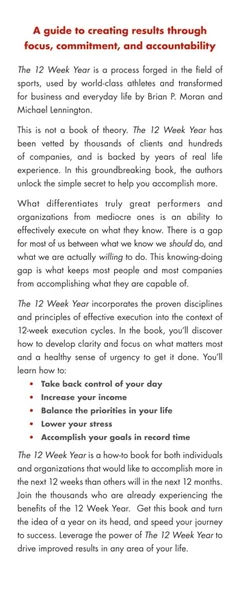
- The book's two central concepts are "annualized thinking" — the habit of treating the twelve-month calendar as the unit of planning, which creates a false sense of abundant time — and "periodization," the proposed antidote of breaking the year into four twelve-week cycles, each treated as a complete year with its own goals and accountability structure. Moran and Lennington also emphasize measuring lead indicators (the behaviors that drive results) rather than just lagging outcomes, and they devote significant attention to the psychological commitments — discipline, accountability, and a revised relationship with urgency — that make the mechanical framework actually function.
- How credible are the authors?
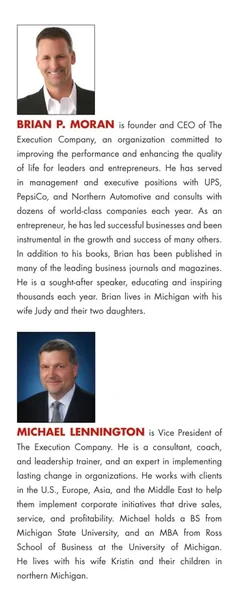
- Both Moran and Lennington bring practitioner backgrounds rather than purely academic credentials. Moran is the founder and CEO of The Execution Company, while Lennington held prior roles at Arthur Andersen and Senn-Delaney Leadership before leading The 12 Week Year Coach. Their hands-on executive coaching and organizational consulting experience lends the framework a grounding in real-world application, which the review identifies as a meaningful strength. The book was published by Wiley, a major business publisher, and has sustained relevance across formats — further indicators of its standing in the productivity space.
- What are the biggest criticisms?
- The most consistent critique in reader commentary is that the book's energy flags in its later chapters, where the writing turns noticeably promotional — a significant friction point in a framework that asks readers to sustain discipline and focus through to the end. Readers already familiar with OKR or GTD traditions may also find that the core principles around urgency and short-cycle planning feel like familiar concepts relabeled as periodization. A third limitation is structural: because the book is a framework-and-philosophy guide rather than a fill-in workbook, readers who want built-in templates will likely need to seek supplementary resources.
Summarize this book
Follow up
Synthesized from verified book data & published reviews · How we review
Press Enter to ask. Answers come from our editorial Q&A — start typing to see related questions.
Age & Reading Level
Recommended age
Adult
Reading level
Adult
who it suits
Skip if you want a template-heavy workbook with built-in planning forms rather than a philosophy-first framework guide.
Editorial Review
The 12 Week Year by Brian P. Moran and Michael Lennington is a business productivity guide that proposes replacing the traditional twelve-month planning cycle with a compressed twelve-week "year," designed to sustain the focus and urgency that most people only feel at year-end.…
Read the Full ReviewBooks like The 12 Week Year
Curated picks for readers who enjoyed The 12 Week Year, with our reasoning for each match.
If you liked The 12 Week Year