
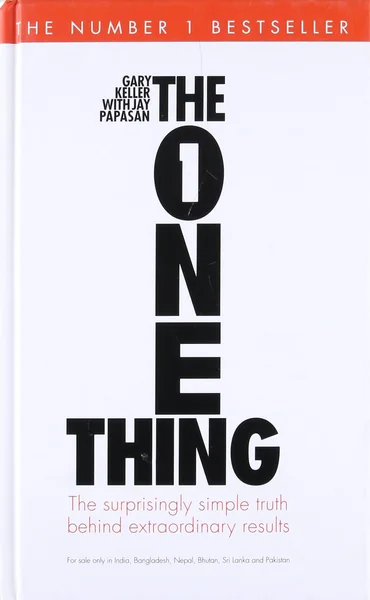
The One Thing: The Suprisingly Simple Truth Behind Extraordinary Results
Gary Keller and Jay Papasan argue that focusing on a single most-important task — guided by their "Focusing Question" — is the key to achieving extraordinary results in work and life.
Read our full reviewAt a glance

LuvemBooks Verdict
Best for: Professionals and entrepreneurs who want a sustained, single-argument case for radical prioritisation — structured from myth-busting through to a concrete execution tool — rather than a broad survey of productivity research.
Worth it? Skip it? Read the full verdict →Ask LuvemBooks
Was this helpful?
- Is it worth reading?
- For professionals and entrepreneurs looking for a structured, sustained argument in favor of single-minded focus, The One Thing delivers genuine value — its three-part architecture progresses logically from debunking myths to introducing the Focusing Question to providing actionable execution tools like time blocking. Its commercial track record is documented and substantial, appearing on the bestseller lists of The New York Times, The Wall Street Journal, USA Today, and Amazon.com. The key caveat is for readers already familiar with the Pareto principle or similar prioritization frameworks: the central insight may feel familiar, and the roughly 300-page treatment can read as an extended elaboration of a concept many professionals will absorb quickly.
- Similar books
- Readers drawn to The One Thing's case for radical focus will find natural companions in Essentialism by Anthony Wright, which similarly argues for doing less but better, and Atomic Habits by James Clear, which grounds behavioral change in the mechanics of small, consistent actions. For those interested in a deeper dive into concentrated, distraction-free work, Cal Newport's Deep Work covers closely related territory with an emphasis on cognitive performance. Greg McKeown's Essentialism and David Allen's Getting Things Done round out a strong productivity reading list that approaches the same problem of prioritization from different angles.
- Who should read this?
- The One Thing is best suited to professionals and entrepreneurs who want a sustained, structured argument for single-minded focus rather than a broad survey of productivity research. Its real-world grounding in the business practices of Keller Williams Realty gives it particular resonance for readers in sales, management, or startup environments. Readers in creative fields, caregiving roles, or non-career domains can still extract value from the Focusing Question, but should expect to do more translation work given the predominantly business-oriented examples.
- About Gary KellerJay Papasan
- Jay Papasan is an American writer and business executive. The One Thing is co-authored with Gary Keller.
- What are the main themes?
- The book's central theme is that radical, singular focus — not busyness, multitasking, or balance — is the true driver of extraordinary results. It systematically challenges productivity myths, most pointedly the cultural glorification of multitasking and the ideal of work-life balance, which Keller and Papasan describe as idealistic but not realistic. Underlying the entire argument is a version of the Pareto principle: "Success isn't a game won by whoever does the most," with the minority of high-impact actions generating the majority of results.
- How did the book perform commercially?
- The One Thing's commercial track record is documented and substantial. It appeared on the bestseller lists of The New York Times, The Wall Street Journal, USA Today, and Amazon.com following its 2013 publication — among the widest commercial reach in the self-help productivity genre. Hudson Booksellers named it among the best Business Interest books of 2013, and Entrepreneur writer Brandon Turner counted it among the five books that changed the direction of his life.
Summarize this book
Follow up
Synthesized from verified book data & published reviews · How we review
Press Enter to ask. Answers come from our editorial Q&A — start typing to see related questions.
Age & Reading Level
Recommended age
Adult
Reading level
Adult
who it suits
Skip if you're looking for a broad survey of productivity research or evidence-based frameworks beyond a single central argument
Editorial Review
First published by Bard Press in 2013, this non-fiction self-help book by real estate entrepreneurs Gary W. Keller and Jay Papasan argues that radical focus on a single most-important task is the engine behind extraordinary results — a message that earned it a place on the bestseller lists of The New York Times, The Wall Street Journal, USA Today, and Amazon.…
Read the Full ReviewBooks like The One Thing
Curated picks for readers who enjoyed The One Thing, with our reasoning for each match.
If you liked The One Thing
Why It’s Trending
The One Thing Is Having a Moment Again — Here's Why Focus Is on Everyone's Mind
Gary Keller and Jay Papasan's 2013 productivity classic keeps finding new audiences, and right now the idea of cutting through noise to focus on what actually matters is resonating more than ever. Sometimes the right book just keeps coming back around.