
8 min read
4.6
· 1,312 Amazon ratingsShare This Review
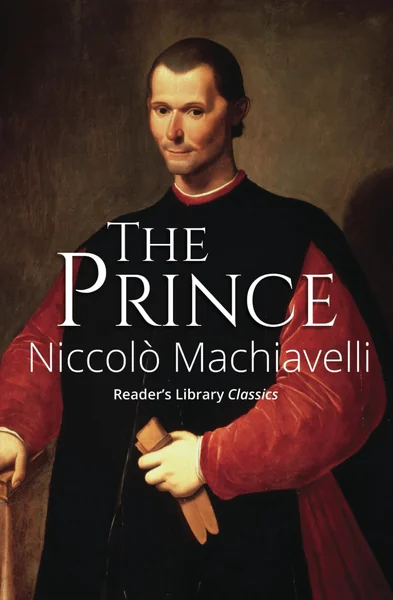
The Prince by Niccolò Machiavelli Review: A Foundational Political Treatise Still Provocative
Machiavelli's The Prince is a 16th-century political treatise — composed in 1513 and first published posthumously in 1532 — that has endured for half a millennium as one of the most controversial and consequential works in the history of political thought, offering a bracingly pragmatic guide to acquiring and holding power.
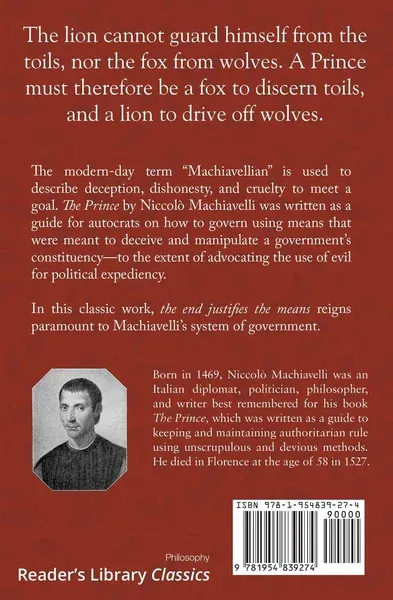 Tap to enlarge
LuvemBooks Verdict
Best for
Readers seriously interested in the origins of modern political thought — students of history, political science, business strategy, or leadership theory — who want to engage with a foundational and deliberately provocative text in a compact, accessible edition.
Worth it if
Worth reading if you can approach it as a historically layered argument rather than a simple manual — ideally with some grounding in Renaissance Italian history to bring Machiavelli's references to Cesare Borgia, the Medici, and early 16th-century Florence fully to life.
Skip if
Skip it if you're looking for moral reassurance or a straightforward how-to guide, or if five centuries of unresolved scholarly debate about the author's own intent is more likely to frustrate than enrich your reading.
What readers & critics say
Wikipedia describes The Prince as one of the texts sometimes claimed to be among the first works of modern political philosophy, and notes that controversy has swirled around it since its first appearance in manuscript — a legacy that extended to shaping the modern pejorative use of "Machiavellian" and even the word "politician." The Guardian, reviewing a modern translation, observes that popular understanding of Machiavelli's ideas — underhand ruthlessness in pursuit of power — turns out to be a faithful summary of the strategies actually outlined in The Prince, while also cautioning that it can be a sludgy read for those without background in the period's complex political geography.
“Popular understanding of Machiavelli's ideas — underhand ruthlessness in pursuit of power — turns out to be a faithful summary of the strategies outlined in The Prince. There is no historical misunderstanding.”
— The GuardianAsk LuvemBooks
Was this helpful?
- Is it worth reading?
- For any reader seriously interested in the origins of modern political thought, The Prince is, as LuvemBooks assesses it, an unavoidable text — not because it offers comfortable answers, but because the questions it forced into the open have never fully closed. At just 107 pages, it is one of the most consequential short works in Western intellectual history, generative across disciplines from political science and history to business strategy and leadership theory. The genuine difficulty is the accumulated weight of interpretive debate: five centuries of commentary — including unresolved scholarly disagreements about whether Machiavelli intended to serve the Medici or subtly mislead them — can make it hard for newcomers to encounter the text on its own terms. Readers expecting moral reassurance will find none, but readers prepared for provocation will find it richly rewarding.
- Similar books
- Readers drawn to The Prince will find natural companions in several works catalogued on LuvemBooks. Plato's The Republic offers the classical idealist counterpoint Machiavelli explicitly rejected — reading both together sharpens what makes Machiavelli so radical. Sun Tzu's The Art of War shares The Prince's stripped-down, pragmatic approach to strategy and has attracted a similarly cross-disciplinary readership. For philosophical depth on power, morality, and human nature, Friedrich Nietzsche's Beyond Good and Evil and Marcus Aurelius's Meditations — the Stoic emperor's private reflections on ruling — provide fascinating contrasts in how great thinkers have approached the ethics of power. Jonathan Haidt's The Righteous Mind: Why Good People Are Divided by Politics and Religion offers a modern social-science lens on the political divisions The Prince laid bare philosophically. Machiavelli's own Discourses on Livy, written shortly after The Prince, overlaps in subject matter and provides important context for understanding the full arc of his political thought, though it is not currently in the LuvemBooks catalogue.
- Who should read this?
- The Prince is essential reading for students and enthusiasts of political science, history, philosophy, and Renaissance Italian history, as well as business and leadership readers who want to trace the intellectual roots of modern strategic thinking. Readers who come to it with some grounding in early 16th-century Italian politics — the Medici, Cesare Borgia, the turbulence of the Italian city-states — will find Machiavelli's references considerably more vivid, though those without that background will still encounter an argument of remarkable directness and compression. It is not a book for readers seeking moral guidance or reassurance; it is a book for readers prepared to sit with uncomfortable arguments and centuries of unresolved interpretive debate. The Reader's Library Classics edition positions it as an accessible entry point for newcomers to the text.
- About Niccolò Machiavelli
- Niccolò di Bernardo dei Machiavelli was a Florentine diplomat, author, philosopher, and historian who lived during the Italian Renaissance. The Prince is the most remembered of his works and the text most responsible for the eventual pejorative use of the word "Machiavellian" in Western culture.
- What are the main themes?
- The Prince turns on several interlocking themes: the tension between moral idealism and political realism; the nature of power — how it is acquired, consolidated, and maintained; the role of force, cunning, and the appearance of virtue in statecraft; and the relationship between a ruler's actions and their historical legacy. Most provocatively, Machiavelli argues that immoral acts are sometimes necessary to achieve political glory, a proposition he illustrates through classical, biblical, and medieval examples, with Cesare Borgia as the treatise's central contemporary case study. The text also interrogates the role of fortune (fortuna) versus individual ability (virtù) in political success — a philosophical tension that runs throughout the work and has generated centuries of interpretive debate.
- What's the historical context?
- The Prince was composed in 1513, a period of intense political turbulence in Italy, when Machiavelli — recently removed from his post as a Florentine diplomat after the Medici family returned to power — was effectively writing from political exile. The treatise draws on his firsthand diplomatic experience, including his direct observation of Cesare Borgia's consolidation of power in central Italy. It was written in the style of the traditional "mirrors for princes" genre — advisory literature aimed at rulers — yet was recognized as especially innovative because Machiavelli explicitly distanced his work from classical political philosophy, which he viewed as overly concerned with the ideal regime rather than the real one. Controversy surrounded the work even before its 1532 publication, as it directly challenged the dominant Catholic and scholastic doctrines of the era.
Summarize this book
Follow up
Synthesized from verified book data & published reviews · How we review
Press Enter to ask. Answers come from our editorial Q&A — start typing to see related questions.
Age & Reading Level
Recommended age
Adult
Reading level
Adult
2 content notes · who it suits
Content to know about
Best for: Adults — the treatise's sustained arguments for political ruthlessness, its dense historical references, and its centuries of unresolved interpretive complexity are best suited to adult readers with some grounding in political philosophy or history.
Skip if you're looking for moral guidance, narrative storytelling, or reassurance about political life.
Our Review
What the Treatise Actually Is and Argues
Its Place in the History of Political Philosophy
What the Work Does Well: Innovation Within a Traditional Frame
Genuine Limitations and Points of Contention
Who This Edition Is For and How It Reads Today
Sources & Further Reading
The key facts and claims in this review are grounded in the retrieved, verified sources listed below.
- Cited in this review
- 1
- 2
- Further reading
- 3
Niccolò Machiavelli, Wikipedia
- 4
en.wikipedia.org
- 5
- 6
theinvisiblementor.com
- 7
thegccollegian.com
- 8
thepowermoves.com
- 9
nyxbookreviews.com
Books like The Prince
Curated picks for readers who enjoyed The Prince, with our reasoning for each match.
If you liked The Prince
Why It’s Trending
Machiavelli's Classic on Power Is Back in the Conversation
The Prince never really goes away, but right now it's drawing fresh attention as readers look for frameworks to make sense of an unpredictable political world. If you've been curious about where phrases like 'the ends justify the means' actually come from, this is the book.