BOOKS
Published

Read Time

8 min read

Curated & edited by

LuvemBooks Editorial

How we create our reviews →
Share This Review

The PRAGMATIST: (Do What Works) by Demian Goldstraj Esq. Review: A Slim Anti-Dogma Manifesto

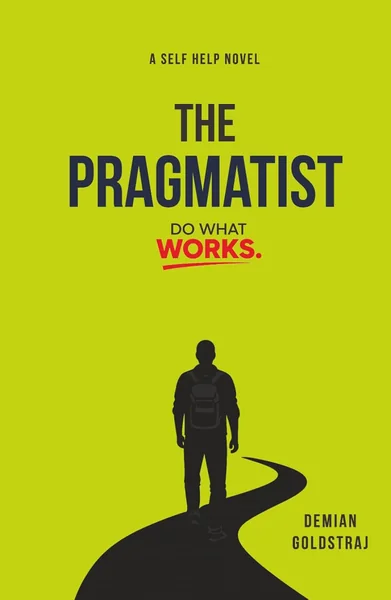
Demian Goldstraj Esq.'s The PRAGMATIST: (Do What Works), a 186-page hardcover from HMD Publishing, follows Lucas — a man whose inherited beliefs fail him in an accelerating world — and challenges readers to trade dogma for what actually works. A concise, story-framed entry point to pragmatic self-examination.
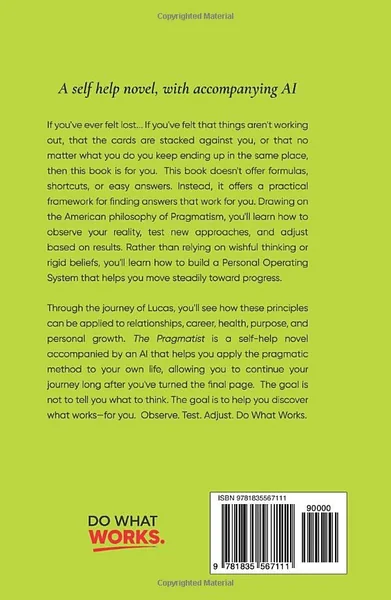
Back cover with synopsis, barcode, and tagline about pragmatic self-help philosophy.Tap to enlarge

LuvemBooks Verdict

Best for

A general reader in a moment of personal transition who senses their inherited beliefs no longer fit and wants a short, story-anchored, non-academic prod to test what they believe against what actually works.

Worth it if

You want a brief, low-commitment invitation to pragmatist self-examination carried by a relatable character's crisis of belief, and you're comfortable with an opening argument rather than a systematic one.

Skip if

Skip it if you're after a scholarly engagement with the pragmatist canon (James, Dewey), a fully developed novel, or a step-by-step program with exercises — its 186 pages and hybrid story-plus-method form sit between those satisfactions rather than delivering any one completely.

Age & Reading Level

Recommended age

Adult

Reading level

Adult

Skip if Skip this if you want a scholarly engagement with the classical pragmatist canon (James, Dewey), a fully developed novel, or a step-by-step program with exercises and protocols — this brief hybrid delivers none of those completely.

In This Review
  • What Works & What Doesn't
  • What the Book Is
  • The Argument: Results Over Dogma
  • Strengths: Compression and a Concrete Premise
  • Limitations and Who It Frustrates
  • Who It Is For

What Works & What Doesn't

What Works
  • Concrete, story-driven premise: Lucas's search for stability, success, and love gives the philosophy a human anchor.
  • States its anti-dogma, results-over-belief thesis plainly and commits to it throughout.
  • Compact at 186 pages — a genuinely low-commitment entry point into pragmatist self-examination.
  • Available in both print and digital formats.
  • Speaks to a general audience without requiring any background in academic philosophy.
What Doesn't
  • At 186 pages, the treatment of life's foundational questions is brief — a starting point rather than a deep or systematic exploration.
  • The hybrid story-plus-method form sits between a fully developed novel and a structured philosophical work, and may not wholly satisfy readers of either.
  • Its accessible, anti-academic stance means no engagement with the classical pragmatist canon (James, Dewey) for readers seeking that.
  • Readers wanting a step-by-step program with exercises or protocols will not find that here.
Verdict: A compact, anti-dogma philosophical work built around one man's crisis of inherited belief — intriguing in premise, though its brevity and hybrid form will suit some readers far better than others.
A note on scope before the substance: this review draws on the book's published record and its stated aims, not on a hands-on read. What follows covers what the book is, what it argues, and who it is built for.
absolutely the only philosophy with no humbug in it

What the Book Is

The PRAGMATIST: (Do What Works), by Demian Goldstraj Esq. And published by HMD Publishing, is a slim hardcover of 186 pages. Its premise, as described in the book's published materials, is a narrative one: it tells the story of Lucas, a man untethered in a world accelerating beyond recognition. Lucas seeks what most people seek — stability, success, love — but finds that the inherited beliefs he has carried no longer suffice. Around that story, the book builds its larger project: challenging readers to test their assumptions, confront their limitations, and adopt a method grounded not in dogma but in results. The author's broader writing, per the same materials, examines belief systems, discipline, power, and the friction between inherited ideas and lived experience — all of which is the explicit terrain of this book.

The Argument: Results Over Dogma

The subtitle — "Do What Works" — is the thesis in three words. The book positions pragmatism not as an academic school to be studied but as a personal operating method: beliefs are to be judged by their consequences in a lived life, and discarded when they stop working. That framing places the book in the long shadow of classical American pragmatism, the tradition William James popularized. James, exhilarated by the approach, once called it "absolutely the only philosophy with no humbug in it," as Harvard University Press's account of his 1907 lectures records. Goldstraj's book is not a commentary on James, and readers should not expect one; it borrows the pragmatist spirit — truth as what proves itself in practice — and aims it at the individual reader's choices rather than at philosophical debate. The challenge-to-the-reader structure (test assumptions, confront limitations) is framed as an exercise in self-interrogation, with Lucas's story as the vehicle.
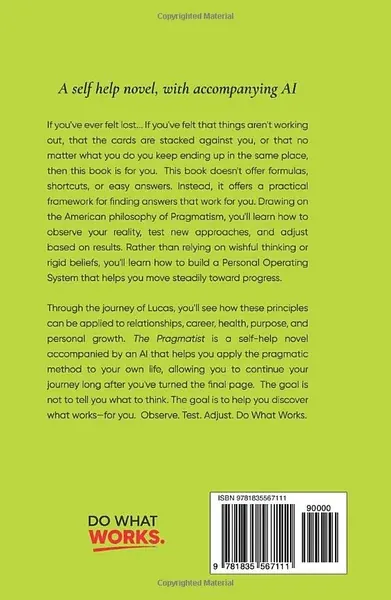
Back cover with synopsis, barcode, and tagline about pragmatic self-help philosophy.

Strengths: Compression and a Concrete Premise

The book's clearest asset is its concreteness of pitch. Rather than presenting abstract doctrine, it anchors its argument in a named character with recognizable wants — stability, success, love — and a recognizable problem: the inherited answers have stopped working. That is a legible entry point for readers who would never pick up a philosophy textbook but will follow a story about a man whose certainties fail him. Second, at 186 pages, the book is deliberately compact; it asks little of the reader's time and is available in both print and digital formats. Third, the anti-dogma stance is stated plainly and consistently in the book's own materials — there is no ambiguity about what the book is trying to do, which is itself a virtue in a genre crowded with vague motivational promises.

Limitations and Who It Frustrates

The same compression that makes the book approachable also bounds it. A 186-page treatment of how to rebuild one's beliefs from the ground up is an opening argument, not an exhaustive one, and readers who want sustained, systematic depth on any single question will reach the end quickly. The hybrid form carries its own risk: the book is built around a story, but it is pitched as a method, and readers seeking either a fully developed novel with rich interiority or a rigorously structured philosophical treatise may find the book sits between those two satisfactions rather than delivering either one completely. Finally, its deliberately accessible, non-academic stance means readers wanting engagement with the pragmatist canon itself — James, Dewey, and their successors — will need to look elsewhere; that is not this book's project.

Who It Is For

The PRAGMATIST: (Do What Works) is aimed squarely at the general reader in a moment of transition — someone who senses that the scripts they were handed no longer fit and wants a short, direct prod to examine why, with a narrative frame to carry them through. It suits readers of reflective, idea-driven fiction and readers of self-examination literature who prefer their philosophy unvarnished by academic apparatus. Those seeking a scholarly account of pragmatism, a lengthy novel, or a step-by-step program with exercises and protocols should calibrate expectations accordingly: this is a brief, pointed invitation to test what you believe against what actually works, and its value rests on how far that invitation carries each reader.

Sources & Further Reading

The key facts and claims in this review are grounded in the retrieved, verified sources listed below.

  1. Cited in this review
  2. 1
  3. Further reading
  4. 2
  5. 3
  6. 4
  7. 5
  8. 6
  9. 7