9 min read
4.6
· 676 Amazon ratingsShare This Review
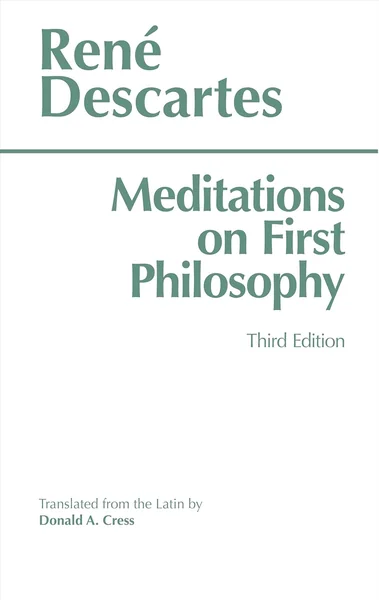
Meditations on First Philosophy by René Descartes Review: A Cornerstone of Western Philosophical Thought
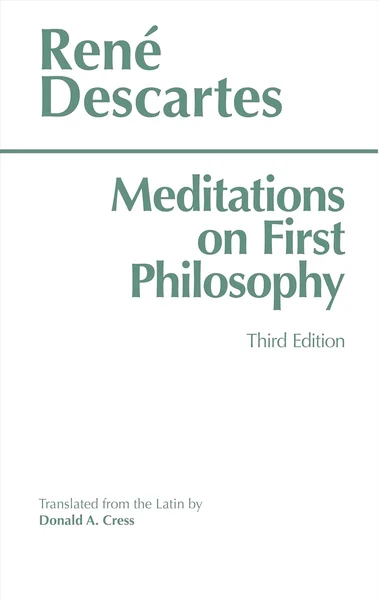
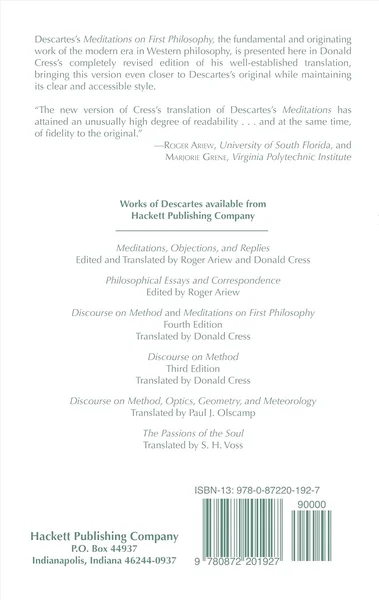
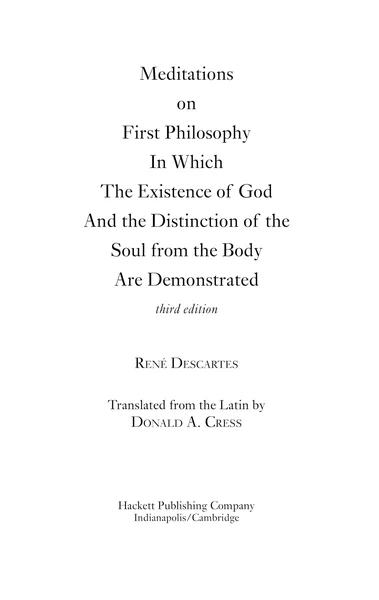
This Hackett Publishing Company third edition of René Descartes's Meditations on First Philosophy, translated by Donald A. Cress, brings one of the most foundational texts in Western philosophy to modern readers in an accessible English rendering — a compact but profound work whose central arguments about doubt, existence, and the nature of God have shaped philosophical inquiry for nearly four centuries.
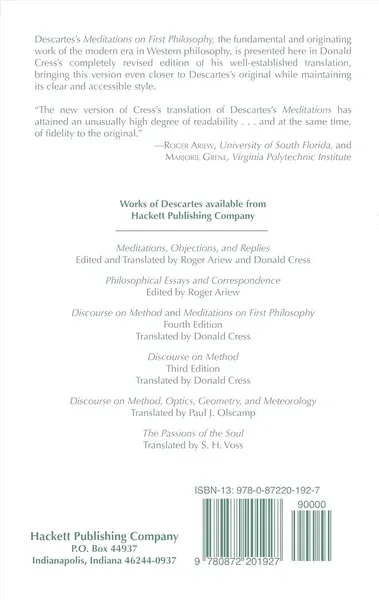

 Tap to enlarge
LuvemBooks Verdict
Best for
Undergraduate philosophy students or independent readers encountering modern Western philosophy for the first time, who need a compact, affordable, and accessible entry point into Descartes's foundational arguments in a widely adopted teaching translation.
Worth it if
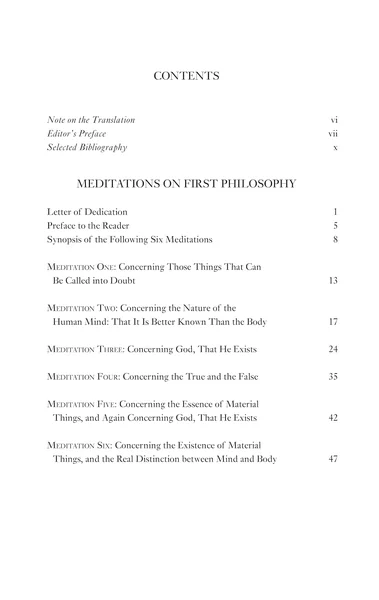
You want to engage seriously with the arguments — radical doubt, the cogito, mind-body dualism, the existence of God — that set the agenda for virtually all subsequent Western philosophy, and are content with the core text without the full scholarly apparatus of Objections and Replies.
Skip if
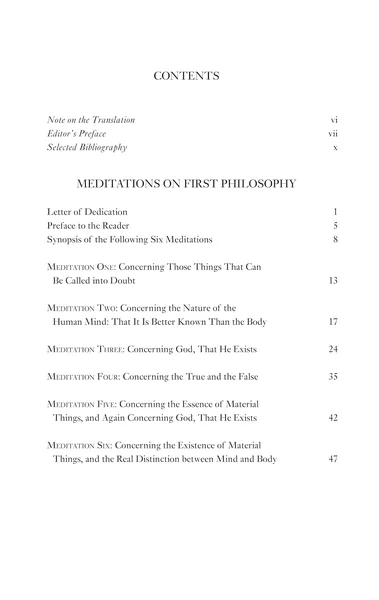
Scholars or advanced students who require the complete, unabridged Objections and Replies (especially those of Hobbes and Arnauld) or the Latin original alongside the English translation will find this compact Hackett edition insufficient and should seek a larger critical edition.
What readers & critics say
Oxford University Press's global academic catalogue notes that subsequent philosophy has continuously grappled with Descartes's ideas and that "his arguments set the agenda for many of the greatest philosophical thinkers" (global.oup.com). Broadview Press's scholarly apparatus describes it as "a foundational text in modern philosophy" whose "powerful arguments to this day influence debates in epistemology, the philosophy of mind, and the philosophy of religion" (broadviewpress.com).
Sources: Oxford University Press (global.oup.com), Broadview Press, Five Books, EBSCO Research StartersPreview the book

Ask LuvemBooks
Was this helpful?
- Is it worth reading?
- For anyone building a working knowledge of modern Western philosophy, the Meditations is, in LuvemBooks' assessment, not optional — it is the text from which an enormous portion of subsequent philosophical conversation proceeds, and the Cress translation makes that conversation accessible. Cambridge University Press describes it as 'one of the most widely studied philosophical texts of all time,' and its themes of radical doubt, the cogito, mind-body dualism, and proofs for God's existence continue to drive active inquiry across philosophy, theology, and cognitive science. Readers without a philosophy background should be prepared for some friction, as the meditative structure can obscure the underlying logical architecture without guidance.
- Similar books
- Readers drawn to the Meditations' project of grounding knowledge through reason will find natural companions in other rationalist and early modern classics. Descartes's own Discourse on the Method is an accessible precursor to the Meditations. Spinoza's Ethics pursues a similar foundationalist ambition with geometric rigour. Leibniz's Monadology and Locke's An Essay Concerning Human Understanding represent immediate responses within the same tradition. For modern readers interested in the mind-body problem the Meditations launches, Gilbert Ryle's The Concept of Mind is an influential twentieth-century rejoinder.
- Who should read this?
- The Hackett/Cress third edition is ideally suited to undergraduate students in philosophy, theology, and cognitive science courses, where it has become a standard adoption. Independent readers with an interest in the foundations of Western philosophy — particularly questions about the nature of mind, the existence of God, and the grounds of human knowledge — will also find the Cress translation a serviceable and affordable entry point. Scholars or advanced students requiring the full Objections and Replies or the Latin original should supplement with a larger critical edition, but for anyone building a working foundation in modern philosophy, this text is essential reading regardless of edition.
- Why is this text so historically important?
- Cambridge University Press describes the Meditations as a text that 'inaugurates many of the key themes that have remained central to philosophy ever since,' and its influence has been continuous since its first publication in 1641. The arguments Descartes introduces — radical doubt as a method, the cogito, mind-body dualism, and the proofs for God's existence — have been interrogated, disputed, and built upon by nearly every major philosopher from Hobbes and Arnauld in the seventeenth century through to present-day cognitive science and phenomenology. Academic citation databases confirm the text's ongoing reach across disciplines from theology to the philosophy of mind, and it has never left active intellectual circulation in nearly four centuries.
- Why do the Objections and Replies matter?
- Descartes published the Objections and Replies alongside the Meditations as part of the original 1641 text — they are not supplementary material but part of the work as he conceived it. The exchanges with Thomas Hobbes and Antoine Arnauld are especially significant: Descartes himself considered Arnauld the most penetrating of his readers, and Arnauld's objections reveal ambiguities and vulnerabilities in the argument that the main text leaves unaddressed. The Hackett/Cress third edition omits these materials in favour of accessibility and compact format, which is appropriate for introductory use but means readers will need a larger critical edition to engage fully with the arguments as Descartes published them.
- How does this edition compare to others?
- The Hackett/Cress third edition is the most widely adopted teaching text for undergraduate philosophy courses, valued for Donald Cress's accessible English rendering and its compact, affordable format. Its main trade-off is that it prioritises that accessibility over exhaustive scholarly apparatus: it does not include the Latin original or the full set of Objections and Replies that Descartes published with the text. Larger critical editions — such as those from Cambridge University Press — include the Hobbes and Arnauld objections-and-replies unabridged and are better suited to advanced study, while the Hackett edition remains the standard entry point for first-time readers and survey courses.
Summarize this book
Follow up
Synthesized from verified book data & published reviews · How we review
Press Enter to ask. Answers come from our editorial Q&A — start typing to see related questions.
Age & Reading Level
Recommended age
Adult
Reading level
Adult
who it suits
Skip if you want a systematically structured philosophical treatise with clearly marked premises, conclusions, and full scholarly apparatus in a single volume.
Our Review
What the Text Is and What It Does
Historical Significance and Place in the Canon
What Distinguishes Descartes's Method
Limitations and Honest Considerations
Who This Edition Is For
Sources & Further Reading
The key facts and claims in this review are grounded in the retrieved, verified sources listed below.
- Cited in this review
- 1
- 2
personal.lse.ac.uk
- Further reading
- 3
en.wikipedia.org
- 4
cambridge.org
- 5
pressbooks.library.torontomu.ca
- 6
1000wordphilosophy.com
- 7
yale.learningu.org
- 8
- 9
Books like Meditations on First Philosophy
Curated picks for readers who enjoyed Meditations on First Philosophy, with our reasoning for each match.
If you liked Meditations on First Philosophy