BOOKS
Published

Read Time

3 min read

Curated & edited by

LuvemBooks Editorial

How we create our reviews →
Share This Review

Guide to a Well-Behaved Parrot by MattieSue Athan Review: A Focused, Psychology-Grounded Training Resource

MattieSue Athan's Guide to a Well-Behaved Parrot is a parrot-training guide now in its third edition that grounds behavior correction in parrot psychology, targeting the three most common owner frustrations — screaming, biting, and feather-chewing — with practical, structured advice.

LuvemBooks Verdict

Best for

Parrot owners actively struggling with screaming, biting, or feather-chewing who want to understand the psychological roots of those behaviors — not just a list of commands to follow.

Worth it if

You are dealing with one of the three headline behavior problems and want a compact, psychology-grounded reference that explains *why* your parrot acts out before telling you what to do about it.

Skip if

You need species-specific depth, advanced trick training, or coverage of avian behavioral science beyond 2007 — this focused 144-page guide will need supplementing with more recent or specialized resources.

What readers & critics say

Multiple retailer and library catalogue descriptions, including campusstore.miamioh.edu and yumpu.com, consistently describe the book as a popular, expanded parrot-training guide that explains parrot psychology and offers practical remedies for the most common behavior problems. AbeBooks notes that Athan is "a widely respected expert on parrots and their care" who contributes regularly to bird-care periodicals, while a reader on amazon.co.uk describes turning to the book immediately upon struggling to keep a consistent schedule for a parrot adapting to a new environment — and finding it answered the specific questions they needed.

Sources: campusstore.miamioh.edu, yumpu.com, abebooks.com, amazon.co.uk
4.4from 301 Amazon ratings— reader ratings, not a LuvemBooks score
In This Review
  • What Works & What Doesn't
  • What the Book Actually Covers
  • Place in the Genre and Publication History
  • Core Strengths: Psychology as the Foundation
  • Reader Reception and Real-World Utility
  • Limitations and Who May Find It Insufficient

What Works & What Doesn't

What Works
  • Grounds behavior correction in parrot psychology rather than rote commands, giving owners transferable understanding
  • Directly addresses the three most common and disruptive parrot behavior problems — screaming, biting, and feather-chewing — with practical remedies
  • Covers a broad range of care topics (grooming, bathing, toys, nutrition, companionship) alongside behavior, making it a rounded quick-reference
  • Multiple revised editions signal sustained usefulness and ongoing refinement of the content
  • Includes bibliographical references and an index, supporting use as a structured reference rather than a casual read
What Doesn't
  • At 144 pages, the guide is compact and focused — owners seeking species-specific depth or advanced training content will need additional resources
  • The third edition dates to 2007, meaning it does not reflect more recent developments in avian behavioral science
  • Coverage of the three headline behavior problems is strong, but owners dealing with less common or complex behavioral challenges may find the scope limited
A practical, psychology-first guide to parrot behavior, this book remains one of the most recognized titles in its niche for owners dealing with difficult companion birds.

What the Book Actually Covers

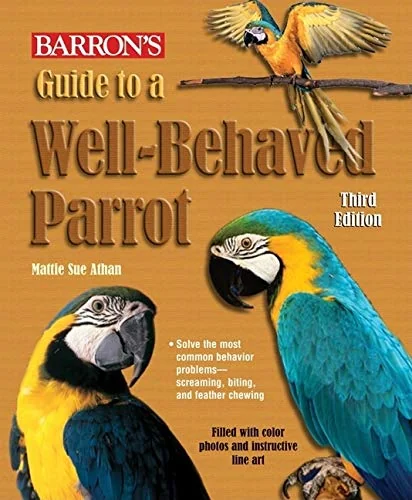
Guide to a Well-Behaved Parrot (Barron's) by MattieSue Athan front cover
Guide to a Well-Behaved Parrot by MattieSue Athan is a parrot-training and behavior guide designed to help owners understand and address the most disruptive challenges of living with a companion parrot. The book focuses squarely on parrot psychology as the foundation for behavior change, explaining how owners can apply an understanding of how parrots think and respond to correct problem behaviors. The three most common complaints Athan addresses are screaming, biting, and feather-chewing — each treated as a solvable problem with root causes that the owner can learn to recognize and redirect. Beyond behavior correction, the book also covers practical care topics including grooming, bathing, toys, nutrition, and the importance of providing consistent companionship for the bird. Bibliographical references and an index are included, giving the guide a structured, reference-friendly format.

Place in the Genre and Publication History

Originally published by Barron's — an imprint long associated with accessible pet-care references — the book has gone through multiple editions, reflecting sustained reader demand. The edition currently catalogued at major retailers is the third, published by Sourcebooks in 2007. The longevity of the title across editions positions it as a reference that has been revised and expanded rather than simply reprinted, with descriptions of the updated editions noting new content that deepens coverage of parrot psychology relative to earlier versions. Illustrator Michele Earle-Bridges is credited on earlier editions for the color photography and line art that accompanies the text; the verified facts confirm color photos and line illustrations are part of the book's visual presentation, per sourced descriptions.

Core Strengths: Psychology as the Foundation

What distinguishes Athan's approach, according to multiple sourced descriptions, is the emphasis on why parrots behave the way they do before prescribing what to do about it. Rather than offering a list of commands or rote training steps, the guide frames behavior problems as issues with identifiable psychological causes — an approach that treats the parrot as an animal with consistent motivations rather than an unpredictable pet. Athan also stresses the need for periodic reinforcement of desirable behaviors, acknowledging that good behavior is not a one-time achievement but an ongoing dynamic between bird and owner. This preventive dimension — covering nutrition and steady companionship alongside crisis correction — gives the book a broader scope than a narrow troubleshooting manual.

Reader Reception and Real-World Utility

Reader responses catalogued on retail platforms reflect the book's practical appeal for owners in active difficulty with their birds. One Amazon reviewer describes turning to the book immediately upon receiving it after struggling to maintain a consistent schedule for a parrot adjusting to a new environment and climate — and finding it answered the specific questions they needed. This kind of direct, situational utility is consistent with what the book is designed to deliver: actionable guidance for owners who are already experiencing problems, not just those preparing for a first bird. Reception of this nature points to the book functioning well as a problem-solving reference rather than purely an introductory overview.

Limitations and Who May Find It Insufficient

The book's compact scope — 144 pages covering behavior, grooming, nutrition, and companionship — means it is, by design, a focused guide rather than a comprehensive encyclopedia of parrot ownership. Readers seeking species-specific deep dives, advanced trick training, or detailed coverage of avian veterinary topics will need to supplement it with other resources. The concentration on the three headline behavior problems (screaming, biting, feather-chewing) is a genuine strength for owners facing those exact issues, but owners dealing with less common behavioral challenges may find the coverage thinner than they need. The third edition was published in 2007, meaning developments in avian behavioral science since that date are not reflected in the text.

Sources & Further Reading

The key facts and claims in this review are grounded in the retrieved, verified sources listed below.

  1. Cited in this review
  2. 1
  3. 2
  4. 3
  5. Further reading
  6. 4
  7. 5
  8. 6
  9. 7