

7 min read
Share This Review
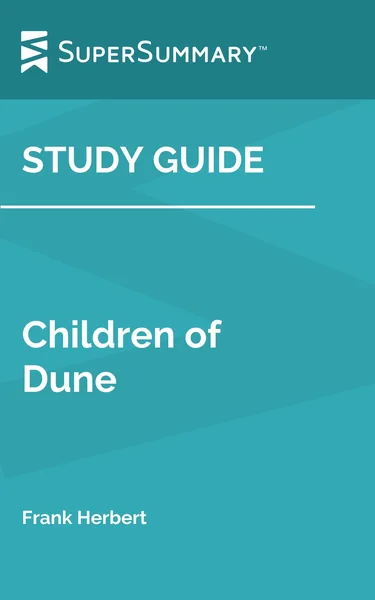
Study Guide: Children of Dune by Frank Herbert (SuperSummary) by SuperSummary Review: A Focused Companion for Herbert's Epic Third Novel
SuperSummary's study guide for Frank Herbert's Children of Dune is a structured, Kindle-format companion designed to help students, book club participants, and returning readers navigate the third entry in The Dune Chronicles — covering chapter summaries, character analysis, thematic breakdowns, and key quotes from the 1976 science fiction classic.
LuvemBooks Verdict
Best for
High school and undergraduate students working through Children of Dune on a course syllabus, book club members preparing for discussion, and Dune franchise fans who want a structured re-engagement with the source material's dense themes and complex plot.
Worth it if
You have already read Children of Dune and need a clear, organised analytical framework — covering chapter summaries, character analysis, thematic breakdowns, and quote explanations — to support coursework, group discussion, or deeper personal engagement with Herbert's ideas.
Skip if
You haven't yet read Children of Dune and are hoping the guide will substitute for or introduce the novel, or you're a scholar seeking original peer-reviewed criticism rather than an accessible structured companion.
What readers & critics say
Reviews.readingtrolls.com notes that Children of Dune itself "is written at a fairly high level and uses a lot of terminology" and is "certainly not an easy read," underscoring why a structured analytical companion has practical value for readers tackling the novel. No aggregated critical reception for the SuperSummary guide specifically was available in retrieved sources.
Sources: Reading TrollsAsk LuvemBooks
Was this helpful?
- Is it worth reading?
- For its target audience — students, book club members, and returning fans of the Dune franchise — the guide delivers genuine value, providing a navigable map of Herbert's intricate narrative alongside substantive critical context that goes well beyond a plain plot synopsis. It is anchored in a source text of real historical significance: Children of Dune was among the first science fiction novels to become a national bestseller. Readers who have already read the novel and want structured support for analysis or discussion will find it a practical, well-organized resource; those who haven't read Children of Dune itself should do so first, as the guide is not designed to function as a standalone introduction.
- Similar books
- Readers drawn to Children of Dune for its exploration of power, religion, and ecology alongside complex world-building will find resonant company in several works. Aldous Huxley's Brave New World shares the series' preoccupation with social control, manufactured belief, and the corruption of ideals at civilizational scale. Yuval Noah Harari's Sapiens: A Brief History of Humankind offers a compelling nonfiction parallel, interrogating how myths, religion, and political structures shape and distort human societies — themes central to Herbert's Dune universe. Thomas C. Foster's How to Read Literature Like a Professor and Joseph Campbell's The Hero with a Thousand Faces are also frequently paired with the Dune series in academic settings, given the saga's rich engagement with mythic archetypes and symbolic language.
- Who should read this?
- The guide is best matched to high school and undergraduate students working through Children of Dune on a course syllabus, book club members preparing for discussion, and fans of the broader Dune franchise — including those drawn in by the 2003 Sci-Fi Channel miniseries Frank Herbert's Children of Dune — who want a more structured re-engagement with the source material. It is not aimed at casual readers looking for a quick plot summary of the whole Dune Chronicles, nor at scholars seeking peer-reviewed criticism. The guide's practical design makes it especially useful wherever unpacking Herbert's complex interlocking threads within a limited time frame is a real necessity.
- About SuperSummary
- Tom Rath is an American author and a consultant on employee engagement, strengths, and well-being.
- What are the main themes?
- Children of Dune uses its far-future Arrakis setting to explore how religion, politics, economics, the environment, and family become corrupted by prized commodities — with the spice melange serving as the series' central symbol of that corruption. Herbert interrogates the dangers of messianic leadership and the intergenerational consequences of Paul Atreides' rise as Muad'Dib. The series is also a landmark of climate fiction, or cli-fi, given its sustained attention to desert ecology and the terraforming of Arrakis. The SuperSummary guide surfaces all of these threads, as well as the scholarly debate over whether Herbert's portrayal of the Fremen relies on orientalist fantasy tropes.
- How does this compare to SuperSummary's other guides?
- LuvemBooks has reviewed one other SuperSummary guide: the study companion for Ron Chernow's Alexander Hamilton, a work of major historical biography. Both guides reflect SuperSummary's approach of providing structured chapter summaries, character or figure analysis, and thematic breakdowns in a compact, practical format aimed at students and book club participants. The Children of Dune guide is distinctive in its engagement with the ongoing scholarly debates unique to science fiction — including orientalism, cli-fi, and the critique of messianic leadership — which gives it a more contested critical landscape to navigate than a straight historical biography.
- Why does Children of Dune matter?
- Children of Dune holds a unique place in science fiction history: it was among the first science fiction novels to become a national bestseller, with its hardcover edition selling over 100,000 copies in the first months of publication and its paperback edition selling nearly two million copies in the first six months. It also sits at a pivotal, often challenging point in The Dune Chronicles, a series widely regarded as one of the foundational works of the genre. The novel's intellectual ambition — its interlocking treatment of religion, politics, ecology, and power — makes it both a landmark text and one that rewards the kind of structured analytical support a study guide provides.
Summarize this book
Follow up
Synthesized from verified book data & published reviews · How we review
Press Enter to ask. Answers come from our editorial Q&A — start typing to see related questions.
Age & Reading Level
Recommended age
Adult
Reading level
Adult
who it suits
Skip if you haven't yet read Children of Dune and are looking for a standalone introduction to the Dune universe
Our Review
What the Source Novel Is and What the Guide Covers
Significance of the Source Text and Why a Study Aid Has Value
What the Guide Is Designed to Do Well
Honest Limitations and Who May Be Frustrated
Who This Guide Is genuinely For
Related reading
Adjacent titles worth exploring. We haven't reviewed these yet, so they link out to Amazon.