BOOKS
Published

Read Time

7 min read

Curated & edited by

LuvemBooks Editorial

How we create our reviews →
Share This Review

Strangers Again: A Memoir of Marriage, Betrayal, and Becoming Whole by Sam Joe Review: A Self-Published Memoir of Betrayal and Rebuilding

Strangers Again: A Memoir of Marriage, Betrayal, and Becoming Whole is an independently published memoir by Sam Joe, released in 2026, chronicling a personal journey through marriage breakdown, betrayal, and self-reconstruction — a compact, intimate account offered directly to readers outside traditional publishing channels.
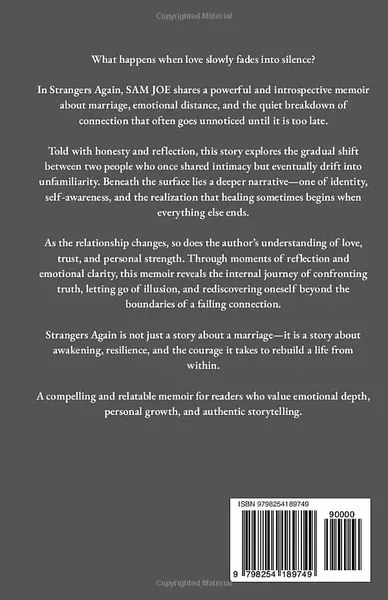
Back cover with synopsis, barcode, and publisher information about a memoir on marriage dissolution and personal recovery.Tap to enlarge

LuvemBooks Verdict

Best for

Readers navigating or reflecting on marital betrayal and the interior work of rebuilding a sense of self, particularly those who gravitate toward independent voices and compact, unmediated first-person memoir forms.

Worth it if

You're looking for a focused, direct personal narrative that traces the full arc from intimate partnership through rupture to self-reclamation — and you value the immediacy of an author speaking without the mediation of a major publishing infrastructure.

Skip if

You prefer expansive trade memoirs enriched by extensive cultural or social context, or expect the editorial polish and production scale that comes with a major-press release.

In This Review
  • What Works & What Doesn't
  • What the Book Is and What It Sets Out to Do
  • Subject Matter and Thematic Scope
  • The Independent Publishing Context and What It Means for Readers
  • Genuine Strengths of the Premise
  • Who This Memoir Is For and Where It Sits

What Works & What Doesn't

What Works
  • Addresses the emotionally resonant arc of marriage, betrayal, and self-reclamation — a subject with broad and enduring reader relevance
  • The subtitle's three-part structure signals a clear, purposeful narrative trajectory from loss toward wholeness
  • Independent publication gives the memoir an unmediated, direct quality — the author's voice reaches readers without outside editorial intervention
  • Compact format suits readers seeking a focused, contained personal narrative
What Doesn't
  • As an independently published work, it lacks the editorial, fact-checking, and publicity infrastructure of a major trade release, which may affect polish and discoverability
  • The book's brevity may frustrate readers who expect the expansive depth and contextual richness of longer trade memoirs on similar subjects
This independently published memoir stands on its own terms: a personal reckoning with marital betrayal and the difficult work of becoming whole again.

What the Book Is and What It Sets Out to Do

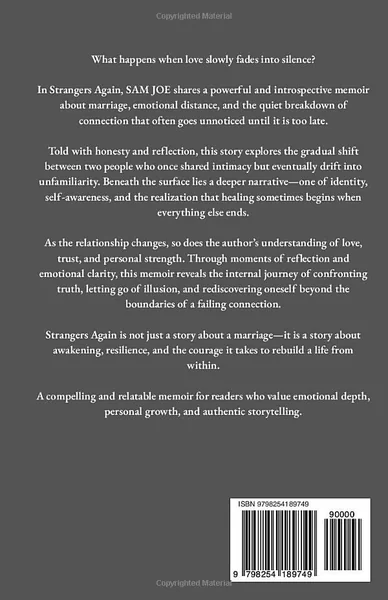
Back cover with synopsis, barcode, and publisher information about a memoir on marriage dissolution and personal recovery.
Strangers Again: A Memoir of Marriage, Betrayal, and Becoming Whole by Sam Joe is a memoir, published independently in 2026, that centers on the author's lived experience of marriage, the discovery of betrayal, and the process of personal reconstruction that follows. The subtitle makes the book's trajectory explicit: this is not simply a story of loss, but one that moves through fracture toward wholeness. As a memoir, it belongs to a personal narrative tradition that asks readers to sit alongside an author working through one of life's most destabilizing experiences — the collapse of a relationship built on trust.
The book is written in English and released under independent publishing, placing it outside the infrastructure of a major trade house. That context matters: it is a work shaped entirely by the author's own choices about what to include, how to frame it, and where to take the story.

Subject Matter and Thematic Scope

The memoir's full title signals its three-part architecture: marriage, betrayal, and becoming whole. Each stage represents a distinct emotional and narrative territory. The first concerns the life that was — the relationship as it existed before rupture. The second concerns the discovery and the collapse. The third, and arguably most demanding, concerns what the author builds in the aftermath.
This thematic arc — from intimate partnership to disillusionment to self-reclamation — places Strangers Again within a recognizable and enduring strand of memoir writing, one that has attracted sustained reader interest, particularly among audiences navigating or reflecting on their own experiences of relationship and identity. The book's subtitle, with its deliberate phrase "becoming whole," signals that the author's intent is not merely to document damage but to trace a path beyond it.

The Independent Publishing Context and What It Means for Readers

Published independently in March 2026, Strangers Again reaches readers without the editorial and publicity apparatus that accompanies trade publishing. For some readers, this is simply a logistical detail. For others, it is a meaningful distinction: independent memoirs of this kind represent an author choosing immediacy and directness over the longer road of traditional acquisition and development.
It is worth noting that the memoir occupies a notably compact form. The book's brevity is a structural fact that will suit readers who want an immersive, contained reading experience — and may give pause to those who expect the expansive depth of a longer trade memoir. Whether that compression serves the material's emotional weight is a question each reader will answer for themselves. What the format does guarantee is a focused, unmediated account, unmediated by outside editorial shaping.

Genuine Strengths of the Premise

The premise of Strangers Again carries inherent emotional power. Betrayal within marriage — and the work of reconstituting a self in its wake — is a subject that resonates because it is, for many readers, either directly familiar or deeply imaginable. Memoirs that trace this territory honestly serve a real function: they offer companionship, frameworks for understanding, and the particular comfort of knowing that someone else has navigated the same disorientation and survived it.
The decision to write under one's own name, and to claim the story in full, is itself a meaningful act within this genre. The word "again" in the title — Strangers Again — carries a precise and quietly devastating implication: that two people who were once intimate can become unknown to each other, and that the self, too, can become a stranger before it becomes whole once more.

Who This Memoir Is For and Where It Sits

Strangers Again is designed for readers drawn to personal narrative centered on resilience and self-discovery after relationship breakdown. It will find its most natural audience among those interested in honest, first-person accounts of marital rupture and the interior work of rebuilding — particularly readers who gravitate toward independent voices and compact memoir forms.
Readers who prefer extensively reported narratives, or memoirs enriched by substantial historical, social, or cultural context, may find the book's scope narrower than they seek. Equally, those accustomed to the production scale of major-press memoir releases should calibrate their expectations accordingly: this is an author speaking directly, without the mediation of a large publishing infrastructure. For the right reader, that directness is precisely the point.

Sources & Further Reading

The key facts and claims in this review are grounded in the retrieved, verified sources listed below.

  1. 1
  2. 2
  3. 3
  4. 4
  5. 5
  6. 6
  7. 7
  8. 8