BOOKS
Published

Read Time

8 min read

Reader rating

4.6

· 1,037 Amazon ratings
reader ratings, not a LuvemBooks score
Curated & edited by

LuvemBooks Editorial

How we create our reviews →
Share This Review

Education of a Wandering Man: A Memoir by Louis L'Amour Review: A Restless Mind's Testament to Self-Education

Education of a Wandering Man is Louis L'Amour's final completed work — a memoir in which the celebrated author of more than 100 books reflects on the unorthodox, experience-driven education that shaped him, from riding the rails as a hobo to sailing as a merchant seaman, all while pursuing a lifelong, voracious hunger for reading and self-improvement. This review is based on the book's contents and published reception; it does not represent hands-on use or application.

LuvemBooks Verdict

Best for

Admirers of L'Amour's fiction curious about the self-made intellectual life behind his westerns, and readers drawn to Depression-era America, self-directed learning, and the romance of a life built on books and open roads.

Worth it if

You prize voice, atmosphere, and inspiration over structure — and find the idea of a man stuffing paperbacks into his pockets while hoboing across America genuinely compelling.

Skip if

You're looking for a systematic framework or prescriptive curriculum for self-education, as the memoir's episodic, discursive design offers inspiration by example rather than any step-by-step instruction.

Critical reception has been broadly appreciative but mixed on structure: grokipedia.com notes some reviewers found the memoir "unstructured and superficial" while others valued its "engaging glimpses into self-education and adventure." Genuine reader response, reflected at sites including bookponder.com and edgeinducedcohesion.blog, runs warmer — consistently citing the book's power to inspire lifelong learning and praising L'Amour's "rigorous plan of self-education that he shares with the reader."

Sources: grokipedia.com, bookponder.com, edgeinducedcohesion.blog, thelittlemanreviews.com, puritanboard.com
4.6from 1,037 Amazon ratings— reader ratings, not a LuvemBooks score
In This Review
  • What Works & What Doesn't
  • What the Book Actually Is
  • The Life Behind the Legend
  • The Self-Education Philosophy at Its Core
  • Reception and Resonance
  • Scope, Limitations, and Who It's For

What Works & What Doesn't

What Works
  • Completed just before L'Amour's death in 1988, it stands as his most personal and introspective work — a rare window into the life and reading habits behind more than 100 published books
  • Combines genuine adventure storytelling (hoboing, prizefighting, merchant sailing) with substantive reflection on books and ideas, giving the memoir unusual range
  • The inclusion of actual reading lists from different periods of L'Amour's life makes the self-education theme concrete and tangible rather than merely rhetorical
  • Bantam's Centennial Edition signals the book's enduring cultural significance, and reader commentary consistently highlights its power to inspire a love of lifelong learning
What Doesn't
  • The memoir is episodic and discursive by design — readers expecting a structured argument or clear narrative arc may find it meandering
  • As inspiration rather than instruction, it offers no systematic framework for self-education, limiting its utility as a practical guide
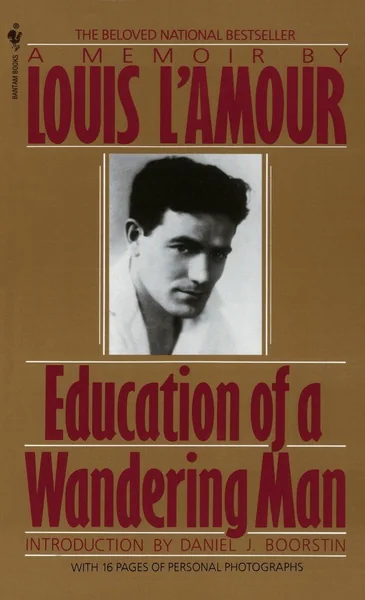
Louis L'Amour's final completed work before his death in June 1988 is not a conventional how-to guide but a memoir-as-testament — and it delivers both a life story and an implicit philosophy of self-directed learning rooted in decades of extraordinary lived experience.
Education of a Wandering Man: A Memoir by Louis L'Amour front cover

What the Book Actually Is

Education of a Wandering Man is part memoir, part personal reflection on a life built around reading, travel, and relentless curiosity. L'Amour, born in 1908, left school at fifteen and set out to educate himself through the world itself. The memoir recounts his years as a hobo on the Southern Pacific Railroad, a cattle skinner in Texas, a merchant seaman in Singapore, and a bare-knuckled prizefighter crossing small-town America. Woven through those adventures is the through-line that gives the book its title and its purpose: at every turn, L'Amour was reading — stuffing his pockets with inexpensive pocket-sized volumes, haunting libraries, and treating every encounter and every place as a classroom. The book includes extensive lists of what L'Amour read during particular periods of his life, making the reading itself a structural feature of the memoir rather than a mere backdrop.
a life lived to the fullest through the never-ending quest for knowledge

The Life Behind the Legend

The episodes L'Amour recounts are remarkable on their own terms. A harrowing two-day trek across the Mojave Desert, encounters with Shanghai waterfront toughs, and portraits of Depression-era hobo culture sit alongside more reflective passages on the fate of figures like Butch Cassidy and the texture of frontier life. As Bantam Books described it at publication, L'Amour is "ever both teacher and storyteller" — and the memoir earns that characterization by keeping the adventure vivid while never losing sight of the intellectual hunger animating it. This dual register, equal parts yarn and meditation, is central to the book's distinctive character.

The Self-Education Philosophy at Its Core

The memoir's deepest contribution is its portrait of what self-education actually looked like in practice for one of America's most widely read authors. L'Amour describes his devotion to the "Little Blue Books," the inexpensive pocket volumes produced by a Kansas publishing company beginning in 1919, which he carried constantly so that no idle moment went unread. As the book records, L'Amour called them "a godsend to wandering men and no doubt to many others." The memoir also reflects on his evolution as a writer in Chapter 18, where L'Amour discusses his emphasis on storytelling over editorial convention — a passage that illuminates how his unconventional education fed directly into his literary voice. The Bantam edition frames the book as L'Amour bequeathing readers "a life lived to the fullest through the never-ending quest for knowledge," and the contents bear that description out.

Reception and Resonance

The memoir was completed shortly before L'Amour's death and published posthumously by Bantam, which later issued a special Centennial Edition — a mark of sustained commercial and cultural significance for a book already attached to one of the best-selling American authors of the twentieth century. Reader commentary, including at sites such as bookponder.com, reflects deep personal resonance, particularly among those who share L'Amour's instinct for self-directed learning. The book is frequently cited as one of L'Amour's most personal and unusual works precisely because it turns inward where his fiction always turned outward.

Scope, Limitations, and Who It's For

The memoir is not structured as a how-to guide for self-education; it does not offer a prescriptive curriculum or step-by-step program. Readers seeking a systematic framework for personal development will find instead an episodic, discursive narrative that leads by example and inspiration rather than instruction. Its chapters are organized around periods and themes in L'Amour's life rather than a linear argument, which gives the book a wandering quality that mirrors its subject — satisfying for those who prize voice and atmosphere, but potentially frustrating for readers wanting a tighter throughline. Education of a Wandering Man is best suited to admirers of L'Amour's fiction curious about the man behind the westerns, to readers interested in Depression-era America and self-made intellectual lives, and to anyone who finds the idea of a life built on books and open roads genuinely compelling.

Sources & Further Reading

The key facts and claims in this review are grounded in the retrieved, verified sources listed below.

  1. Cited in this review
  2. 1
  3. 2
  4. 3
  5. 4
  6. Further reading
  7. 5
  8. 6
  9. 7
  10. 8