8 min read
4.4
· 125,262 Amazon ratingsFeatured In
Share This Review
Our review
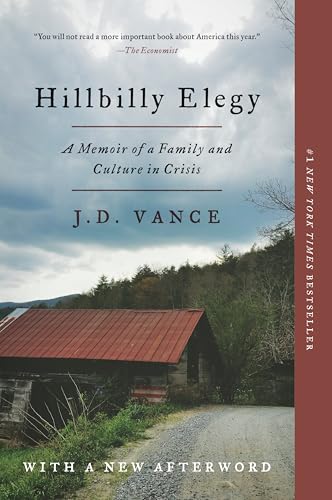
Hillbilly Elegy
Hillbilly Elegy by J. D. Vance Review: A Culturally Divisive Memoir of American Hardship
J. D. Vance's Hillbilly Elegy is a memoir that traces his family's roots in the Appalachian hills of Kentucky through to the socioeconomic struggles of Middletown, Ohio — a book that became a genuine cultural touchstone, spending more than a year on The New York Times bestseller list, and that remains as contested as it is widely read.
LuvemBooks Verdict
Best for
Readers curious about the biography and formative world of a sitting U.S. Vice President, or those drawn to working-class American memoir rooted in specific family lives rather than abstract sociology.
Worth it if
You approach it as one man's intensely personal account of Appalachian and Rust Belt origins — powerful in its intimate, named-family storytelling — while remaining aware of the serious scholarly debate surrounding its broader cultural claims.
Skip if
You are looking for a reliable sociological or policy guide to Appalachia, as historians and regional scholars have directly disputed its representational claims and its tendency to attribute poverty to individual choices over systemic forces.
What readers & critics say
The New York Times praised the book as "a compassionate, discerning sociological analysis" arriving at a historically urgent moment for understanding working-class political estrangement, while the LSE Review of Books found Vance's unflinching personal recollections compelling even as its reviewer remained less convinced by the overtly politicised sociological analysis. Britannica documents harsher criticism — including voices from Appalachia itself — arguing the book deploys stereotypes to advance a political agenda, and Wikipedia's reception summary notes that historian Elizabeth Catte compared the memoir's outsized media influence to distorted poverty imagery from the 1960s War on Poverty.
“In scenes at once harrowing and hilarious, we come to know these loud, rowdy gun-toters as the loyal and loving family whose encouragement helped the author endure decades of chaos and heartbreak.”
— Kirkus ReviewsAsk LuvemBooks
Was this helpful?
- Is it worth reading?
- For readers drawn to American memoir in the tradition of working-class self-examination, Hillbilly Elegy delivers an intimate, fast-moving account grounded in specific, named lives — Mamaw, Vance's mother, and the extended network of kin who shaped him. The New York Times singled out the family stories as the part 'most of which are no doubt better experienced on the page than they were in real life.' Those approaching it as regional sociology or policy analysis, however, should do so knowing that historian Elizabeth Catte and other Appalachian scholars have directly disputed its representational claims, arguing it attributes poverty to individual choices while sidestepping systemic and historical forces. It is most honestly understood as one man's interpretation of his own origins — and, given Vance's election as Vice President, as documentary evidence of lasting political significance.
- Similar books
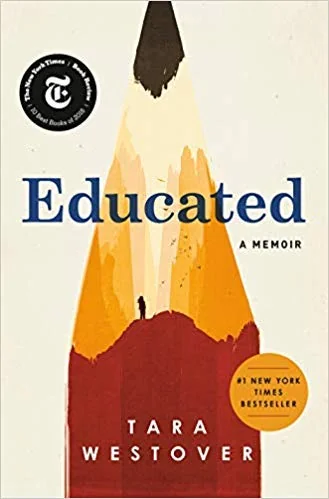
- Readers who respond to Hillbilly Elegy's working-class memoir mode will find a natural companion in Tara Westover's Educated, another acclaimed account of escaping a chaotic rural upbringing through education. For a sociological counterpoint that examines political estrangement from the outside, Arlie Russell Hochschild's Strangers in Their Own Land covers overlapping terrain with a scholar's rigour. Matthew Desmond's Evicted: Poverty and Profit in the American City and Jessica Bruder's Nomadland: Surviving America in the Twenty-First Century offer further portraits of American economic precarity, while Joe Bageant's Deer Hunting with Jesus: Dispatches from America's Class War provides an Appalachian-adjacent take on working-class culture that predates Vance's. Paul Kalanithi's When Breath Becomes Air is linked by the Yale formation shared by both authors and by its memoir's unflinching personal stakes.
- Who should read this?
- Hillbilly Elegy is essential reading for anyone tracing the biography and worldview of J. D. Vance, now U.S. Vice President, and for readers drawn to American working-class memoir and the tradition of self-examination around class mobility. It also speaks directly to those seeking to understand white working-class political estrangement — the question that propelled the book to prominence in 2016. Readers who want a rigorous, evidence-based account of Appalachian poverty and culture, rather than one man's interpretation of his own origins, should approach it alongside the scholarly criticism it has generated, particularly Elizabeth Catte's What You Are Getting Wrong About Appalachia.
- Tell me about the adaptation
- Ron Howard directed a Netflix film adaptation of Hillbilly Elegy, released in 2020, with Amy Adams playing Vance's mother and Glenn Close as Mamaw — the grandmother who is one of the memoir's most powerful figures. The film received largely negative critical reviews, with many arguing that it stripped the source material of its contextual complexity and leaned into sentiment. For most readers, the book remains the more substantive experience: the personal narrative's texture and the sociological debate it generated are both difficult to translate to film.
- Why did this book become such a phenomenon?
- Hillbilly Elegy arrived in the summer of 2016 at a moment when commentators and readers were urgently searching for an explanatory framework for white working-class political estrangement. A July 2016 interview with Vance in The American Conservative drew so much traffic it briefly disabled the magazine's website, and by mid-August the book had been in Amazon's top ten continuously since that interview's publication. It filled a perceived explanatory gap with unusual speed — offering, as The New York Times put it, an investigation of voter estrangement that 'has never felt more urgent.' The book's prominence surged a second time in July 2024 when Donald Trump selected Vance as his running mate.
- How does Vance becoming VP change the book?
- Donald Trump's selection of Vance as his running mate in July 2024 — and Vance's subsequent election as U.S. Vice President — transformed Hillbilly Elegy into primary source material for understanding a significant figure in American political life. LuvemBooks notes that this gives the memoir a documentary weight that extends well beyond its original literary ambitions: readers can trace Vance's stated values, his interpretation of working-class culture, and the personal history he drew on as a political candidate directly back to the text. The book topped bestseller lists a second time following the announcement, reflecting widespread recognition of its new political relevance.
Summarize this book
Follow up
Synthesized from verified book data & published reviews · How we review
What would you like to know about Hillbilly Elegy?
Answers come from our editorial notes on this book. If we haven't covered something, we'll say so.
Readers often ask
Our Review
This review covers the book's content, premise and published critical reception, not a first-hand reading.
What the Book Actually Is
Cultural Significance and Moment of Arrival
What the Memoir Does Well
The Critiques: A Genuinely Contested Book
Who This Book Is For
Sources & Further Reading
The key facts and claims in this review are grounded in the retrieved, verified sources listed below.
- Cited in this review
- 1
- 2
- 3
- Further reading
- 4
en.wikipedia.org
- 5
- 6
- 7
- 8
- 9Hillbilly Elegy: A Memoir of a Family and Culture in Crisis | Washington Independent Review of Books
washingtonindependentreviewofbooks.com
- 10
- 11
Age & Reading Level
Recommended age
Adult
3 content notes · who it suits
Content to know about
Skip if you want a rigorously evidence-based, scholarly account of Appalachian culture and poverty rather than a personal memoir
Reader reviews
Be one of the first readers to answer.
Read it? Was it right for you?
Books like Hillbilly Elegy
Curated picks for readers who enjoyed Hillbilly Elegy, with our reasoning for each match.
If you liked Hillbilly Elegy