BOOKS
Published

Read Time

8 min read

Reader rating

4.6

· 49,300 Amazon ratings
reader ratings, not a LuvemBooks score
Curated & edited by

LuvemBooks Editorial

How we create our reviews →
Share This Review

The Glass Castle by Jeannette Walls Review: A Landmark Memoir of Resilience and Reckoning

The Glass Castle is Jeannette Walls' memoir of growing up in a nomadic, deeply impoverished, and chaotic household under the care of her father Rex and mother Rose Mary Walls — a #1 New York Times bestseller that earned the Christopher Award and the American Library Association's Alex Award, and has remained a touchstone of American memoir writing since its original 2005 publication.
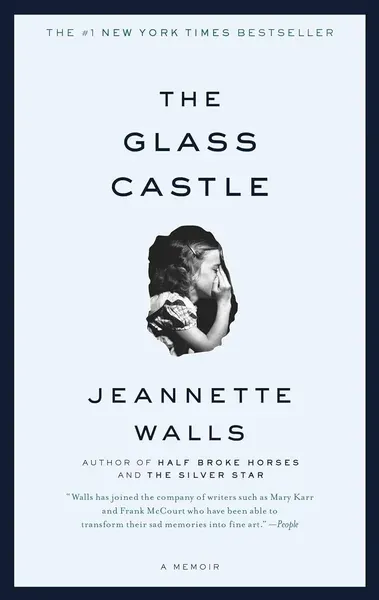
The Glass Castle: A Memoir (book) by Jeannette Walls front coverTap to enlarge

LuvemBooks Verdict

Best for

Readers drawn to unsentimental American memoirs about poverty, family dysfunction, and hard-won self-determination — particularly those who want emotional complexity over tidy moral resolution.

Worth it if

You're willing to sit with a narrator who holds genuine love and justified outrage toward the same parents simultaneously, and let that tension do the heavy lifting.

Skip if

You expect a memoir to deliver explicit moral verdicts on its subjects' neglect, or prefer a conventional linear narrative over episodic, memory-driven structure.

Kirkus Reviews praises Walls' "journalistic bare-bones style" as producing "a chilling, wrenching, incredible testimony of childhood neglect," singling out the memoir's unsentimental balance as its defining strength. Wikipedia's reception summary notes the book has earned "broad readership and positive critical feedback," while storey-lines.com and bookbrowse.com both relay the New York Times' assessment that it is "a very good memoir" — one that falls just short of art but succeeds on its own terms.

Moving because it's unsentimental; Walls' journalistic bare-bones style makes for a chilling, wrenching, incredible testimony of childhood neglect.

Kirkus Reviews
Sources: Kirkus Reviews, Wikipedia, Storey-Lines, BookBrowse
4.6from 49,300 Amazon ratings— reader ratings, not a LuvemBooks score
Trending Now
Trending

The Glass Castle: A Memoir by Jeannette Walls is Trending

Updated Jul 27, 2026
In This Review
  • What Works & What Doesn't
  • What the Memoir Actually Recounts
  • Significance and Place in the Genre
  • Craft and Narrative Voice
  • Reception and Readership
  • Genuine Limitations to Consider

What Works & What Doesn't

What Works
  • A #1 New York Times bestseller recognized with the Christopher Award and the ALA Alex Award, marking it as a critically validated work
  • Kirkus Reviews praises Walls' 'journalistic bare-bones style' as producing a genuinely unsentimental and powerful account of childhood neglect
  • Walls' refusal to demonize or idealize her parents Rex and Rose Mary gives the memoir unusual emotional and moral complexity
  • Sits in distinguished company alongside landmark American memoirs such as Mary Karr's The Liars' Club and Rick Bragg's All Over But the Shoutin'
  • Broad and durable readership across decades, further amplified by a 2017 feature film adaptation starring Brie Larson
What Doesn't
  • Walls' deliberate restraint and lack of explicit moral judgment on her parents' neglect may frustrate readers seeking a more direct reckoning
  • The memoir's episodic, memory-driven structure is not a conventional linear narrative, which requires adjustment for some readers
This review covers the content and published critical reception of The Glass Castle; it is not based on hands-on reading or use.

What the Memoir Actually Recounts

The Glass Castle is structured in five parts, opening with the jolt of adult Jeannette Walls spotting her mother, Rose Mary, rummaging through garbage on a New York City street — a scene that, the book establishes, compelled Walls to finally set the record straight about her origins. From there the memoir moves back in time, tracing Walls' childhood alongside her siblings Lori, Brian, and Maureen under the roof — or lack of one — provided by their parents: Rex Walls, a charismatic, physically gifted but alcoholic dreamer from the poor mining town of Welch, West Virginia, and Rose Mary, a well-educated artist from Phoenix who placed her own creative freedom above domestic stability. The family moved constantly, drifted through the American Southwest desert and eventually Appalachian West Virginia, and left the children to fend for themselves with alarming regularity. The memoir's title is drawn from Rex's most emblematic unfulfilled promise: blueprints he kept for a fantastical glass-walled home he vowed one day to build for his family, a dream that functioned as both inspiration and convenient distraction. Walls ultimately escapes to New York City, where she builds a career in journalism — a trajectory that gives the narrative its arc of hard-won self-determination.
a chilling, wrenching, incredible testimony of childhood neglect.

Significance and Place in the Genre

Originally published in 2005, The Glass Castle quickly established itself as a major work in the American memoir tradition. It became a #1 New York Times bestseller and collected significant recognition, including the Christopher Award, the American Library Association's Alex Award in 2006, and the Books for Better Living Award. Publishers at Simon & Schuster positioned it alongside Mary Karr's The Liars' Club and Rick Bragg's All Over But the Shoutin' as a memoir about a wildly original — and wildly dysfunctional — family told with humor and compassion. Its reach extended beyond the page: a feature film adaptation was released in 2017, with Brie Larson portraying Jeannette Walls. The Scribner reprint edition, issued in January 2006, is the edition most widely in circulation today.

Craft and Narrative Voice

critical coverage describes Walls' approach as a "journalistic bare-bones style" that produces what it calls "a chilling, wrenching, incredible testimony of childhood neglect." That same review notes the memoir is "moving because it's unsentimental" — Walls neither demonizes nor idealizes Rex and Rose Mary, holding both her affection for them and her justified outrage in deliberate, sustained tension. This tonal balance is widely regarded as the book's defining literary achievement. Rather than sensationalizing her material or resolving it into easy moral lessons, Walls renders her parents as fully contradictory human beings: Rex, when sober, taught his children physics, geology, and what the publisher's synopsis calls "how to embrace life fearlessly," even as his alcoholism and grandiosity exposed them to genuine danger and deprivation. The prose's restraint is calibrated to let the facts carry their own weight.
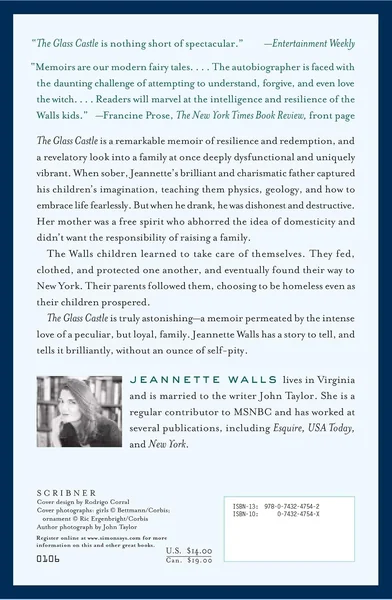
Back cover with synopsis, review quotes, and author biography with photograph.

Reception and Readership

Critical feedback has been broadly positive, with particular praise directed at Walls' balanced perspective on both the harm and the vitality her unconventional upbringing produced. Wikipedia's reception summary notes the book has received "broad readership and positive critical feedback" for this equilibrium. The memoir's appeal has proven durable across demographics — it draws readers interested in family dysfunction, poverty in America, resilience narratives, and the ethics of memoir itself. Its longevity on bestseller lists speaks to its capacity to provoke genuine conversation about parental responsibility, freedom, and the complicated loyalties of childhood. Readers who gravitate toward confessional memoirs that resist sentimentality and self-pity tend to find the book particularly compelling.

Genuine Limitations to Consider

The memoir's very strengths create friction for some readers. Walls' unsentimental restraint — her refusal to editorialize or render final verdicts on her parents — can read, depending on the reader, as either admirable complexity or as an insufficient reckoning with serious neglect and endangerment. Critical coverage acknowledges that Rex and Rose Mary's laissez-faire parenting "justifiably elicits the children's exasperation and disgust," and readers who approach the book expecting a more direct moral accounting may find the narrative's compassion toward Rex and Rose Mary difficult to settle into. Additionally, readers seeking a linear, conventionally plotted childhood narrative will encounter a structure shaped by episodic memory rather than tidy chronological momentum — which suits the material but is a real adjustment for some audiences.

Sources & Further Reading

The key facts and claims in this review are grounded in the retrieved, verified sources listed below.

  1. Cited in this review
  2. 1
  3. 2
  4. 3
  5. Further reading
  6. 4
  7. 5
  8. 6
  9. 7
  10. 8
  11. 9
  12. 10