Large cast and early confusion
Carole Beu admits having to constantly check the character directory during the first 200 pages to keep track of the twelve men gathered in Hokitika.

8 min read
Our review
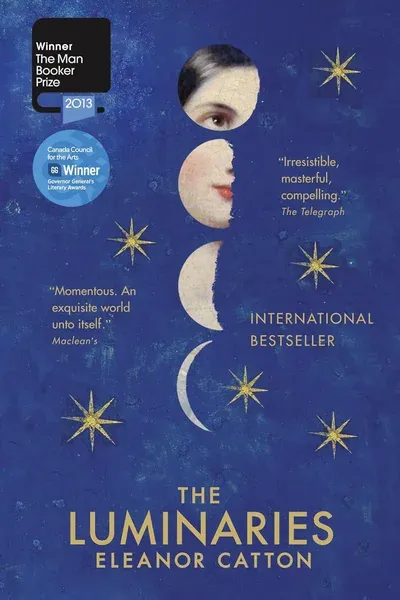
The Luminaries by Eleanor Catton Review: An Astrological Gold Rush Mystery
Set in 1866 New Zealand, The Luminaries tracks prospector Walter Moody as he investigates unsolved crimes among twelve local men. Eleanor Catton’s Booker-winning novel rewards patient readers with a structurally ingenious puzzle that prioritizes architectural design over emotional depth.
Best for
Readers who enjoy intricate plotting and literary experimentation will appreciate its meticulous historical pastiche.
Worth it if
Worth reading if you are willing to savor precise descriptions, complex plotting, and a deliberately disorienting narrative structure that rewards patience.
Skip if
Skip it if you seek straightforward character development or a fast-paced mystery, as the novel deliberately distances readers from its cast to prioritize structural mechanics.
Where reviewers agree and split
Readers rate it 3.9 on Amazon. The reviews we read that discuss it in depth split on some points:
The Guardian · Press review: intellectual triumph lacking emotional weight
Kirkus Reviews · Press review: pleasantly complex mystery with a lovely payoff
Nyx Book Reviews · Book blog: technically brilliant but frustrates with passive female roles
Civilian Global · Book blog: tremenously enjoyable but ultimately a squandered opportunity
What readers & critics say
Critical reception for The Luminaries is sharply divided between admiration for its technical ambition and criticism for its emotional coldness. While Kirkus Reviews and BookBrowse celebrate its Victorian pastiche, The Guardian and Bookmarks.Reviews argue that the novel's structural complexity ultimately sacrifices character depth and moral weight.
“great empty bag; an enormous, wicked, gleeful cheat.”
— The Guardian“lovely payoff after the miles of twists and turns.”
— Kirkus ReviewsCarole Beu reviews Eleanor Catton's Booker-shortlisted novel The Luminaries.
A BookTube review by Patricia Kay, 2013 · 4.1K views · 156 subscribers · Watch on YouTube ·
Their views, not ours. The points are our AI summary of what they say, each playing from where they say it.
Carole Beu admits having to constantly check the character directory during the first 200 pages to keep track of the twelve men gathered in Hokitika.
The town and its gold rush atmosphere feel intensely real through the characters rather than excessive exposition.
While the novel incorporates intricate astrological mathematics into every chapter, Carole Beu reassures readers that understanding astrology is not necessary to enjoy the story.
The chapter lengths progressively decrease toward the end of the book, eventually becoming shorter than the chapter headings introducing them.
Was this helpful?
Summarize this book
Follow up
Synthesized from verified book data & published reviews · How we review
Answers come from our editorial notes on this book. If we haven't covered something, we'll say so.
Readers often ask
We review the evidence: reader verdicts, gathered and weighed with AI assistance and edited by LuvemBooks, rather than one reader's first-hand take.
The key facts and claims in this review are grounded in the retrieved, verified sources listed below.
en.wikipedia.org
en.wikipedia.org
thebookerprizes.com
bookbrowse.com
3 content notes · who it suits
Content to know about
Skip if you seek straightforward character development or a fast-paced mystery
Eleanor Catton discusses winning the Man Booker Prize for 'The Luminaries' and explains the intricate astrological architecture behind the novel on France 24.
Uploaded by FRANCE 24 English, 2015 · Watch on YouTube ·
Catton describes modeling characters on the twelve zodiac signs and seven astrological planets, tracking their movements according to the actual stars in 1866. She used astronomical star charts to dictate the choreography and narrative progression of the novel.
Catton explains that she wanted to challenge the perceived divide between sprawling, adventure-driven 19th-century novels and tightly wrought 20th-century experimental fiction. Her goal was to see if a single work could sustain a fast-paced mystery within a rigorous, formal constraint.
Catton notes that the small number of female characters reflects the historical 10-to-1 male-to-female ratio during the Hokitika gold rush. This dynamic mirrored her astrological schema, where only two of the nineteen celestial bodies—Venus and the Moon—are traditionally feminine.
No LuvemBooks readers have answered yet.
Read it? Was it right for you?
Curated picks for readers who enjoyed The Luminaries, with our reasoning for each match.
If you liked The Luminaries