
At a glance
About the Author
Samantha Harvey1 book reviewed
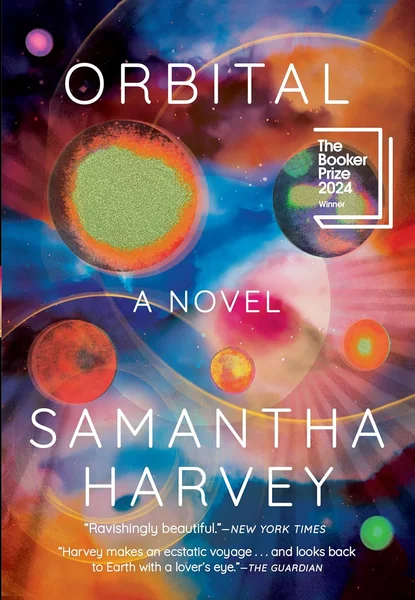
Orbital
A Novel
by Samantha Harvey
LuvemBooks Verdict
Best for: Readers of contemplative literary fiction who want a Woolfian, essay-in-motion meditation on Earth and consciousness — ideally consumed in a single sitting — rather than a story with conventional plot momentum.
Worth it? Skip it? Read the full verdict →Ask LuvemBooks
Was this helpful?
- Is it worth reading?
- Yes — with a clear condition. LuvemBooks' assessment, drawn from the published record and critical coverage, is that Orbital earns its 2024 Booker Prize on prose and philosophical ambition: it is a slim, luminous meditation that suits a single sitting and rewards a second. But readers who need plot should look elsewhere; Literary Review notes that whenever an event threatens to generate drama — a death, a gathering storm — Harvey declines to follow through. Whether its 136 pages feel perfectly judged or underpressured depends entirely on what the reader wants.
- Who should read this?
- Readers of contemplative literary fiction — those who value a Woolfian attentiveness to consciousness and are happy for a novel to be an essay in motion. Its portrait of Earth as a fragile, borderless whole gives it obvious resonance in the climate era, which is part of why the Booker judges framed it as a book of the moment. It is not for readers expecting the dramatic machinery of space fiction or a conventional character study; the book actively refuses both routes.
- Is Orbital science fiction?
- Not in the conventional sense. It blends elements of science fiction, literary fiction, and philosophical fiction, but it is best understood as the latter two wearing the setting of the first. Harvey has no space background and built her portrait of station life entirely from research — convincing enough, per readers with an eye for aerospace detail, to send them checking reference sources — but that realism grounds a meditation rather than an adventure.
- Is it a good book club pick?
- Strongly, yes. Its 136 pages make it accessible to every member, and its central refusal — absorbing a mother's death and a swelling typhoon as meditation rather than crisis — gives groups a genuine fault line to argue over. The themes (grief, faith, art, human progress, and Earth's fragility in the climate era) are big enough to sustain a full evening, and the near-poetic prose rewards close reading aloud.
- Similar books
- For readers who loved Orbital's form-driven, philosophical mode, Olga Tokarczuk's Flights is the closest cousin — a fragmentary, travel-structured meditation that loops around its themes the way Harvey's station loops the planet. Emily St. John Mandel's Sea of Tranquility offers another lyrical, time-hopping literary take on speculative premises, while Benjamin Labatut's When We Cease to Understand the World shares Orbital's blend of rigorous factual research and existential unease about human progress. For readers who wanted the space-station setting but with conventional stakes and momentum, Andy Weir's Project Hail Mary delivers the plot Orbital refuses. Those curious about Harvey's range might also seek out her previous novel, The Western Wind, about a priest in fifteenth-century Somerset.
- Where should I start with Samantha Harvey?
- Orbital is her fifth novel and the one that won the 2024 Booker, so it is the obvious entry point — especially for readers who want her most distilled, contemplative mode. For a sense of her range, the review notes her debut The Wilderness (an architect with Alzheimer's, longlisted for the 2009 Booker and winner of the Betty Trask Prize) and her previous novel The Western Wind (a priest in fifteenth-century Somerset). Her work is known for changing shape from book to book, so no single title fully predicts another.
Summarize this book
Follow up
Synthesized from verified book data & published reviews · How we review
Press Enter to ask. Answers come from our editorial Q&A — start typing to see related questions.
Age & Reading Level
Recommended age
Adult
Reading level
Adult
1 content note · who it suits
Content to know about
Skip if you want a plot-driven space story with stakes, tension, and fully developed characters — Orbital deliberately refuses all three.
Editorial Review
Samantha Harvey's Orbital follows six astronauts through a single day aboard a space station — sixteen sunrises, little plot, and a sustained meditation on Earth. It won the 2024 Booker Prize, the first space-set novel to do so.
Read the Full ReviewRelated reading
Adjacent titles worth exploring. We haven't reviewed these yet, so they link out to Amazon.
Why It’s Trending