BOOKS
Published

Read Time

8 min read

Reader rating

4.1

· 8,813 Amazon ratings
reader ratings, not a LuvemBooks score
Curated & edited by

LuvemBooks Editorial

How we create our reviews →
Share This Review

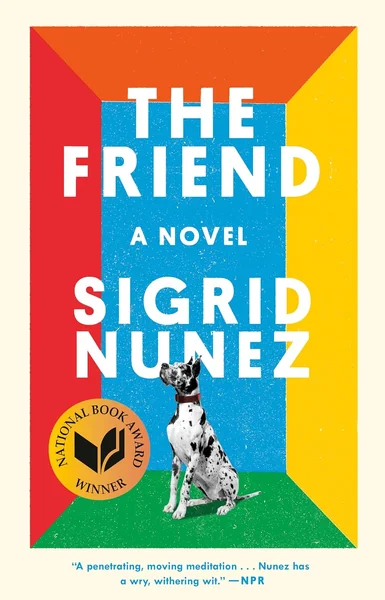
The Friend by Sigrid Nunez Review: An Acerbic, Tender Elegy with a Great Dane

Sigrid Nunez's The Friend (Riverhead, 2018) follows an unnamed novelist who inherits Apollo, her dead mentor's Great Dane, after his suicide. The 2018 National Book Award winner and NYT bestseller turns grief into something acerbic, funny, and unsentimental.
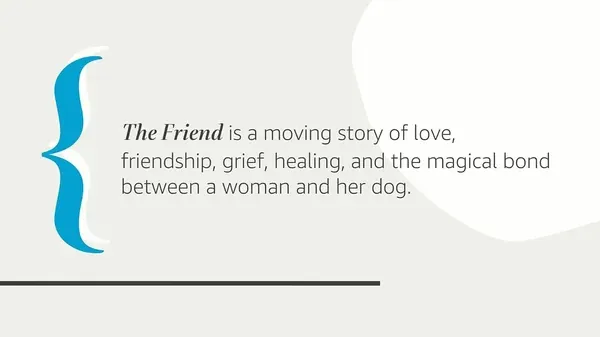
Interior page with book title and synopsis describing a story about a woman and her inherited dog.Tap to enlarge

LuvemBooks Verdict

Best for

Readers of literary fiction who like their novels thoughtful, talkative, and a little severe — and, unmistakably, anyone who has loved a dog, plus book clubs that enjoy dividing over big questions of suicide, loyalty, art, and obligation.

Worth it if

It's worth reading if you'll trade narrative drive for a compact, unsentimental meditation on grief and the writing life that finds its emotional center in a bereaved Great Dane.

Skip if

Skip it if you want plot momentum, a conventional arc, or warmth on demand — the digressive shop talk about writers, mentors, and MFA culture can feel hermetic, and the cool, aphoristic tone holds emotion at arm's length for much of the book.

The New York Times reported that The Friend won the 2018 National Book Award for fiction to euphoric reviews hailing it as a subtle, unassuming masterpiece, calling it an acerbic but often poignant exploration of love, friendship, death, grief, art, and literature. Wikipedia's critical-reception summary cites Critics McAlpin praising Nunez for turning a potentially mawkish story into a penetrating, moving meditation, while the publisher's collected notices on Penguin Random House include praise from Publishers Weekly, the Wall Street Journal, and NPR.

Sources: The New York Times, Wikipedia, Penguin Random House
4.1from 8,813 Amazon ratings— reader ratings, not a LuvemBooks score
Buy on Amazon

Age & Reading Level

Recommended age

Adult

Reading level

Adult

Content to know about

suicide of a central character — the mentor's death by suicide is the premise and is discussed throughout
candid discussion of student-teacher relationships and literary-world exploitation

Best for: Adults — literary fiction built around a suicide, with essayistic arguments about the ethics of student-teacher relationships

Skip if you want plot momentum, a conventional arc, or warmth on demand rather than essayistic literary-world talk.

Trending Now
Trending

The Friend: A Novel by Sigrid Nunez is Trending

Updated Sep 22, 2026
In This Review
  • What Works & What Doesn't
  • What the Book Is
  • Its Place and Its Reception
  • What It Does Well
  • Where Readers Push Back
  • Who It Is For

What Works & What Doesn't

What Works
  • Winner of the 2018 National Book Award for Fiction and a New York Times bestseller.
  • Ranked #68 on the New York Times' 2024 list of the 100 best books of the 21st century.
  • A distinctive second-person-to-the-dead structure that blends elegy, satire, and meditation.
  • Widely praised for steering a potentially mawkish human-animal story into unsentimental territory.
  • Compact and short by design — an intense read rather than a long one.
What Doesn't
  • Essayistic, digressive structure offers little conventional plot momentum.
  • Insider focus on writers, mentors, and MFA culture can read as hermetic to outsiders.
  • Cool, aphoristic tone keeps readers at an emotional arm's length for much of the book.
A National Book Award winner that earns its reputation: austere, funny, and quietly devastating on grief, writing, and the consolations of a very large dog.

What the Book Is

The Friend is a novel by Sigrid Nunez, published by Riverhead Books in 2018 (the edition under review is the 2019 paperback reprint). Its narrator is an unnamed novelist and writing teacher whose closest friend and mentor — a celebrated, charismatic, deeply flawed older writer — has died by suicide. In the aftermath, she is pressed into adopting Apollo, the dead man's enormous, aging Great Dane, despite living in a small apartment where dogs are not permitted. What follows is less a conventional plot than an extended address: the narrator speaks to her lost friend about his life, his wives, his students, the ethics of what he did and what writers do, while the dog — grieving in his own way, refusing to eat, taking up more space than the room allows — becomes the book's emotional center of gravity. Critical coverage, in its profile of Nunez, described the novel as an acerbic but often poignant exploration of love, friendship, death, grief, art, and literature, and that is an accurate map of its territory.

Its Place and Its Reception

The novel's standing is unusually well documented. It won the 2018 National Book Award for Fiction, became a New York Times bestseller, and was a finalist for the 2020 International Dublin Literary Award. In 2024 it placed at number 68 on the New York Times list of the 100 best books of the 21st century, and it has been adapted into a film directed by Scott McGehee and David Siegel, starring Naomi Watts as the narrator. Critical response at publication was strong: the Times reported euphoric reviews hailing the book as a subtle, unassuming masterpiece, and the publisher's collected notices — from Library Journal, Electric Lit, and others — consistently single out the same qualities, its dark humor and its refusal of sentimentality. Nunez, the author of nine novels including A Feather on the Breath of God and The Vulnerables, and of the memoir Sempre Susan about Susan Sontag, has said she was surprised by the scale of the response, since her earlier work had never reached so many readers.

What It Does Well

The book's great formal gamble is its voice. It is built as a kind of one-sided conversation with the dead, moving freely between the practical problem of the dog, memories of the friendship, and sharp, unsentimental essays-in-miniature on the literary life — student-teacher relationships, the marketplace for fiction, the ego costs of the vocation. The Times noted the novel's unflinching aim at a status-obsessed literary world, and that acid is what keeps the grief material from turning soft. The premise — a woman and a bereaved dog learning to live together — is one that could easily curdle into mawkishness, and critics across the board credited Nunez with steering it instead toward something penetrating and unsentimental, a meditation in which the animal is a genuine presence rather than a device. It is also a genuinely compact book: a short, taut novel by design, which suits its elegiac register.
Interior page with book title and synopsis describing a story about a woman and her inherited dog.

Where Readers Push Back

The same qualities that admirers praise are the ones that will lose some readers. The Friend is essayistic and digressive rather than plot-driven; long stretches are given over to literary gossip, quotations, and argument about writing itself, and readers who come for the dog story will find the dog shares the stage with a great deal of shop talk about the publishing world. Its unnamed narrator and insider milieu — novelists, mentors, MFA classrooms — can read as hermetic to anyone outside that world, and the cool, aphoristic tone that keeps the book unsentimental also keeps it at a certain emotional arm's length for much of its length. None of this is a flaw of execution so much as a matter of design; but design has a cost, and readers wanting narrative momentum or a conventional arc should know what they are picking up.

Who It Is For

The Friend is for readers of literary fiction who like their novels thoughtful, talkative, and a little severe — and, unmistakably, for anyone who has loved a dog, since the human-animal bond at its core lands even for readers indifferent to its literary-world satire. It suits book clubs: it is short, raises genuine questions about suicide, loyalty, art, and obligation, and divides opinion in productive ways. Readers who want plot, pace, or warmth on demand should look elsewhere; readers who want a novel that thinks hard about what remains after a death — and finds an answer with four legs and an inconvenient appetite for floor space — will understand exactly why the literary world embraced it.

Sources & Further Reading

The key facts and claims in this review are grounded in the retrieved, verified sources listed below.

  1. Cited in this review
  2. 1
  3. 2
  4. Further reading
  5. 3
  6. 4
  7. 5
  8. 6
  9. 7
  10. 8
  11. 9