BOOKS
Published

Read Time

8 min read

Reader rating

4.4

· 7,422 Amazon ratings
reader ratings, not a LuvemBooks score
Curated & edited by

LuvemBooks Editorial

How we create our reviews →
Share This Review

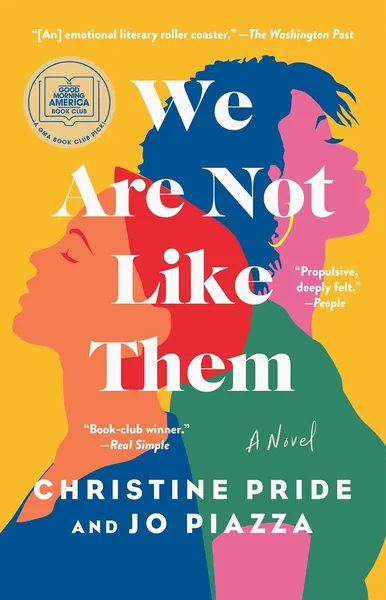
We Are Not Like Them by Christine Pride and Jo Piazza Review: Friendship Fractured by a Police Shooting

Christine Pride and Jo Piazza's debut novel follows lifelong best friends Riley, a Black broadcast journalist, and Jen, a white woman whose husband is involved in the police shooting of a Black teen in Philadelphia. Alternating between their voices, it is earnest, accessible book-club fiction built for hard conversations.
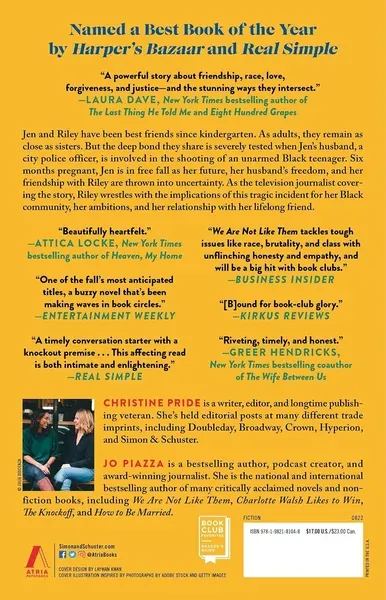
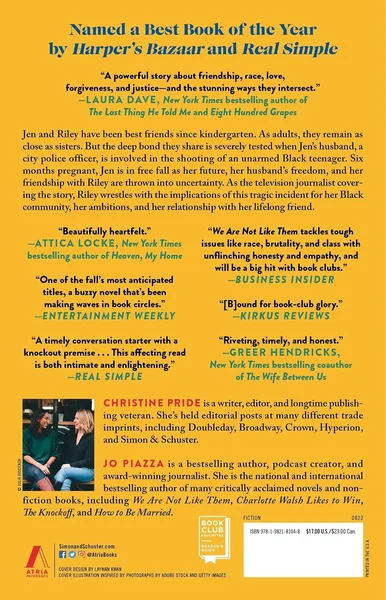
Back cover with synopsis, review quotes, and author biographies.Tap to enlarge

LuvemBooks Verdict

Best for

Book clubs and readers of issue-driven contemporary fiction who want a fast, dual-narrator story about how a police shooting fractures a lifelong cross-racial friendship — and a novel designed to be argued about afterward.

Worth it if

Worth it if you want propulsive, emotionally direct book-club fiction that runs a headline tragedy through two women's alternating perspectives — and you can accept that the shooting is the catalyst, not the subject.

Skip if

Skip it if you want a legal procedural, a story centered on the victim's family, or a subtler, less message-forward treatment — much of the page time goes to the white friend's moral reckoning.

Critics read the novel against real events: The Washington Post said its prologue of an unarmed Black teen shot by a white officer was "all too familiar," invoking Tamir Rice, Michael Brown, and Philando Castile, while The New York Times noted the book is deliberately "not about Justin or his family" but about the overdue reckoning between two friends. Kirkus Reviews predicted it was "bound for book-club glory," and Broad Street Review called it gripping while questioning some believability gaps, such as why the friends had never discussed race before.

The heartbreak of the prologue was all too familiar: an unarmed Black teen, shot dead by a White police officer.

The Washington Post

With its timely premise, clear-cut messages, and appealing female characters, this novel is bound for book-club glory.

Kirkus Reviews

The novel isn't about Justin or his family; his tragedy becomes the catalyst for an overdue reckoning between two lifelong friends.

The New York Times
Sources: The Washington Post, Kirkus Reviews, Broad Street Review, The New York Times
4.4from 7,422 Amazon ratings— reader ratings, not a LuvemBooks score
Buy on Amazon

Age & Reading Level

Recommended age

Adult

Reading level

Adult

Content to know about

police shooting of an unarmed Black teenager
racial injustice and racial trauma
sustained grief throughout

Best for: Adults — the narrative is built around a police killing, racial trauma, and sustained grief, suited to mature readers

Skip if you want a legal procedural or a story centered on the shooting victim and his family — the case is the backdrop, not the plot

In This Review
  • What Works & What Doesn't
  • The Premise: One Shooting, Two Best Friends, One Fault Line
  • Why It Struck a Nerve
  • What It Does Well
  • Where Readers May Push Back
  • Who This Book Is For

What Works & What Doesn't

What Works
  • Alternating Riley/Jen narration gives both sides of the divide a full interior voice
  • Grounded in contemporary events with real emotional force —critical reception's review tied its prologue to the cases of Tamir Rice, Michael Brown, and Philando Castile
  • Co-authors bring complementary expertise: Pride is a veteran book editor, Piazza an award-winning journalist
  • Strong momentum and discussion-ready stakes make it a natural book-club pick
What Doesn't
  • Justin and his family recede after the prologue; the friendship, not the victim or the case, is the story
  • Significant page time goes to the white friend's moral reckoning, a framing that will frustrate some readers
  • Earnest, message-forward register offers little ambiguity for readers who prefer subtler fiction
  • Emotionally heavy subject matter throughout — not a light read
A propulsive, conversation-ready debut novel about a police shooting in Philadelphia and the cross-racial friendship it fractures — earnest, accessible book-club fiction that keeps its focus on two women rather than the courtroom.

The Premise: One Shooting, Two Best Friends, One Fault Line

We Are Not Like Them opens with a prologue in which Justin Dwyer, a 14-year-old Black boy in Philadelphia, is struck by police bullets. From there the novel pivots to its true subject: Riley and Jen, lifelong best friends whose bond is tested by Justin's death. Riley is a Black broadcast journalist who has returned to her Philadelphia hometown after a painful separation; Jen is white, and her husband is a Philadelphia police officer involved in the shooting. The structure alternates between Riley's and Jen's points of view, so the reader is moved back and forth across the racial and emotional divide the killing opens between them. First published by Atria Books in 2021 and issued in paperback in August 2022, the novel is the debut collaboration of Christine Pride — a writer and longtime publishing veteran who has held editorial posts at Doubleday, Broadway, Crown, Hyperion, and Simon & Schuster — and Jo Piazza, a bestselling author and award-winning journalist.
The heartbreak of the prologue was all too familiar: an unarmed Black teen, shot dead by a White police officer.

Why It Struck a Nerve

The novel arrived at a moment of national reckoning, and reviewers treated it accordingly. The Washington Post's review invoked the real names the prologue brought to mind — Tamir Rice, Michael Brown, Philando Castile — and described the opening bluntly: "The heartbreak of the prologue was all too familiar: an unarmed Black teen, shot dead by a White police officer." That framing captures the book's deliberate strategy: it builds fiction directly on top of events readers already carry with them, then asks what those events do to an intimate relationship rather than to a courtroom or a movement. The publisher pitches it as "a powerful story about friendship, race, love, forgiveness, and justice," and that combination — headline subject matter processed through a domestic, two-woman story — is what positioned it squarely in the book-club market, where it found a wide readership.

What It Does Well

The alternating-narration design is the book's engine. By splitting the story between a Black narrator and a white narrator, Pride and Piazza give each woman an interiority the other cannot access, and the reader watches the same events refract through two sets of assumptions about race, loyalty, marriage, and motherhood. The authors bring complementary résumés to that task: Pride's decades acquiring and editing bestselling fiction inform the book's pacing and structure, while Piazza's journalism background suits Riley's broadcast-news career. Advance praise gathered by the publisher emphasizes exactly this compulsive quality, with early readers describing finishing it in a single sitting. The novel also does something structurally honest with its premise: rather than pretending friendship can simply absorb a crisis like this, it stages the reckoning as overdue — the shooting exposes distance that was always there, which gives the central relationship real stakes beyond the news cycle.
Back cover with synopsis, review quotes, and author biographies.

Where Readers May Push Back

The same focus that powers the book is also its most debatable choice. Justin's tragedy functions as a catalyst, and after the brief, brutal prologue the novel turns its attention to Riley and Jen — Justin and his family recede from the foreground. Readers who come expecting the victim's family, the investigation, or the legal aftermath to carry the narrative should know that this is a friendship story first; the case is the weather around it, not the plot. Relatedly, a substantial share of the page time belongs to Jen's reckoning, which means a story set in motion by a Black boy's death spends much of its energy on a white woman's moral education — a framing some readers will find fruitful and others will find frustrating. The register is earnest and message-forward throughout; readers who prefer their fiction oblique, ironic, or ambiguity-friendly may find the novel's emotional directness more persuasive in a discussion group than on the page alone. None of this is a flaw so much as a clear set of priorities, but they are priorities worth knowing before buying.

Who This Book Is For

This is issue-driven contemporary fiction engineered for conversation — the natural pick for book clubs ready to talk about race and friendship, and for readers who like novels that grab a current of real public life and run it through personal relationships. It will suit readers of socially engaged book-club fiction who want momentum, dual perspectives, and characters forced into hard conversations they have spent years avoiding. It will frustrate readers seeking a legal procedural, a story centered on the shooting victim's family, or a subtler, less declarative treatment of its themes. As a debut collaboration, it announces Pride and Piazza as a pairing built for exactly this kind of high-concept, high-empathy storytelling.

Sources & Further Reading

The key facts and claims in this review are grounded in the retrieved, verified sources listed below.

  1. Cited in this review
  2. 1
  3. Further reading
  4. 2
  5. 3
  6. 4
  7. 5
  8. 6
  9. 7
  10. 8
  11. 9
  12. 10
  13. 11
  14. 12