
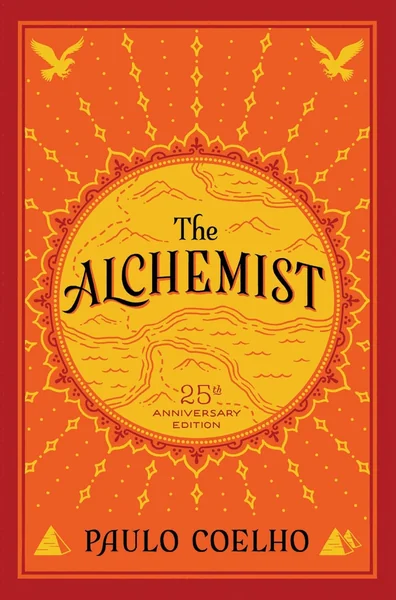
The Alchemist: A Modern Classic Fable of Spiritual Healing, Self-Discovery,
by Paulo Coelho
At a glance

LuvemBooks Verdict
Best for: Readers at a crossroads — those questioning whether they have honoured their own ambitions, or younger readers encountering big questions of purpose and destiny for the first time — who want a story that addresses those themes directly, without requiring theological or philosophical background.
Worth it? Skip it? Read the full verdict →Ask LuvemBooks
Was this helpful?
- Is it worth reading?
- For the right reader, The Alchemist delivers exactly what it promises: a spiritually resonant, accessible fable about purpose and courage that has earned its global reputation honestly, with over 150 million copies sold and recognition from Oprah Daily as one of the best self-help books of a generation. Its fable structure makes complex ideas about destiny and personal calling accessible without requiring specialized theological or philosophical background. The key caveat is that the novel's characters are archetypes rather than psychologically complex individuals, and the narrative never entertains genuine doubt about its own premises — readers who prize interiority and moral ambiguity are likely to find it too schematic.
- Similar books
- Readers drawn to The Alchemist's spiritual fable format and questions of purpose will find natural companions in several works curated alongside it. Hermann Hesse's Siddhartha shares the same quest-for-meaning structure and Eastern spiritual underpinning. Antoine de Saint-Exupéry's The Little Prince operates in a similarly parable-like register, using a deceptively simple journey to carry philosophical weight. Richard Bach's Jonathan Livingston Seagull pursues similar themes of individual purpose and transcendence in an even more compressed fable. For readers who want a longer, more immersive spiritual journey with rich setting, Gregory David Roberts' Shantaram and Robert M. Pirsig's Zen and the Art of Motorcycle Maintenance both explore the intersection of travel, identity, and philosophical awakening — with considerably more psychological depth.
- Who should read this?
- The Alchemist is designed for readers at moments of transition — those reconsidering the direction of their lives, questioning whether they have honored their own ambitions, or simply seeking a story that addresses purpose directly without requiring specialized theological or philosophical background. It is equally accessible to younger readers encountering it for the first time and to adults returning to it at a different stage of life. Readers who prize psychological complexity, moral ambiguity, or friction in their fiction are likely to be disappointed — the cast is archetypal by design and the narrative does not entertain doubt about its own spiritual premises.
- About Paulo Coelho
- Paulo Coelho de Souza is a Brazilian lyricist and novelist.
- What are the main themes?
- The novel's core themes are destiny, personal purpose, and the relationship between fear and a meaningful life — all organised around Coelho's concept of the 'Personal Legend,' the idea that every person carries a unique calling that the universe will assist them in pursuing. The tension between deferred dreams and active pursuit is dramatised through contrasting figures: the crystal merchant who has long postponed his own calling, the Englishman so narrowly fixated on alchemical formulas that he misses the living lessons around him, and Santiago himself. The relationship between love and personal purpose is also central — framed by Santiago's proposal to Fatima at the oasis, and the novel's argument that true love does not require the abandonment of one's calling.
- What are the main criticisms?
- The most common criticism of The Alchemist is that its characters function as archetypes rather than psychologically complex individuals — Santiago, Fatima, the crystal merchant, and the Englishman are all designed to embody philosophical positions rather than to feel like fully realized people. A closely related criticism is that the novel's fable logic is self-confirming: omens reliably point toward truth, destiny is vindicated, and genuine doubt about the book's spiritual premises is never entertained within the narrative. Readers looking for moral ambiguity or friction will not find it here, and critics who find the book shallow are often responding to this deliberate formal constraint rather than to careless writing.
Summarize this book
Follow up
Synthesized from verified book data & published reviews · How we review
Press Enter to ask. Answers come from our editorial Q&A — start typing to see related questions.
Age & Reading Level
Recommended age
Adult
Reading level
Adult
who it suits
Skip if you want psychologically complex characters, moral ambiguity, or a narrative that entertains genuine doubt about its own spiritual premises.
Editorial Review
Paulo Coelho's The Alchemist is a spiritual fable that has traveled far beyond its 1988 Portuguese origins to become one of the most widely read novels in publishing history, now available in a HarperOne anniversary edition that introduces it to yet another generation of readers seeking meaning and direction.
Read the Full ReviewIf you liked this, try…






Why It’s Trending
The Alchemist Heading to the Stage in New Theater Adaptation
Theater troupe Actomania is bringing Paulo Coelho's classic fable to the stage in a new production called 'The Alchemist: Subarnasrastha.' If you've been meaning to revisit — or discover — Santiago's journey, now's a great time to pick up the book.