At a glance

The Wayward Pines Trilogy Series 3 Books Set
by Blake Crouch
LuvemBooks Verdict
Best for: Readers who enjoy paranoid, high-concept speculative fiction with a horror edge — particularly fans of Stephen King, Twin Peaks-style unsettling Americana, or Blake Crouch's later work (Dark Matter, Recursion) who want to explore where his genre-blending instincts began.
Worth it? Skip it? Read the full verdict →Ask LuvemBooks
Was this helpful?
- Is it worth reading?
- For readers who enjoy paranoid, high-concept speculative fiction with a horror edge, the Wayward Pines Trilogy offers a genuinely distinctive reading experience — its genre-blending across mystery, science fiction, dystopian horror, and thriller gives it a wider imaginative range than most comparable series. Pines, the opener, earned a Booklist starred review and a Bloody Disgusting Top 10 of 2012 placement, and the critical record broadly supports its reputation as nail-bitingly suspenseful. The caveat is real, however: critical coverage found momentum dipping in Wayward and The Last Town hampered by thin characterizations and repetitive action, so the trilogy's rewards are front-loaded. Readers who invest most heavily in psychological complexity and precise plotting may find the finale a less satisfying destination than the journey to it.
- Similar books
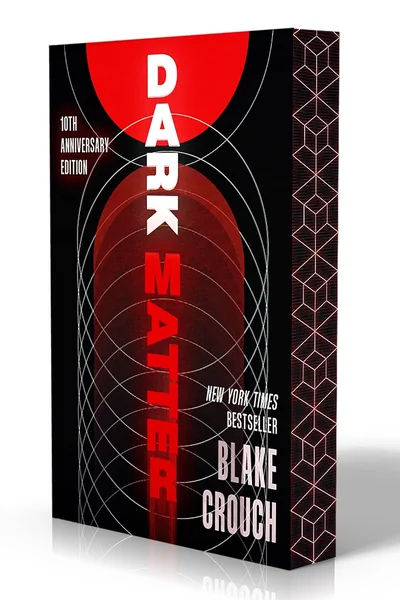
- Readers who respond to the Wayward Pines Trilogy's blend of small-town paranoia and genre-crossing ambition have several strong adjacent options. Blake Crouch's own Dark Matter and Recursion share the same high-concept speculative DNA — both are propulsive, idea-driven thrillers from a New York Times bestselling author with a demonstrated track record in this territory. For readers drawn to the horror-inflected isolation of Wayward Pines, Nick Cutter's The Troop delivers a similarly intense, boundary-pushing experience. Stephen King's Under the Dome echoes the trapped-community premise closely, while Justin Cronin's The Passage offers another ambitious genre-crossing series that blends thriller and dystopian horror at scale.
- Who should read this?
- The Wayward Pines Trilogy is best suited to readers who enjoy paranoid, high-stakes speculative fiction with a horror edge — specifically those who follow authors like Stephen King, Dean Koontz, Peter Straub, or F. Paul Wilson, as cited by Booklist critic Alesi in the starred review of Pines. Fans of boundary-crossing genre fiction who are comfortable being disoriented by a narrative that refuses easy categorization will find the most to enjoy here. The series is rated for readers 18 and up, and it is explicitly not for readers seeking grounded realism, gentle pacing, or a neatly resolved trilogy finale.
- About Blake Crouch
- Born in North Carolina in 1978, Blake Crouch is a bestselling novelist and screenwriter who has become one of contemporary fiction's most compelling voices in speculative thriller territory.
- Tell me about the adaptation
- The Wayward Pines novels became the basis for the Wayward Pines television series produced by M. Night Shyamalan. Notably, Crouch was still writing the final books while the show was in development, resulting in what he described as 'all kinds of cross pollinating' between the source material and the adaptation. The show makes a significant structural change: it reaches the central reveal of the town's secret at its midpoint, compressing the events of Pines and redistributing the remaining story — a different pacing from the novels, which build revelation more gradually across all three books.
- How does this compare to Dark Matter and Recursion?
- All three share Crouch's signature high-concept, genre-blending approach, but the Wayward Pines Trilogy is the most sustained and horror-inflected of the group — a three-book series built around accumulated revelation and small-town dystopian dread rather than a single propulsive narrative. Dark Matter and Recursion, both reviewed by LuvemBooks, are self-contained novels that many readers find more tightly constructed, without the momentum concerns critics noted in Wayward and The Last Town. For readers new to Crouch, either standalone novel may offer a more immediately satisfying single-volume experience, while the trilogy rewards those drawn to an immersive, binge-ready series arc.
Summarize this book
Follow up
Synthesized from verified book data & published reviews · How we review
Press Enter to ask. Answers come from our editorial Q&A — start typing to see related questions.
Age & Reading Level
Recommended age
Adult
Reading level
Adult
3 content notes · who it suits
Content to know about
Best for: Adults / mature 18+ — the series is explicitly rated for readers 18 and up, combining dystopian horror, paranoia-driven thriller tension, and science fiction elements unsuited to younger readers
Skip if you prioritize grounded realism, gentle pacing, or deeply developed character psychology over high-concept premise and plot mechanics.
Editorial Review
Blake Crouch's Wayward Pines Trilogy — comprising Pines, Wayward, and The Last Town — is a mystery/thriller/science fiction series that follows U.S.…
Read the Full ReviewBooks like The Wayward Pines Trilogy Series 3 Books Set
Curated picks for readers who enjoyed The Wayward Pines Trilogy Series 3 Books Set, with our reasoning for each match.
More by Blake Crouch
If you liked The Wayward Pines Trilogy Series 3 Books Set