BOOKS
Published

Read Time

8 min read

Reader rating

4.7

· 27 Amazon ratings
reader ratings, not a LuvemBooks score
Curated & edited by

LuvemBooks Editorial

How we create our reviews →
Share This Review

The 5 Ingredient Diabetic Slow Cooker Cookbook by Marianne Greene & Elizabeth M. Berkey Review: A Focused, Dietitian-Backed Kitchen Resource

Co-authored by Marianne Greene and Elizabeth M. Berkey, RDN LD CDCES, with nutritionist Ana Moreno as editor, *The 5 Ingredient Diabetic Slow Cooker Cookbook* delivers 60 five-ingredient slow cooker recipes with 15-minute prep times and a low glycemic weekly meal plan aimed at people managing Type 2 diabetes. Its professional credentials and tightly scoped design make it a purposeful, accessible resource for its target audience, though its deliberate constraints mean it is not built for readers seeking culinary breadth or already well-versed in low glycemic meal planning.
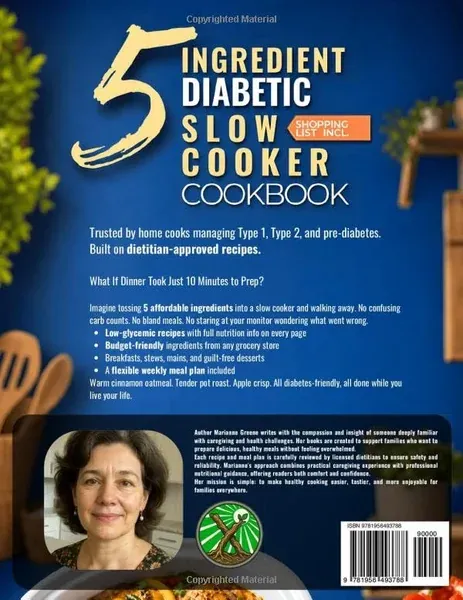
Back cover with book title, author photo, synopsis, and key features of diabetic slow cooker recipes.Tap to enlarge

LuvemBooks Verdict

Best for

People newly diagnosed with Type 2 diabetes — or those supporting a family member managing the condition — who want a clinically grounded, low-effort starting point for daily blood sugar management through home cooking.

Worth it if

You want a tightly scoped, dietitian-backed resource that removes the guesswork from meal planning, with a ready-made low glycemic weekly plan and recipes constrained to five ingredients and 15 minutes of prep.

Skip if

You're an experienced low glycemic cook seeking culinary complexity or a comprehensive all-seasons slow cooker library, or you're managing diabetes alongside additional dietary restrictions — such as renal requirements or food allergies — that fall outside the book's defined scope.

4.7from 27 Amazon ratings— reader ratings, not a LuvemBooks score

Ask LuvemBooks

Was this helpful?

The 5 Ingredient Diabetic Slow Cooker Cookbook delivers 60 slow cooker recipes built around five ingredients or fewer, 15-minute prep times, and a low glycemic weekly meal plan, all developed under the clinical co-authorship of Elizabeth M. Berkey, RDN LD CDCES, and edited by licensed nutritionist Ana Moreno. Its greatest strength is its purposeful, credentialed specificity — it is built squarely for people newly navigating Type 2 diabetes who need a manageable, professionally grounded starting point, not a comprehensive culinary library. Readers seeking flavour complexity, culinary breadth, or an all-seasons slow cooker resource will find the book's deliberate constraints limiting by design.

Is it worth reading?
For its intended audience — people newly diagnosed with Type 2 diabetes, or those supporting a family member managing the condition — the book offers a clear, professionally credentialed, and practically structured starting point that broadly targeted slow cooker cookbooks do not. The combination of a CDCES co-author, a licensed nutritionist editor, and a built-in low glycemic meal plan addresses real gaps a newly diagnosed reader faces. However, readers already experienced in low glycemic cooking will likely find the structured meal plan redundant, and those seeking culinary complexity or an expansive recipe library should look elsewhere — the book's constraints are real and intentional.
Similar books
Readers drawn to this book's combination of clinical credibility and simplified cooking may also find value in other dietitian-backed diabetic cookbooks, such as The Complete Diabetes Cookbook by America's Test Kitchen, which applies rigorous recipe testing to diabetic-friendly cooking, or The Easy Diabetes Cookbook by Paula Deen and Melissa Clark, which also prioritises accessible home cooking for blood sugar management. For those specifically interested in the slow cooker format with health-focused constraints, Fix-It and Forget-It Diabetes Cookbook by Phyllis Pellman Good covers similar ground with a larger recipe count. Those interested in the low glycemic angle more broadly might explore The Low GI Diet Revolution by Jennie Brand-Miller and Kaye Foster-Powell.
Who should read this?
The book is most purposefully suited to people who have been newly diagnosed with Type 2 diabetes, or to those supporting a family member managing the condition, and who want a professionally credentialed, low-barrier starting point for cooking at home. Its structured meal plan and simple recipes are particularly useful for readers still learning to navigate low glycemic eating rather than those already experienced with it. It is not designed for readers seeking culinary variety, flavour complexity, or a comprehensive slow cooker library.
What does the five-ingredient limit actually mean for the recipes?
The five-ingredient ceiling is a conscious accessibility principle, not an oversight — it is designed to lower the barrier to consistent home cooking for people managing fatigue, time constraints, or the demands of a new diagnosis. The trade-off, which the review acknowledges directly, is that the limit necessarily restricts the complexity of flavour profiles achievable in any single recipe. Readers who value culinary depth or adventurous slow cooker cooking will find this constraining; readers who need a manageable, repeatable kitchen routine will find it enabling.
How does the weekly meal plan work?
The book includes a structured low glycemic weekly meal plan that draws on the cookbook's 60 recipes, providing readers with a ready-made dietary framework rather than leaving them to build one independently. The review frames this as an extension of the book's accessibility philosophy: rather than offering recipes as standalone options, the meal plan is designed to support daily dietary adherence for readers who may be newly managing blood sugar through food. It is particularly useful for those who find the volume of conflicting nutritional guidance overwhelming.
Why the slow cooker format specifically?
The slow cooker format complements the book's accessibility principles directly: it reduces active kitchen time, aligns with the 15-minute prep ceiling, and suits readers managing fatigue or time constraints alongside a medical condition. The review frames the format as purposeful rather than incidental — it reinforces the book's goal of making consistent, health-supporting home cooking manageable for people with Type 2 diabetes. The format also means readers do not need advanced cooking skills or equipment beyond the slow cooker itself.
Summarize this book

Summarize this book

The 5 Ingredient Diabetic Slow Cooker Cookbook, co-authored by Marianne Greene and registered dietitian and certified diabetes care and education specialist Elizabeth M. Berkey, RDN LD CDCES, presents 60 slow cooker recipes each capped at five ingredients and a 15-minute prep time, alongside a structured low glycemic weekly meal plan. The book is edited by licensed nutritionist Ana Moreno, adding a further layer of professional dietary review. Its design philosophy holds that managing blood sugar through food should not require complex recipes or lengthy time in the kitchen — a premise baked into every structural choice the book makes. It is a tightly scoped specialist resource, not a general-purpose slow cooker collection.

Follow up

What is the book's core design philosophy?
Why only 60 recipes?
How clinically grounded is the book?

Synthesized from verified book data & published reviews · How we review

Press Enter to ask. Answers come from our editorial Q&A — start typing to see related questions.

Age & Reading Level

Recommended age

Adult

Reading level

Adult

Skip if you are looking for an expansive, all-seasons slow cooker library or recipes with genuine flavour complexity.

Our Review

This review assesses the book's content, organisation, and stated design intent from verified published sources, not a kitchen test.

What the Book Is and What It Offers

The 5 Ingredient Diabetic Slow Cooker Cookbook is a specialty cookbook authored by Marianne Greene and Elizabeth M. Berkey, RDN LD CDCES — a registered dietitian nutritionist, licensed dietitian, and certified diabetes care and education specialist — with Ana Moreno, Licensed Nutritionist, serving as editor. That professional lineup shapes the book's premise directly: 60 slow cooker recipes, each built from five ingredients or fewer, each designed for people managing Type 2 diabetes. The book is also structured around 15-minute prep times and includes a low glycemic weekly meal plan, making its functional ambition explicit from the title down to its organisation. This is a cookbook with a clinical purpose, not simply a collection of convenient meals.
The Significance of the Credential-Driven Approach

The involvement of a credentialed diabetes care and education specialist as a named co-author — rather than as a blurb contributor or a vague consultant — is a meaningful structural choice. Elizabeth M. Berkey's credentials (RDN LD CDCES) are not incidental; the CDCES designation specifically recognises expertise in diabetes self-management education, which informs the book's stated approach of pairing recipe design with a low glycemic framework. The editorial oversight of a licensed nutritionist further positions this title as a resource grounded in nutritional standards rather than general wellness trends. For a reader navigating Type 2 diabetes, the question of who is behind the recipes matters, and this book addresses that question with verifiable professional credentials rather than generalist authority.

Design Intent: Simplicity as a System

The book's core design argument is that managing blood sugar through food does not require complex recipes or lengthy time in the kitchen. The five-ingredient limit and 15-minute prep ceiling are not just convenience features — they function as accessibility principles intended to lower the barrier to consistent home cooking for people who may be managing fatigue, time constraints, or the cognitive load of a new diagnosis. The accompanying low glycemic weekly meal plan extends this logic: rather than offering 60 standalone recipes and leaving readers to build their own framework, the book is designed to hand them a ready-made structure. That integration of recipes with a planning tool reflects a design goal of supporting daily dietary adherence, not just occasional healthy cooking.
Back cover with book title, author photo, synopsis, and key features of diabetic slow cooker recipes.

Genuine Strengths and the Audience This Serves

The combination of a narrow ingredient count, a defined health focus, and professional dietary credentials gives this cookbook a specificity that broadly targeted slow cooker books do not offer. Readers who have been newly diagnosed with Type 2 diabetes, or who are supporting a family member managing the condition, often face an overwhelming volume of conflicting nutritional guidance. A book co-authored by a CDCES that constrains its scope to 60 recipes, slow cooker format, and low glycemic principles offers a clear, navigable starting point. The recipe count itself — 60 — is deliberate in scale: large enough to provide meaningful variety across a weekly plan, modest enough not to overwhelm someone still learning to cook for a medical condition. The editorial hand of a licensed nutritionist adds a layer of review beyond the authors' own expertise.

Limitations and Who May Want More

Readers looking for an expansive slow cooker library or broad culinary variety will find the book's constraints — by design — limiting. The five-ingredient ceiling necessarily restricts the complexity of flavour profiles achievable in any single recipe, which is a trade-off the book makes consciously in service of accessibility. The 60-recipe count, while purposeful, means the book is not intended to serve as a comprehensive, all-seasons slow cooker resource. Those already experienced in low glycemic cooking and comfortable building their own meal plans may find the structured weekly plan redundant rather than useful. Similarly, readers managing diabetes alongside other dietary restrictions — such as renal diet requirements or food allergies — would need to evaluate recipes against additional criteria the book is not designed to address. These are not flaws so much as the honest edges of a tightly scoped resource, and readers should enter with clear expectations about what a focused, 60-recipe specialist cookbook is and is not built to do.

Books like The 5 Ingredient Diabetic Slow Cooker Cookbook

Curated picks for readers who enjoyed The 5 Ingredient Diabetic Slow Cooker Cookbook, with our reasoning for each match.

If you liked The 5 Ingredient Diabetic Slow Cooker Cookbook