
9 min read
4.6
· 12,992 Amazon ratingsShare This Review
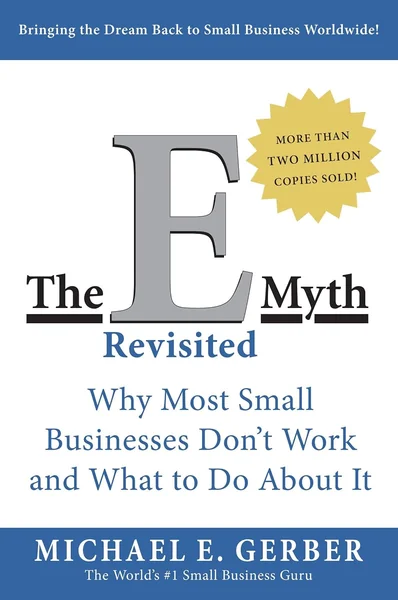
The E-Myth Revisited by Michael E. Gerber Review: A Landmark Small Business Mindset Shift
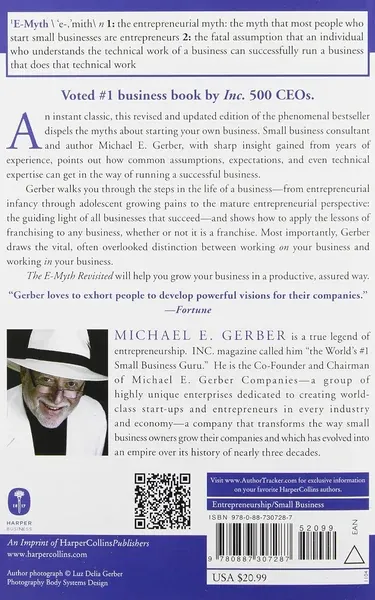
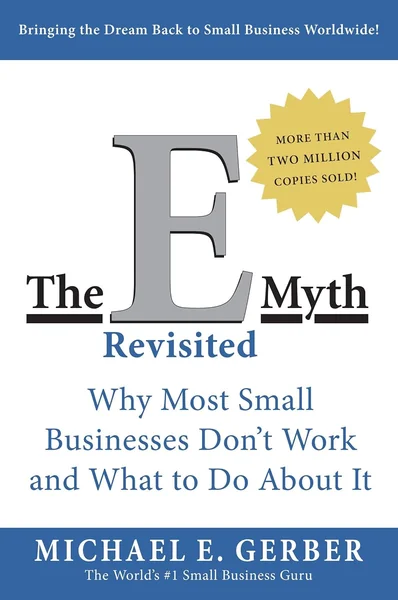
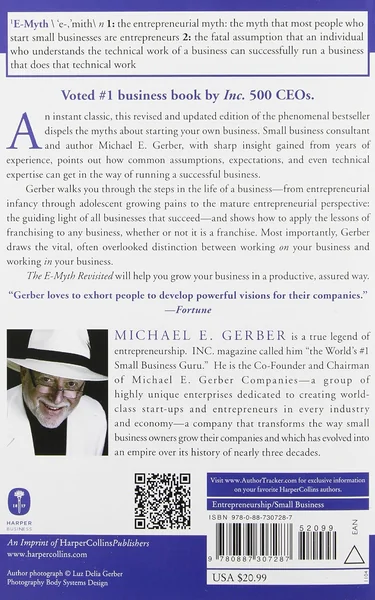
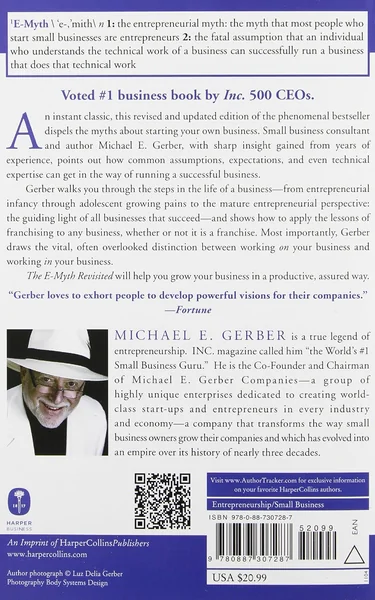
The E-Myth Revisited is a foundational business guide by small business consultant Michael E. Gerber that challenges the widespread assumption — the "entrepreneurial myth" itself — that technical skill in a trade automatically equips someone to run a business built around that trade. Voted the number one business book by Inc. Magazine, this updated Harper Business edition walks owners through the distinct stages of a business's life and introduces the critical discipline of working on your business rather than merely in it.
 Tap to enlarge
LuvemBooks Verdict
Best for
Small business owners in the early or middle stages of building their enterprise who want a clear conceptual framework — the E-Myth, the three personas, the franchise prototype — for understanding why owner-dependent businesses stall and how to systematise their way out of it.
Worth it if
You're a founder or aspiring entrepreneur who suspects you're trapped working *in* your business rather than *on* it and want a durable, widely field-tested mindset shift backed by a structured systems philosophy.
Skip if
You need granular, tactical instruction — detailed financial frameworks, industry-specific checklists, or legal guidance — or you strongly prefer dense, data-driven business writing over narrative-driven explanation.
What readers & critics say
Abebooks.com notes the book was "voted #1 business book" and describes it as "an instant classic" that "dispels the myths about starting your own business," citing Gerber's sharp insight from years of experience. Chmltech-consulting.com calls it "a must-read for anyone serious about growing a small business," praising its timeless framework for understanding why so many ventures fail and how to fix them.
Sources: AbeBooks, CHML Tech ConsultingPreview the book

Ask LuvemBooks
Was this helpful?
- Is it worth reading?
- For small business owners at the early or middle stages of building their enterprises, The E-Myth Revisited offers something genuinely rare: a precisely articulated central concept — the E-Myth — that explains a failure pattern most owners have lived but never named, backed by a practical vocabulary readers can apply immediately. Its status as the number one business book as voted by Inc. Magazine, whose editors dubbed Gerber "The World's #1 Small Business Guru," reflects decades of documented influence rather than fleeting hype. The main caveat is scope: the book operates at the level of mindset and systems philosophy, not granular tactics, so readers who need detailed financial frameworks, industry-specific checklists, or step-by-step legal guidance will need to supplement it with more specialized resources. Those who prefer dense, data-driven business writing may also find the narrative storytelling format slower than they would like.
- Similar books
- Readers who respond to The E-Myth Revisited's systems-thinking approach will find strong companions in several related titles. Gino Wickman's Traction builds on similar ground, offering the Entrepreneurial Operating System as a structured framework for getting a grip on a growing business. Simon Sinek's Start with Why complements Gerber's mindset argument by tracing how purpose-driven leadership shapes organizational culture. The Rhythm Wave by Kevin Cover approaches the leadership systems question through six laws for building sustainable organizational rhythm. For a more foundational leadership lens, M.B.A. by D.M. Christensen examines core leadership truths that intersect with the owner-operator challenges Gerber diagnoses.
- Who should read this?
- The E-Myth Revisited is most directly valuable for small business owners at the early and middle stages of building their enterprises — particularly those who founded their business on technical skill and are struggling with the gap between doing the work and running the operation that does the work. It is equally relevant for aspiring entrepreneurs who want to understand the structural thinking required before launching, and for business advisors and consultants who work with small business owners. Readers managing already-systematized, large-scale organizations are unlikely to find it as directly applicable, and those seeking granular tactical instruction should approach it as a foundational mindset text rather than an operational manual.
- What are the key concepts?
- The E-Myth Revisited introduces a tightly interconnected set of concepts that build from its central diagnosis. The E-Myth itself — the entrepreneurial myth — is the fatal assumption that technical skill in a trade equates to readiness to run a business. From that foundation, Gerber introduces the three personas every owner must manage: the Entrepreneur (visionary), the Manager (pragmatist), and the Technician (craftsperson), whose internal tension drives most business growing pains. The franchise prototype concept reframes systematization as the universal discipline of any scalable business — not just formally franchised ones — by documenting processes so the business can operate independently of any single person. All of these converge in the book's most-quoted distinction: working on your business versus working in it, the shift in orientation that separates scalable enterprises from owner-dependent ones.
- What are the book's limitations?
- The E-Myth Revisited's most significant limitation is its scope: it operates primarily at the level of mindset and systems philosophy rather than granular tactical instruction, so readers seeking detailed financial frameworks, industry-specific checklists, or step-by-step legal guidance will need to supplement it with more specialized resources. The narrative storytelling format, while effective for accessibility, can slow the delivery of actionable content for readers who prefer dense, data-driven business writing. Additionally, the book's focus on small business owners at the earlier and middle stages of building their enterprises means it is unlikely to be as directly applicable to those managing already-systematized organizations at scale.
- Why is it considered a classic?
- The E-Myth Revisited earned its status through a combination of conceptual precision and durability: Inc. Magazine voted it the number one business book, and the editors of Inc. named Gerber "The World's #1 Small Business Guru" — credentials the publisher cites prominently. More tellingly, the book's central vocabulary — the E-Myth itself, the three personas, the franchise prototype, working on versus in your business — has entered the mainstream of entrepreneurship discourse, appearing across decades of business literature and curated reading lists alongside titles such as Rich Dad Poor Dad. That kind of conceptual influence, where a book's terms become the shared language of a field, is a reliable marker of foundational status.
Summarize this book
Follow up
Synthesized from verified book data & published reviews · How we review
Press Enter to ask. Answers come from our editorial Q&A — start typing to see related questions.
Age & Reading Level
Recommended age
Adult
Reading level
Adult
who it suits
Skip if you want granular, step-by-step operational templates or industry-specific tactical checklists rather than a mindset and systems-philosophy framework.
Our Review
What the Book Actually Argues
Structure and Central Framework
Significance and Reception
Genuine Strengths

Limitations and Who It May Frustrate
Sources & Further Reading
The key facts and claims in this review are grounded in the retrieved, verified sources listed below.
- 1
- 2
- 3
Related reading
Adjacent titles worth exploring. We haven't reviewed these yet, so they link out to Amazon.