
8 min read
4.4
· 517 Amazon ratingsShare This Review

The Innovator's Dilemma by Clayton M. Christensen Review: A Foundational Business Classic Worth Revisiting
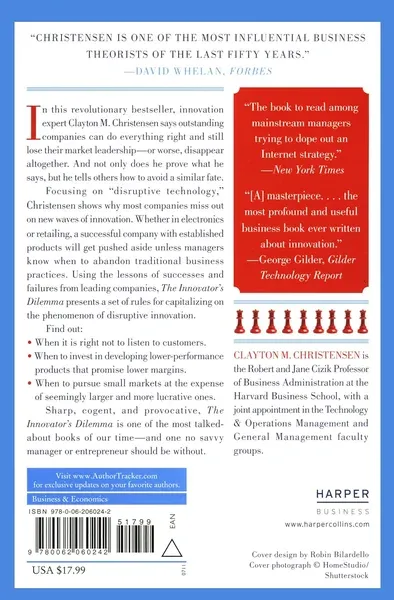
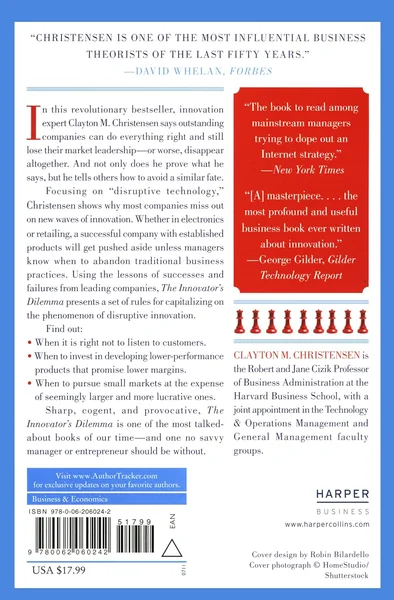
First published in 1997 and reissued by HarperBusiness, The Innovator's Dilemma: When New Technologies Cause Great Firms to Fail is widely regarded as the best-known work of Harvard professor and businessman Clayton M. Christensen. It introduces and systematizes the theory of disruptive innovation, explaining how well-managed, successful companies can do everything right by conventional measures and still lose their market leadership — or fail entirely — when upstart competitors build new technologies in overlooked market niches and then rapidly improve them. Essential reading for managers, entrepreneurs, and anyone navigating competitive markets shaped by technological change.
 Tap to enlarge
LuvemBooks Verdict
Best for
Managers at established companies and entrepreneurs in strategy or leadership roles who need a rigorous conceptual framework for understanding why dominant firms are structurally vulnerable to disruption — and how challengers can exploit that vulnerability.
Worth it if
Worth reading if you want to engage with a foundational business framework as a conceptual lens for diagnosing competitive dynamics, rather than expecting a step-by-step operational playbook.
Skip if
Skip it if you need a universally settled management theory — the disruption framework remains the subject of active academic debate, and readers in industries far removed from technology sectors may find the empirical grounding requires significant interpretive work to apply directly.
What readers & critics say
Wikipedia identifies The Innovator's Dilemma as Christensen's best-known work and traces how its core argument — that incumbents fail by listening too well to existing customers while new entrants improve from the low end — has generated extensive scholarly debate, with studies both supporting and challenging its framework since publication. Bookishelf describes it as "a groundbreaking book" offering "compelling insights into why well-managed companies often struggle to adapt," while YoungUpstarts notes it is "backed by rigorous research" and builds a premise that even attentive, well-managed companies can still lose market dominance.
Sources: Wikipedia, Bookishelf, YoungUpstarts, HBS, BruceJonesDesign, ResearchGateAge & Reading Level
Recommended age
Adult
Reading level
Adult
who it suits
Skip if you want a step-by-step operational playbook rather than a conceptual framework for understanding competitive dynamics.
In This Review
- What Works & What Doesn't
- What the Book Actually Argues
- Significance and Place in the Field
- Where the Framework Is Strongest
- Genuine Limitations and Points of Debate
- Who This Book Is For
What Works & What Doesn't
What Works
- Introduces and rigorously defines the concept of disruptive innovation, a framework that has become foundational vocabulary across business, technology, and policy
- Grounds its theory in multi-industry empirical research and real case studies, not anecdote alone — and its core prediction about incumbents vs. Entrants has been independently replicated in the hard disk drive industry
- Moves beyond diagnosis to prescription, offering concrete organizational recommendations such as creating small autonomous divisions sized to match emerging markets
- Cited by major thought leaders including Steve Jobs and Malcolm Gladwell, reflecting genuine and broad real-world influence
What Doesn't
- The framework has attracted sustained academic debate since publication, with scholars both supporting and challenging its consistency and predictive power across industries
- The deepest empirical grounding draws heavily from the hard disk drive sector, which may require readers in other industries to do additional interpretive work to apply the conclusions directly
What the Book Actually Argues
Significance and Place in the Field
Where the Framework Is Strongest
Genuine Limitations and Points of Debate
Who This Book Is For
Frequently Asked Questions
Sources & Further Reading
The key facts and claims in this review are grounded in the retrieved, verified sources listed below.
- Cited in this review
- 1
en.wikipedia.org
- 2
youngupstarts.com
- 3
- Further reading
- 4
- 5
Related Reviews
Reviews of books we picked for readers who enjoyed The Innovator's Dilemma.


Reader Comments
No comments yet
Be the first to share your thoughts!