BOOKS
Published

Read Time

8 min read

Reader rating

4.6

· 4,202 Amazon ratings
reader ratings, not a LuvemBooks score
Curated & edited by

LuvemBooks Editorial

How we create our reviews →
Share This Review

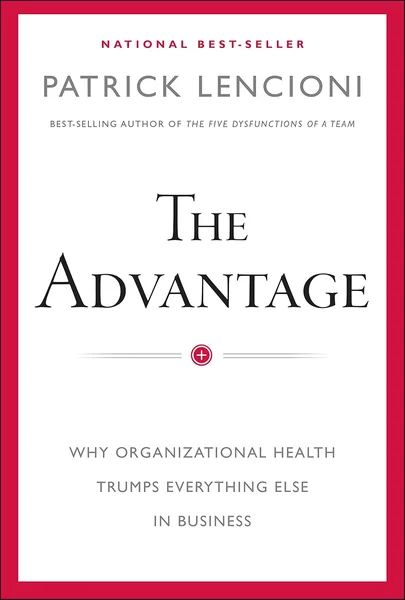
The Advantage by Patrick M. Lencioni Review: A Practical Blueprint for Organizational Health

Patrick M. Lencioni's The Advantage: Why Organizational Health Trumps Everything Else in Business makes a direct, focused case that the most powerful competitive differentiator available to any organization is not strategy, innovation, or talent — it is organizational health. Published by Jossey-Bass in 2012, the book is a comprehensive business guide that synthesizes themes from across Lencioni's prior work into a single, actionable framework built around four disciplines and six critical questions of clarity.
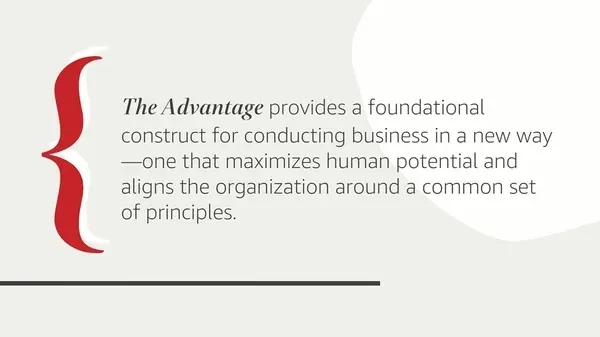
Interior page with pull quote defining "The Advantage" as a foundational business construct emphasizing human potential and organizational principles.Tap to enlarge

LuvemBooks Verdict

Best for

Senior leaders, executives, and managers who are responsible for shaping organizational culture and performance at a systemic level and want a single, unified framework that consolidates Lencioni's thinking on team cohesion, clarity, and alignment.

Worth it if

You're looking for a comprehensive leadership philosophy — grounded in concrete disciplines and a directly applicable six-question clarity model — rather than a narrow fix for one isolated management problem.

Skip if

You're already deeply familiar with Lencioni's earlier work (particularly The Five Dysfunctions of a Team) and are hoping for substantially new territory, or you're a front-line employee without influence over team structure and strategic direction.

Publishers Weekly, as quoted on wiley.com, called the book "smart, pithy, and practical" and named it "a must-read for executives and other businesspeople who need to get their proverbial ducks back in a row." A reviewer at gordonconwell.edu highlighted it as Lencioni's first straightforward management book (without a fable wrapper) and noted its ambition to deliver a cohesive, comprehensive exploration of organizational health — a first in his body of work.

Smart, pithy, and practical — a must-read for executives who need to get their proverbial ducks back in a row.

Publishers Weekly
Sources: Wiley, Publishers Weekly, Gordon-Conwell Theological Seminary
4.6from 4,202 Amazon ratings— reader ratings, not a LuvemBooks score

Look inside the book

Preview the actual pages, via Google Books
In This Review
  • What Works & What Doesn't
  • What the Book Argues and How It Is Structured
  • Significance and Place in Lencioni's Body of Work
  • Genuine Strengths: Practicality and Clarity of Framework
  • Honest Limitations: Familiarity and the Trust-Building Question
  • Who This Book Is For

What Works & What Doesn't

What Works
  • Publisher's Weekly praised it as 'smart, pithy, and practical' and a must-read for executives seeking real organizational improvement
  • Synthesizes themes from across Lencioni's body of work into a single, cohesive framework for the first time
  • Built around a concrete six-question model for creating clarity that leaders can apply directly to their organizations
  • Draws on real consulting examples to address peer-to-peer accountability, office politics, and strategic communication
  • Written by a New York Times bestselling author with deep practitioner experience as founder of The Table Group
What Doesn't
  • Readers already familiar with Lencioni's earlier books may find significant thematic overlap, given the book's explicit role as a synthesis of prior work
  • The framework's treatment of trust-building, while diagnostically sound, has been noted by some in the consulting community as underestimating the difficulty of reversing deep organizational distrust
The Advantage is one of the most direct and actionable books in Lencioni's catalog, offering a unified framework for organizational health that stands as the clearest synthesis of his career's key arguments.

What the Book Argues and How It Is Structured

Interior page with pull quote defining "The Advantage" as a foundational business construct emphasizing human potential and organizational principles.
At the center of The Advantage is a bold claim, stated plainly in the book's opening: "The single greatest advantage any company can achieve is organizational health." Lencioni, founder and president of The Table Group and a New York Times bestselling author, argues that the defining difference between successful companies and mediocre ones has little to do with intelligence, strategy, or innovation, and everything to do with whether an organization is whole, consistent, and complete — with complementary management, operations, strategy, and culture working in alignment. The book organizes this argument around four disciplines: building a cohesive leadership team, creating clarity, overcommunicating clarity, and reinforcing clarity. Within the "create clarity" discipline, Lencioni poses six foundational questions every organization must answer, among them: Why do we exist? What do we do? How will we succeed? What is the top priority right now? And who does what? These questions form the structural spine of the book's prescriptive half.
a must-read for executives and other businesspeople who need to get their proverbial ducks back in a row.

Significance and Place in Lencioni's Body of Work

Lencioni had spent years exploring adjacent themes — team dysfunction, leadership fables, the miseries of bad management — across books including The Five Dysfunctions of a Team. The Advantage is explicitly presented as a synthesis: a first-of-its-kind effort to pull those threads into a cohesive and comprehensive exploration of organizational health as a unified concept. Where his earlier books tended to isolate single dysfunctions or problems, this book is designed as a foundational construct — a complete operating framework for leaders. That ambition gives The Advantage a distinct position in the business management genre: it functions less as a narrow fix for one leadership problem and more as an overarching philosophy for running an organization.

Genuine Strengths: Practicality and Clarity of Framework

Publishers Weekly called the book "smart, pithy, and practical" and named it "a must-read for executives and other businesspeople who need to get their proverbial ducks back in a row." Those qualities are structural, not incidental. Lencioni builds the case through real-world examples drawn from his own consulting experience and the experiences of others, addressing concrete behaviors such as peer-to-peer accountability, the corrosive effects of office politics and bureaucracy, and the discipline of constant, creative communication. The six-question framework for creating clarity is specific enough to be applied directly — each question targets a real organizational ambiguity that, left unanswered, produces misalignment. The book's insistence on overcommunicating clarity as a distinct, repeated discipline (rather than a one-time memo) reflects a sophisticated understanding of how organizations actually absorb direction.

Honest Limitations: Familiarity and the Trust-Building Question

Readers already well-versed in Lencioni's earlier work may find portions of The Advantage covering familiar ground, since the book is explicitly a consolidation of themes from his prior bestsellers. The framework's breadth is also its constraint in one specific area: trust. The book identifies building genuine trust — not superficial team-bonding exercises — as foundational to a cohesive leadership team. However, some readers in the consulting and leadership development community have noted that the book's treatment of trust-building, while correctly diagnosing its importance, does not fully grapple with how deeply entrenched distrust in an organization resists rapid intervention. The framework's four-discipline structure implies a relatively navigable path that real organizational cultures can complicate considerably.

Who This Book Is For

The Advantage is designed for executives, senior leaders, and managers who are responsible for organizational culture and performance at a systemic level. It is not a book for front-line employees or those without influence over team structure and strategic communication. Lencioni explicitly argues that organizational health is neither glamorous nor easily quantifiable — which is precisely why most organizations neglect it despite having ample intelligence and experience to succeed. Readers who come to this book seeking a single tactical fix for a specific management problem may find its scope broader than expected; those looking for a comprehensive leadership philosophy grounded in alignment, clarity, and human potential will find The Advantage a rigorous and well-structured guide.

Sources & Further Reading

The key facts and claims in this review are grounded in the retrieved, verified sources listed below.

  1. Cited in this review
  2. 1
  3. 2
  4. 3
  5. Further reading
  6. 4

    Patrick M. Lencioni, Wikipedia

  7. 5
  8. 6
  9. 7
Related Reviews

Reviews of books we picked for readers who enjoyed The Advantage.