
BOOKS
Published
Read Time
6 min read
Our Rating
3.8
An engaging introduction to economic thinking that makes complex data analysis accessible, though it sometimes prioritizes entertainment over nuance in tackling social issues.
Reviewed by
LuvemBooks
Share This Review
Freakonomics by Steven D. Levitt & Stephen J. Dubner - Review
Our Rating
3.8
An engaging introduction to economic thinking that makes complex data analysis accessible, though it sometimes prioritizes entertainment over nuance in tackling social issues.
In This Review
- When Economics Meets Pop Culture
- The Rogue Economist's Methodology
- Hidden Connections and Surprising Insights
- Accessibility Without Oversimplification
- Where the Analysis Falls Short
- A Gateway to Economic Thinking
When Economics Meets Pop Culture
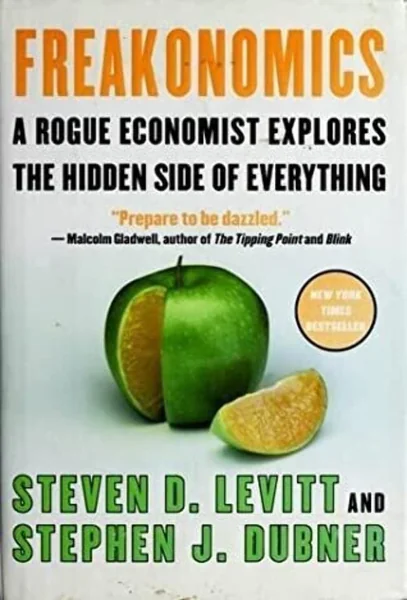
s Freakonomics worth reading after all these years? Steven D. Levitt and Stephen J. Dubner's groundbreaking collaboration transforms dry economic theory into compelling detective stories that reveal the hidden forces shaping our world. Rather than following traditional economic textbook formats, this book applies rigorous data analysis to unexpected questions: Why do drug dealers live with their mothers? What do schoolteachers and sumo wrestlers have in common? How did a bag of bagels reveal human nature?
The authors' approach feels revolutionary because it abandons economic jargon in favor of storytelling. Where books like Thinking, Fast and Slow dive deep into cognitive psychology, Freakonomics maintains a lighter touch while delivering equally profound insights about human behavior and incentives.
The Rogue Economist's Methodology
Levitt's academic credentials as a University of Chicago economist provide the analytical rigor, while Dubner's journalism background ensures the findings remain accessible to general readers. Their partnership creates a unique voice that treats economics as a lens for understanding everyday mysteries rather than an abstract academic discipline.
The book's structure deliberately avoids traditional economic categories. Instead of chapters on supply and demand or market theory, readers encounter case studies that feel more like investigative journalism. Each section begins with a seemingly simple question, then uses data analysis to uncover surprising answers that challenge conventional wisdom.
The authors excel at making correlation versus causation tangible. Through concrete examples rather than theoretical explanations, they demonstrate how proper data analysis can reveal truth while sloppy thinking leads to false conclusions. This practical approach to statistical thinking makes complex methodological concepts genuinely understandable.
Hidden Connections and Surprising Insights
The book's central thesis argues that economics explains far more human behavior than traditional boundaries suggest. Levitt and Dubner demonstrate how economic thinking applies to parenting decisions, criminal behavior, educational outcomes, and social phenomena that seem entirely removed from markets or money.
Their most provocative analyses challenge popular assumptions about causation. The authors systematically dismantle feel-good explanations for social changes, replacing them with data-driven alternatives that often prove uncomfortable. This willingness to follow evidence regardless of political implications gives the book intellectual credibility while generating controversy.
The writing maintains momentum by treating each revelation as a puzzle to solve. Rather than presenting dry statistical findings, the authors build narrative tension around their investigations. Readers find themselves genuinely curious about outcomes, transforming economic analysis into page-turning material.
Accessibility Without Oversimplification
Unlike academic economics texts, Freakonomics requires no prior knowledge of economic theory or statistical methods. The authors translate complex analytical concepts into plain English without dumbing down their conclusions. Mathematical reasoning appears through logical explanation rather than equations, making sophisticated analysis accessible to any interested reader.
The book succeeds because it respects readers' intelligence while acknowledging their lack of specialized training. Technical concepts emerge naturally through examples rather than abstract definitions. This pedagogical approach proves more effective than traditional textbook methods for conveying how economic thinking actually works.
However, this accessibility occasionally sacrifices nuance. Complex social phenomena receive abbreviated treatment that, while engaging, sometimes glosses over important caveats and limitations. The authors' confidence in their conclusions occasionally outpaces the strength of their evidence.
Where the Analysis Falls Short
The book's greatest weakness lies in its tendency toward oversimplification of complex social issues. While the authors excel at identifying interesting correlations, their causal explanations sometimes rely on incomplete data or ignore alternative explanations that don't fit their narrative structure.
Some analyses feel more provocative than rigorous. The authors clearly enjoy overturning conventional wisdom, but this contrarian impulse occasionally leads them to overstate their findings or dismiss competing theories too quickly. Academic economists have challenged several of the book's central claims, though these debates often involve technical details beyond general readers' expertise.
The writing style, while engaging, sometimes prioritizes entertainment over precision. Complex social phenomena receive treatment that sacrifices important nuance for narrative clarity. Readers seeking comprehensive understanding of the topics discussed will need to supplement this book with more detailed sources.
A Gateway to Economic Thinking
Freakonomics succeeds brilliantly as an introduction to economic reasoning for general audiences. The book demonstrates how data analysis can reveal counterintuitive truths about human behavior, making abstract concepts concrete through memorable examples. Readers finish with genuine appreciation for how economic thinking applies beyond traditional business or policy contexts.
The authors deserve credit for making economics genuinely interesting to people who might otherwise never encounter the discipline. Their approach has influenced countless subsequent books that apply academic insights to popular topics, establishing a template for accessible social science writing.
For readers curious about behavioral economics or data analysis, this book provides an excellent starting point. While it shouldn't be anyone's only source on these topics, it offers valuable introduction to thinking systematically about social phenomena and questioning conventional explanations.