BOOKS
Published

Read Time

3 min read

Curated & edited by

LuvemBooks Editorial

How we create our reviews →
Share This Review

The Call of the Last Frontier by Melissa L. Cook Review: A Raw, Resilient Alaska Memoir

Melissa L. Cook's memoir chronicles the twenty years she and her family spent living and teaching in Alaska's remote bush communities, weaving together adventure, hardship, humor, and her experience living with multiple sclerosis into a portrait of life at the edge of the American frontier.

LuvemBooks Verdict

Best for

Alaska enthusiasts, adventure-travel readers, and anyone drawn to memoirs of personal resilience — particularly those curious about the realities of family life in remote bush schools or navigating chronic illness alongside an unconventional existence.

Worth it if

You want an immersive, anecdote-rich memoir that trades in genuine specificity — two decades of Alaskan bush life, a chronic illness diagnosis, and hard-won humor — rather than a polished wilderness fantasy.

Skip if

Readers who prefer a tightly constructed, thematically compressed narrative arc may find the episodic, twenty-years-of-anecdotes structure loosely paced and sprawling across its 344 pages.

What readers & critics say

The Billings Gazette, covering the book's High Plains Book Awards finalist status, praised Cook's entertaining and often terrifying anecdotes as carrying the power to provoke genuine recognition even in readers with firsthand Alaska experience, noting how accurately her writing captures the raw edge of the state. The author's own storefront (shop.thealaskafrontier.com) documents blurbs from polar explorer Aaron Linsdau — who described the book as helping readers "live adventures I'll never have but desperately want" — and notes Cook's humor in situations unique to the Last Frontier alongside her candid account of life with multiple sclerosis.

Sources: Billings Gazette, The Alaska Frontier (author storefront)
4.5from 1,362 Amazon ratings— reader ratings, not a LuvemBooks score
In This Review
  • What Works & What Doesn't
  • What the Book Actually Is
  • The Premise and Its Stakes
  • Strengths: Voice, Humor, and Specificity
  • Recognition and Place in the Genre
  • Who This Book Is For — and Where It Challenges

What Works & What Doesn't

What Works
  • Covers a genuinely rare subject — two decades of family life in Alaska's bush schools — with specificity and authenticity praised by readers with firsthand Alaska experience
  • Balances adventure, humor, and a candid account of living with multiple sclerosis, giving the memoir unusual tonal and thematic range
  • Recognized as a finalist in the High Plains Book Awards Woman Writer category, lending it documented literary standing
  • Blurbs from named authors with direct Alaska expertise (Aaron Linsdau, Ann Parker) speak to the accuracy and resonance of Cook's portraiture
  • Available in print, eBook, and audiobook formats, broadening accessibility for different reading preferences
What Doesn't
  • The episodic, anecdote-driven structure built across twenty years may feel loosely paced to readers who prefer a tightly constructed narrative arc
  • As a self-published memoir from an independent press, it has received less mainstream critical coverage than traditionally published Alaska titles in the same genre
A gripping and deeply personal memoir, The Call of the Last Frontier earns its reputation as a standout account of life in one of North America's most demanding environments.

What the Book Actually Is

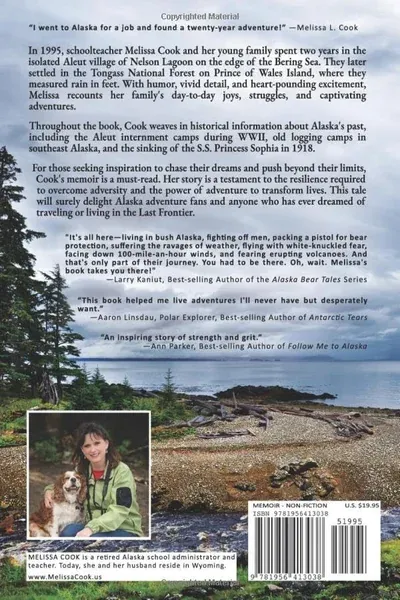
Back cover with synopsis, author photo with dog, and review quotes about Alaska frontier living.
In 1995, schoolteacher Melissa L. Cook and her young family relocated to Alaska — initially for a job — and stayed for two decades. That journey is the backbone of this memoir, published in 2021 by Hoodoo Books, LLC, the independent press Cook founded with her husband Elgin Cook. The book recounts their years in Alaska's bush schools, where Elgin served as a teacher and technology director, and traces the family's movement across different corners of the state, including a period on Prince of Wales Island in the Tongass National Forest — a region where, as Cook notes, rain is measured in feet. Historical tidbits are woven throughout, giving the personal narrative a broader grounding in Alaskan history and culture. The memoir is also candid about Cook's diagnosis and life with multiple sclerosis, threading that physical and emotional challenge through the larger story of adventure and adaptation.

The Premise and Its Stakes

The title's promise — a "true story" — is central to the memoir's appeal. This is not a curated wilderness fantasy but an account rooted in the daily realities of bush life: few luxuries, few conveniences, and the ever-present rawness of the Alaskan landscape. The school administrator who asked the Cooks at their job interview whether they owned a.44 Magnum — because a student had been eaten by a bear on the way to school — signals early the tone of the book: adventure arrived, uninvited, on the doorstep. Cook frames the two decades not as an ordeal but as a transformation, with the memoir's through-line being the resilience required to meet that life on its own terms. Polar explorer and bestselling author Aaron Linsdau, who provided a blurb for the book, described it as capturing experiences that readers will never have but "desperately want."

Strengths: Voice, Humor, and Specificity

The memoir's particular strength, as noted by the Billings Gazette in its coverage of the book's High Plains Book Awards finalist status, lies in its entertaining anecdotes drawn from lived experience — many of them described as terrifying. The review notes that Cook's stories carry the power to provoke genuine memory and recognition even in readers who have spent time in Alaska themselves, speaking to the accuracy and specificity of her portraiture. Bestselling author Ann Parker, in a blurb for the book, calls it "an inspiring story of strength and grit that conveys a deep connection to this wild place." Cook also finds and deploys humor in situations unique to the Last Frontier, giving the memoir tonal range that prevents it from settling into either pure adventure writing or hardship narrative. Her development of an eye for the land through photography on Prince of Wales Island adds yet another dimension to a story that might otherwise risk being read as purely episodic.

Recognition and Place in the Genre

The Call of the Last Frontier was a finalist in the Woman Writer category of the High Plains Book Awards — a regional literary prize recognizing works connected to the American West and Plains. The book sits within a tradition of Alaska frontier memoirs but distinguishes itself through the specific combination of its classroom setting, the author's ongoing life with multiple sclerosis, and a two-decade timespan that allows for genuine narrative arc rather than a single-season snapshot. Hoodoo Books produced the title in print, eBook, and audiobook formats, with Elgin Cook drawing on his technology background to bring all three editions to market. Signed copies are available directly through the author's own storefront.

Who This Book Is For — and Where It Challenges

Readers who come to this memoir as Alaska enthusiasts or adventure-travel devotees will find it a natural fit; the book is explicitly designed to delight that audience. Readers drawn to stories of personal resilience — particularly those centered on navigating chronic illness alongside an unconventional life — will find that strand equally present. The memoir's bush-school setting also gives it appeal for readers interested in rural and Indigenous education in Alaska, though the emphasis remains on Cook's personal experience rather than a systemic account of those institutions. The book's episodic structure, built around twenty years of accumulated anecdotes, may suit readers who enjoy immersive scene-by-scene storytelling more than those who prefer a tightly argued or thematically compressed narrative arc. At 344 pages, it is a substantial read, and the density of experience it covers reflects the scope of two decades in an unforgiving landscape.

Sources & Further Reading

The key facts and claims in this review are grounded in the retrieved, verified sources listed below.

  1. Cited in this review
  2. 1
  3. 2
  4. Further reading
  5. 3

    Melissa L. Cook, Wikipedia

  6. 4