

8 min read
4.8
· 1,610 Amazon ratingsShare This Review

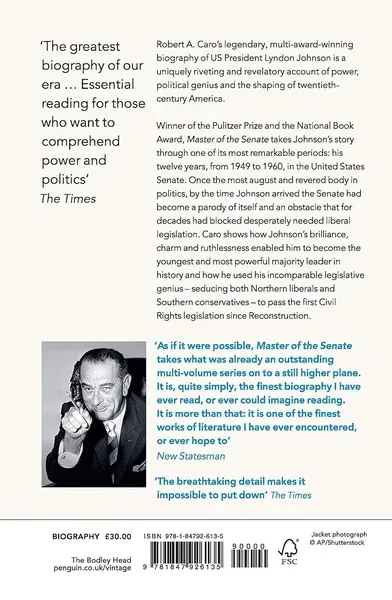
Master of the Senate: The Years of Lyndon Johnson by Robert A. Caro Review: A Monumental, Pulitzer-Winning Political Biography
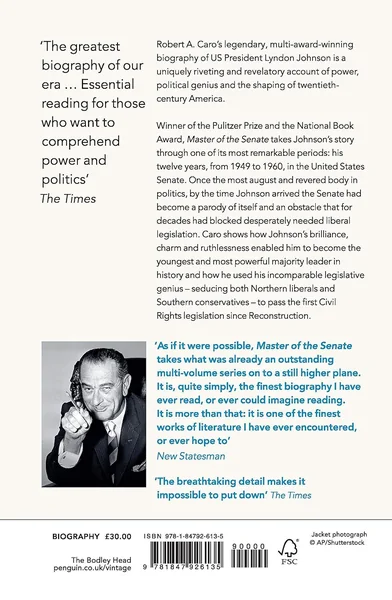
Robert A. Caro's Master of the Senate is the third volume in his ongoing multi-book biography The Years of Lyndon Johnson, winner of the 2003 Pulitzer Prize for Biography or Autobiography. It chronicles Lyndon B. Johnson's tenure in the United States Senate from 1949 to 1960 — his rise from freshman senator to Senate majority leader — and his pivotal role in passing the Civil Rights Act of 1957, the first such legislation since the Reconstruction era. Combining exhaustive institutional history with granular political biography, the book stands as one of the most ambitious works of American political nonfiction ever published.
 Tap to enlarge
LuvemBooks Verdict
Best for
Readers with a serious interest in the mechanics of American political power, the legislative history of civil rights, or the mid-twentieth-century Senate who are prepared to engage with the full multi-volume series.
Worth it if
You are willing to commit to more than 1,100 pages — including a roughly 100-page institutional history of the Senate before Johnson fully enters the frame — and ideally have already read the first two volumes of the series.
Skip if
You are new to Caro's series and looking for a self-contained, streamlined political biography, or find exhaustive legislative and procedural detail more draining than illuminating.
What readers & critics say
The Guardian praised the volume as "a vivid and stunningly accurate picture of how business is done in the United States Senate," highlighting Johnson as "the greatest one on one salesman that ever lived." Fivebooks.com recommends it as "one of the first books you should read if you're really interested in congressional history," while bookmarks.reviews likened the reading experience to a Trollope novel — one that provoked laughter and genuine suspense even when outcomes were already known.
“A vivid and stunningly accurate picture of how business is done in the United States Senate.”
— The GuardianAge & Reading Level
Recommended age
Adult
Reading level
Adult
2 content notes · who it suits
Content to know about
Skip if you want a fast-paced biographical narrative rather than exhaustive institutional and political history
In This Review
- What Works & What Doesn't
- What the Book Is and What It Covers
- The Central Drama: Civil Rights and the Limits of Power
- Institutional Depth and the Portrait of Richard Russell
- Reception and Standing in the Series
- Who This Book Is For — and Who Should Prepare Accordingly
What Works & What Doesn't
What Works
- Won the 2003 Pulitzer Prize for Biography or Autobiography and the 2002 National Book Award for Nonfiction — among the most decorated volumes in the series
- Provides exhaustive institutional context, including a book-length history of the Senate, that illuminates how legislative power actually functions in America
- Centers a genuinely dramatic political conflict — Johnson's navigation of the Civil Rights Act of 1957 — that carries major historical consequences
- Offers morally complex portraits of key figures, including the contradictory Richard Russell, that resist easy characterization
- Part of a multi-volume series praised by politicians, historians, and cultural figures as a defining work of American political biography
What Doesn't
- At over 1,100 pages, with a roughly 100-page institutional prologue before Johnson fully enters the narrative, the book demands exceptional reader patience and commitment
- The depth of senatorial procedure and coalition-building detail, while a scholarly strength, may feel exhausting to readers seeking a more streamlined biographical narrative
- Readers approaching this as a standalone volume will miss significant context; the book functions best as part of a years-long engagement with the full series
What the Book Is and What It Covers
The Central Drama: Civil Rights and the Limits of Power
Institutional Depth and the Portrait of Richard Russell
Reception and Standing in the Series
Who This Book Is For — and Who Should Prepare Accordingly
Frequently Asked Questions
Sources & Further Reading
The key facts and claims in this review are grounded in the retrieved, verified sources listed below.
- Cited in this review
- 1
theguardian.com
- 2
- Further reading
- 3
Robert A Caro, Wikipedia
- 4
en.wikipedia.org
- 5
- 6
- 7
robertcaro.org
Related Reviews
Reviews of books we picked for readers who enjoyed Master of the Senate.

Reader Comments
No comments yet
Be the first to share your thoughts!