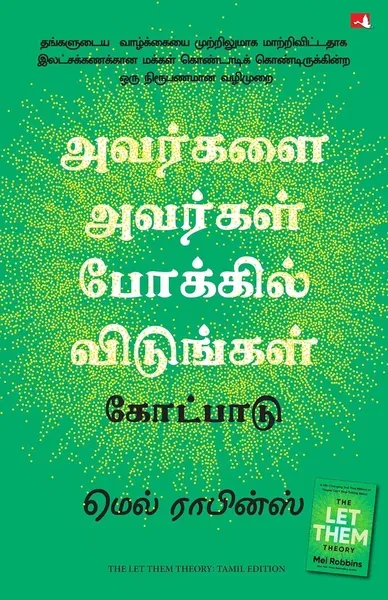
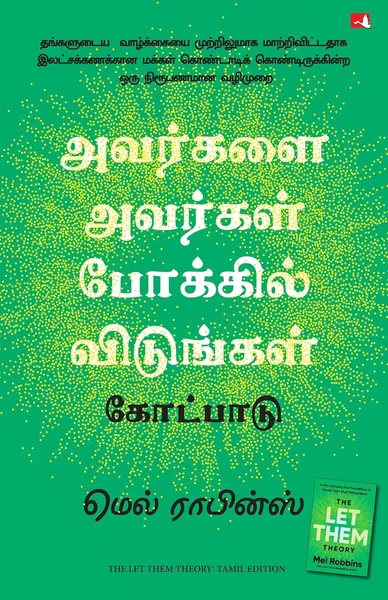
The Core Philosophy Unpacked
Robbins structures her argument around three fundamental shifts in thinking. Rather than fighting against people's behaviors that frustrate us, she advocates for a radical acceptance captured in the phrase "let them." The central premise challenges readers to examine why they invest emotional energy in changing others rather than focusing on their own responses and growth.
The Tamil edition benefits from cultural examples that speak directly to family dynamics, workplace hierarchies, and social expectations common in Tamil society. Where the original English version might reference American workplace scenarios, this adaptation weaves in situations involving extended family pressures, educational expectations, and community judgment that Tamil readers navigate daily.
The methodology draws from cognitive behavioral principles without overwhelming readers with academic jargon. Robbins presents her framework through accessible language that the Tamil translation preserves effectively, maintaining the conversational tone that made her previous works popular.
Cultural Adaptation and Translation Quality
The Tamil rendering deserves particular attention for how it handles Robbins' colloquial American expressions. The translation succeeds most when it finds Tamil equivalents for her direct, no-nonsense communication style rather than literal word-for-word conversions. Phrases about "letting them" find natural expression in Tamil concepts of acceptance and detachment that have deep cultural roots.
However, some Western psychological concepts feel forced when pushed into Tamil linguistic structures. The translator occasionally relies on English loanwords where more authentic Tamil expressions might have served the content better. This creates moments where the text feels like a translation rather than a native work.
The cultural examples added for Tamil readers strengthen the book's relevance significantly. Discussion of family obligations, respect for elders, and community expectations provides concrete contexts where the "let them" philosophy can be applied meaningfully.
Practical Framework and Real-World Application
Robbins organizes her approach into actionable steps that readers can implement immediately. The strength lies in specificity—rather than vague advice about "letting go," she provides scripts, thought patterns, and behavioral modifications that address common scenarios.
The book excels when addressing workplace conflicts, family tensions, and social media overwhelm. Each section includes exercises that help readers identify their emotional triggers and practice new response patterns. The Tamil edition enhances these with culturally relevant scenarios involving joint families, arranged marriages, and professional hierarchies.
Where it falls short is in addressing systemic inequalities or situations where "letting them" might enable harmful behavior. The framework works well for everyday frustrations but struggles with more complex scenarios involving abuse, discrimination, or injustice where action rather than acceptance might be necessary.
Strengths and Notable Limitations
The book's accessibility makes complex psychological concepts digestible for general readers. Robbins avoids academic terminology while maintaining scientific backing for her recommendations. The Tamil translation preserves this balance effectively, making the content approachable for readers regardless of their educational background.
The practical exercises provide immediate value, offering readers concrete tools they can use in real situations. The framework's simplicity becomes an asset—readers don't need extensive preparation or complex systems to begin implementing the "let them" approach.
However, the book suffers from oversimplification in places. Not every interpersonal challenge responds well to the "let them" philosophy, and Robbins doesn't adequately address situations where engagement and boundary-setting are more appropriate than detachment. The Tamil context, with its emphasis on family interconnection, makes this limitation more apparent.
The repetition across chapters, while helpful for reinforcement, occasionally feels excessive. Readers familiar with Robbins' other works will notice overlapping concepts and similar anecdotes repurposed for this framework.
Cultural Resonance and Broader Impact
The Tamil edition's greatest success lies in its cultural resonance. For readers navigating traditional family structures while pursuing individual goals, the "let them" philosophy offers a middle path between complete rebellion and total compliance. The framework provides language for healthy emotional boundaries within interconnected family systems.
The book's timing feels particularly relevant as Tamil society grapples with generational differences in values, career expectations, and lifestyle choices. Robbins' approach offers tools for managing these tensions without severing important relationships.
Yet the Western individualistic assumptions underlying the theory sometimes clash with Tamil communal values. The translation attempts to bridge this gap but doesn't fully resolve the tension between self-focused emotional management and community-oriented decision making.