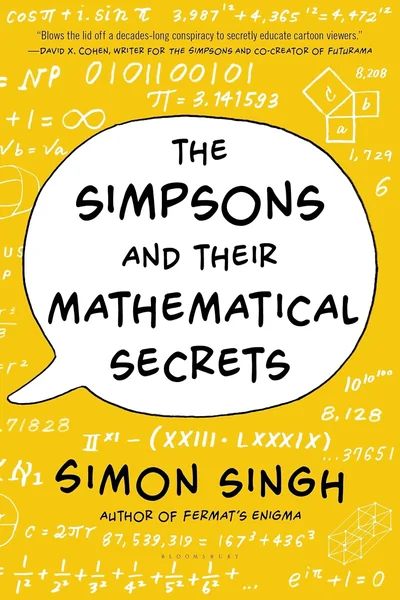
The Writer's Room Mathematical Conspiracy
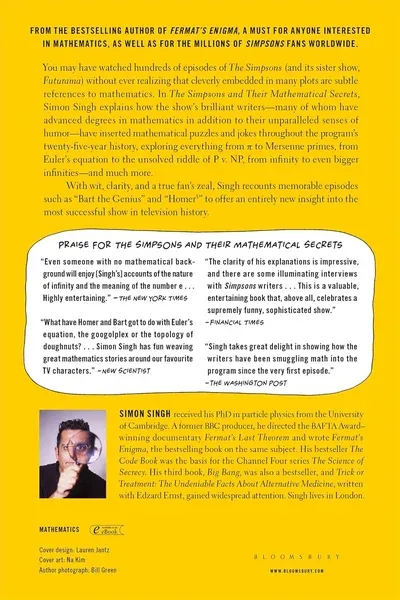
The book's central revelation lies in exposing the academic backgrounds of The Simpsons' writing staff. Singh demonstrates how former mathematicians, physicists, and computer scientists have infiltrated the show's creative team, using their positions to slip mathematical references past unsuspecting viewers. These aren't accidental inclusions but deliberate attempts to make mathematics more accessible through popular culture.
Singh's research uncovers the sophisticated mathematical jokes embedded in episodes, from simple visual gags involving equations scrawled on classroom blackboards to complex references that would challenge graduate students. The writing team's collective academic credentials read like a university mathematics department roster, explaining the show's unusually high mathematical literacy.
The author traces this mathematical influence through specific episodes, showing how concepts like infinity, prime numbers, and even advanced calculus have appeared disguised as throwaway jokes. For viewers who caught these references, the experience becomes multilayered entertainment that rewards mathematical knowledge.
Making Complex Concepts Digestible
Singh's strength lies in his ability to explain mathematical concepts without overwhelming general readers. When discussing topics like Fermat's Last Theorem or the properties of prime numbers, he provides sufficient context for understanding without requiring advanced mathematical training. The Simpsons references serve as entry points, making abstract concepts feel approachable.
However, the book occasionally struggles with its dual audience. Mathematical enthusiasts may find some explanations overly simplified, while general readers might still feel intimidated by certain sections. The challenge of serving both audiences simultaneously creates moments where the pacing feels uneven.
The author's enthusiasm for both mathematics and The Simpsons comes through clearly, making even dry theoretical discussions engaging. His explanations benefit from years of experience writing for popular science audiences, evident in his previous works on cryptography and physics.
Hidden Gems and Mathematical Easter Eggs
The book shines when revealing specific examples of mathematical content embedded in episodes. Singh catalogs instances where complex equations appear briefly on screen, often containing genuine mathematical significance rather than random symbols. These discoveries feel like archaeological finds, uncovering layers of meaning in familiar entertainment.
The most compelling sections explore how the show has tackled concepts like topology, statistics, and even advanced number theory through visual jokes and dialogue. Readers familiar with both the series and mathematical concepts will appreciate the detailed analysis of how these references function within the show's comedic framework.
Singh also examines Futurama, Matt Groening's other animated series, which contains even more sophisticated mathematical content due to its science fiction setting. The comparison highlights how different narrative contexts can accommodate varying levels of mathematical complexity.
Where Academic Meets Popular Culture
The book raises interesting questions about the role of education in entertainment media. Singh argues that The Simpsons represents a unique experiment in stealth education, introducing mathematical concepts to viewers who might otherwise avoid such topics. This approach challenges traditional boundaries between academic and popular culture.
The main weakness lies in the book's occasional tendency to overstate the significance of brief mathematical references. While the writers' academic backgrounds are genuine, not every equation or number that appears in the show necessarily carries deep mathematical meaning. Singh sometimes seems eager to find patterns where simple coincidence might explain certain instances.
The cultural analysis feels strongest when examining how mathematical literacy varies among the show's audience. Singh acknowledges that many references go unnoticed by general viewers while providing additional entertainment value for those with mathematical training.
Worth the Mathematical Journey
For readers interested in both mathematics and popular culture, this book offers a unique perspective on how complex concepts can infiltrate mainstream entertainment. Singh succeeds in making mathematical ideas accessible while respecting the intelligence of his audience.
The book works best as an entry point for readers curious about mathematics but intimidated by traditional academic approaches. Using familiar cultural references as teaching tools proves effective for explaining concepts that might otherwise seem abstract or irrelevant.
However, readers expecting deep mathematical instruction may find the coverage too broad and elementary. The book functions more as mathematical appreciation than mathematical education, inspiring interest rather than providing comprehensive understanding.
The bottom line: Singh delivers an entertaining exploration of an unexpected intersection between popular culture and academic mathematics. While not groundbreaking in either field, it successfully demonstrates how mathematical concepts can exist in surprising places, making it highly recommended for curious readers who enjoy discovering hidden depths in familiar entertainment.