

8 min read
4.4
· 39,536 Amazon ratingsShare This Review
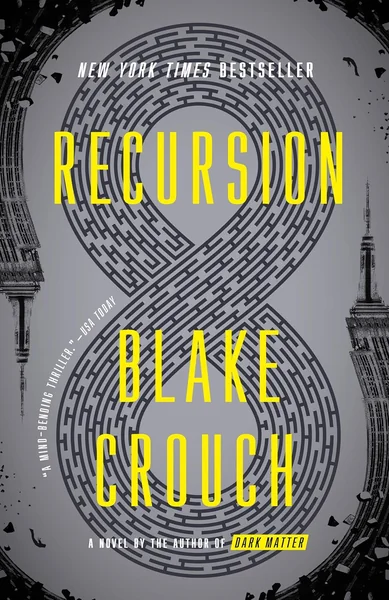
Recursion by Blake Crouch Review: A Propulsive, Philosophically Charged Sci-Fi Thriller
Blake Crouch's Recursion, published by Crown Publishing Group in June 2019, is a thriller science fiction novel that fuses breakneck pacing with genuine intellectual weight, earning starred praise from critical coverage and a spot in critical coverage as summer reading that resonates at an "anxious frequency."
LuvemBooks Verdict
Best for
Readers who want high-concept science fiction anchored in genuine emotional stakes — particularly those drawn to grief, memory, and identity explored through a tightly engineered thriller framework with a dual-protagonist structure.
Worth it if
You enjoy speculative fiction where the mechanics of the premise (here, a memory chair that enables time travel through death) are made emotionally consequential rather than merely clever, and where propulsive pacing is a feature rather than a flaw.
Skip if
You come to science fiction primarily for ruminative prose or deep world-building, as the novel's thriller-first architecture deliberately subordinates contemplative depth to relentless narrative momentum.
What readers & critics say
Kirkus Reviews awarded the novel a starred review, calling it "an exciting, thought-provoking mind-bender" and singling out its treatment of grief and memory as substantive thematic territory beneath the thriller surface. The New York Times Book Review, as quoted on nytimes.com, described Recursion as "a heady campfire tale of a novel built for summer reading," capturing both its accessibility and its darker undercurrent.
“An exciting, thought-provoking mind-bender — a machine designed to help people relive memories creates apocalyptic consequences.”
— Kirkus Reviews“A heady campfire tale of a novel built for summer reading.”
— nytimes.comAge & Reading Level
Recommended age
Adult
Reading level
Adult
2 content notes · who it suits
Content to know about
Skip if you prefer ruminative, world-building-focused science fiction over propulsive thriller pacing.
Recursion: A Novel by Blake Crouch is Trending
Blake Crouch Teases New Sci-Fi Books as Dark Matter Returns to Apple TV+
Blake Crouch just teased upcoming sci-fi projects alongside news of Dark Matter's Apple TV+ return, putting a spotlight on his whole catalog — including Recursion. If you haven't read it yet, now's a great time to catch up.
Blake Crouch is back in the conversation this week after teasing new sci-fi books ahead of Dark Matter's return to Apple TV+. That buzz naturally pulls readers toward everything else he's written — and Recursion is consistently the first place fans point newcomers after they finish Dark Matter.
Crouch has built a reputation for mind-bending, high-concept thrillers that actually deliver on their premises, and Recursion is widely considered his best work. It tackles memory, time, and identity in a way that feels both intellectually satisfying and genuinely hard to put down. When Crouch is in the news, readers who got hooked by the Dark Matter show tend to go looking for more — and Recursion is the obvious next read.
If you're one of the many people who discovered Crouch through Apple TV+ and want something to tide you over until his new projects arrive, Recursion is exactly where to start. It stands completely on its own, no prior Crouch knowledge required.
In This Review
- What Works & What Doesn't
- What the Novel Is and What It Does
- The Architecture of the Premise
- Critical Reception and Cultural Placement
- Thematic Depth and Genuine Limitations
- Who This Novel Is For
What Works & What Doesn't
What Works
- Dual-protagonist structure effectively balances emotional urgency (Barry's grief) with intellectual stakes (Helena's scientific and moral dilemma)
- Critical coverage, in a starred review, praised Crouch's ability to integrate sophisticated philosophical concepts into an engrossing plot without sacrificing accessibility
- The False Memory Syndrome conceit and the memory chair mechanics give the time-travel narrative a distinctive, coherent internal logic
- Kirkus Reviews recognized the novel's treatment of grief and memory as substantive thematic territory beneath the thriller surface
- Strong mainstream critical reception, including a New York Times notice that positioned it as both compulsively readable and culturally resonant
What Doesn't
- Prioritizes propulsive pacing over contemplative depth, a trade-off that may frustrate readers seeking more ruminative or world-building-focused science fiction
- The thriller-first architecture means some of the novel's philosophical concepts are subordinated to plot momentum rather than explored at length
What the Novel Is and What It Does
The Architecture of the Premise
Critical Reception and Cultural Placement
Thematic Depth and Genuine Limitations
Who This Novel Is For
Frequently Asked Questions
Sources & Further Reading
The key facts and claims in this review are grounded in the retrieved, verified sources listed below.
- Cited in this review
- 1
en.wikipedia.org
- 2
rizzolibookstore.com
- 3
barnesandnoble.com
- Further reading
- 4
Blake Crouch, Wikipedia
- 5
- 6
eustaciatan.com
- 7
shelfreflection.com
Related Reviews
Reviews of books we picked for readers who enjoyed Recursion.
Reader Comments
No comments yet
Be the first to share your thoughts!