Barrett's Revolutionary Theory of Constructed Emotion
Barrett's central thesis upends classical emotion theory. The traditional view—that we have basic, universal emotions like anger, fear, and joy hardwired into our brains—simply isn't supported by modern neuroscience. Instead, Barrett presents the theory of constructed emotion: our brains actively construct emotional experiences using prediction, past experiences, and cultural concepts.
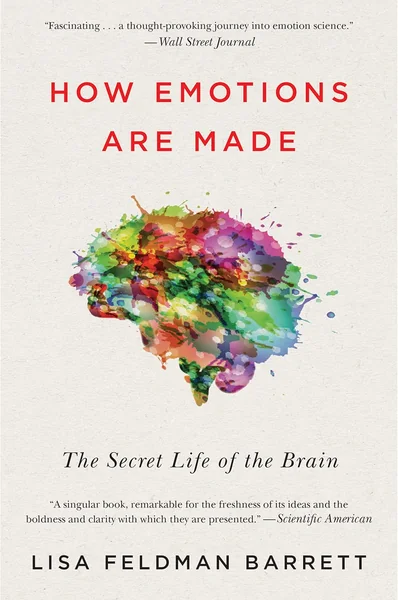
The book's cover, with its vibrant brain illustration, perfectly captures this complexity. Emotions aren't simple on/off switches but intricate neural networks constantly predicting and interpreting bodily sensations based on context and learning.
Barrett's argument is methodical and devastating to classical emotion theory. She demonstrates that no universal emotion circuits exist in the brain, that facial expressions aren't reliable indicators of internal states, and that what we call "emotions" are actually constructed categories our brains create to make sense of physical sensations.
Rigorous Science Made Accessible
Barrett's background as a distinguished professor of psychology at Northeastern University and her extensive research credentials shine through without overwhelming lay readers. Her writing strikes an ideal balance between scientific rigor and accessibility—complex neurological concepts become comprehensible without dumbing down the science.
The book progresses logically from debunking classical emotion theory to building Barrett's alternative framework. Each chapter builds methodically on the previous one, using compelling examples and analogies. Barrett's prose is precise yet engaging, avoiding both academic jargon and pop psychology oversimplification.
Research-backed strategies appear throughout, but this isn't a self-help manual. Barrett focuses on explaining how emotions work rather than prescribing what to do with that knowledge, though the implications for emotional regulation, mental health, and interpersonal relationships become clear.
Cultural Construction of Emotional Reality
One of Barrett's most fascinating arguments concerns emotion's cultural dimension. Different cultures don't just express emotions differently—they literally construct different emotional experiences. The book explores how language, social context, and cultural concepts shape the very emotions we can feel.
Barrett examines emotion words across cultures, showing how some languages have emotional concepts that don't translate directly into English, and vice versa. This isn't merely linguistic—these cultural differences reflect genuinely different emotional experiences constructed by different brains in different contexts.
The implications extend far beyond academic psychology. Barrett's framework explains why emotional intelligence training often fails, why some therapeutic approaches work better than others, and why cross-cultural emotional misunderstandings occur so frequently.
Where Traditional Emotion Science Goes Wrong
Barrett systematically dismantles the basic emotion theory that has dominated psychology for decades. She shows how researchers' expectations shaped their interpretations of brain scans, how facial expression studies failed to account for context, and how the search for universal emotions ignored crucial cultural variations.
The main weakness lies not in Barrett's critique but in the density of her scientific arguments. Readers expecting a light introduction to emotion science may find themselves overwhelmed by detailed discussions of neural networks, statistical analyses, and experimental methodology. The book demands active engagement and occasional re-reading of complex sections.
Barrett also sometimes undersells the practical applications of her theory. While she hints at implications for education, therapy, and personal development, she could have explored these connections more thoroughly without compromising scientific integrity.
Revolutionary Implications for Daily Life
The constructed emotion theory has profound practical implications. If emotions are constructed rather than triggered, we have more agency over our emotional experiences than previously thought. Barrett shows how understanding prediction and categorization can help people develop better emotional granularity and regulation skills.
The book challenges readers to reconsider fundamental assumptions about emotional authenticity, mental health diagnosis, and interpersonal relationships. Barrett's framework suggests that emotional intelligence isn't about reading universal signals but about understanding how different people construct different emotional realities.
For parents, educators, and mental health professionals, these insights could revolutionize approaches to emotional development and intervention. Barrett provides a scientific foundation for more nuanced, culturally sensitive approaches to emotional well-being.
A Paradigm Shift Worth Wrestling With
How Emotions Are Made represents a genuine paradigm shift in emotion science. Barrett's argument is compelling, well-researched, and potentially transformative for how we understand human experience. While the scientific density may challenge casual readers, the payoff is substantial: a fundamentally new understanding of what emotions are and how they work.
This book is essential reading for anyone interested in psychology, neuroscience, or human behavior. It's particularly valuable for mental health professionals, educators, and researchers who work with emotions professionally. General readers willing to engage with complex scientific arguments will find their understanding of themselves and others permanently altered.
The theory of constructed emotion isn't just academically interesting—it's personally liberating. Understanding that we actively construct our emotional experiences opens new possibilities for emotional growth and interpersonal understanding.