

BOOKS
Published

Read Time

8 min read

Reader rating

4.6

· 10,048 Amazon ratings
reader ratings, not a LuvemBooks score
Curated & edited by

LuvemBooks Editorial

How we create our reviews →
Share This Review

Reaper Man: Discworld, Book 11 by Terry Pratchett Review: A Profound, Funny Death's-Eye View

Reaper Man, originally published in 1991 as the eleventh novel in Terry Pratchett's beloved Discworld series, is a satirical fantasy that confronts mortality, bureaucracy, and the meaning of a life well-lived — all through the unlikely premise of Death being made redundant. The Audible audiobook edition, released by Transworld Digital in October 2022, features a trio of narrators — Sian Clifford, Peter Serafinowicz, and Bill Nighy — and runs just under nine hours. The Chicago Tribune called it "engaging, surreal satire... Nothing short of magical," and it remains one of the most celebrated entries in Pratchett's long-running series.

LuvemBooks Verdict

Best for

Readers who enjoy comic fantasy with genuine philosophical heft — particularly those curious about mortality, meaning, and bureaucratic absurdity — whether they're new to Discworld or returning fans eager to see Death at his most fully realised.

Worth it if

The premise of Death becoming a mortal farmhand and confronting his own finitude sounds like exactly the kind of tragicomic, ideas-driven fantasy you're after — especially if you want a Discworld entry that works as both a standalone and a series deepening.

Skip if

Those who find Pratchett's allusion-dense, layered humour requires more active engagement than they want from audio or light reading may feel the Discworld-wide chaos subplot stretches the novel's focus thin.

Critical and reader responses retrieved consistently position Reaper Man as a high-water mark in the series: douxreviews.com calls it "prime Pratchett," arguing the novel marks the beginning of Pratchett's "golden phase" in which "humor, life, and characters begin to synchronize" toward "moments of beautiful and meaningful clarity." Theturtlemoves.com notes it "solidifies the Death series" strand, highlighting Pratchett's skill at "balancing humor with sincere, thoughtful reflection," while fanfiaddict.com singles out his "ability to write underlying humour whilst weaving a story" as something that "always astounds."

Sources: Doux Reviews, The Turtle Moves, Fanfi Addict, eyrie.org, bookstooge.wordpress.com
4.6from 10,048 Amazon ratings— reader ratings, not a LuvemBooks score

Age & Reading Level

Recommended age

Adult

Reading level

Adult

Skip if you want a straightforward comic fantasy with a single propulsive plot rather than a dual-narrative structure that balances philosophical reflection with absurdist comedy.

In This Review
  • What Works & What Doesn't
  • What the Book Is and What It Does
  • Its Place in the Discworld Canon
  • Pratchett's Craft: Humor as a Vehicle for Depth
  • The 2022 Audiobook Edition
  • Who This Book Is For

What Works & What Doesn't

What Works
  • Death's character arc — from cosmic bureaucrat to mortal farmhand Bill Door — gives the novel genuine emotional weight alongside its comedy
  • Pratchett's dual-narrative structure keeps the pacing varied, balancing the philosophical with the absurd
  • The Chicago Tribune praised it as 'engaging, surreal satire... Nothing short of magical,' reflecting its strong critical standing
  • The 2022 Audible edition features a distinguished three-narrator cast including Sian Clifford, Peter Serafinowicz, and Bill Nighy across an unabridged runtime
  • Widely considered accessible to new Discworld readers while still rewarding long-time fans
What Doesn't
  • The dual-narrative structure, while ambitious, means some readers may find one storyline (particularly the Discworld-wide chaos subplot) less compelling than Death's central arc
  • Listeners new to Pratchett's dense, allusion-rich style — including the title's reference to Alex Cox's film *Repo Man* — may find the comedy requires active engagement rather than passive listening
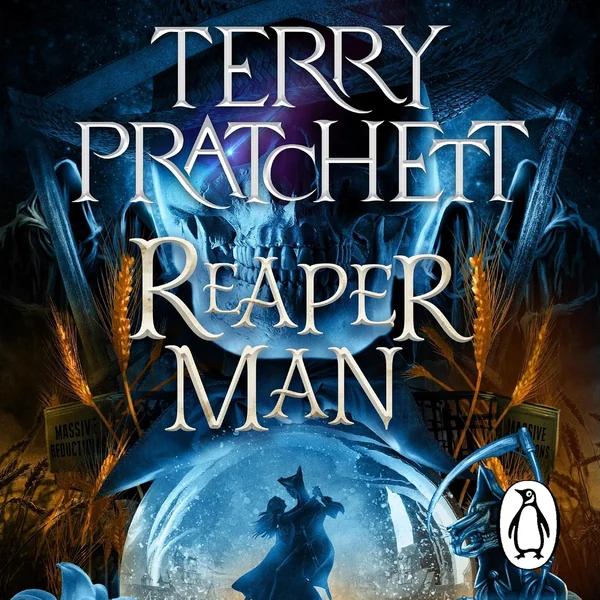
Reaper Man is one of the Discworld series' most emotionally resonant and philosophically ambitious entries — a novel that earns its laughs while asking questions few fantasy books dare to pose.
Reaper Man: Discworld, Book 11 by Terry Pratchett front cover

What the Book Is and What It Does

Reaper Man begins with an audacious premise: Death — the cosmic, scythe-bearing anthropomorphic personification of mortality — has been dismissed from his post by the Auditors of Reality, the formless bureaucratic entities who ensure the universe runs efficiently. With Death gone, the living stop dying, and chaos of an entirely practical sort descends on the Discworld. Ghosts and poltergeists accumulate without any mechanism to move them on. Dead Rights activist Reg Shoe — whose slogan, "You Don't Have to Take This Lying Down," captures Pratchett's wit at its sharpest — suddenly finds his cause overrun with more constituents than he ever anticipated. Meanwhile, Death himself is reborn into a mortal existence, taking the name Bill Door and living as a farmhand, learning what it means to have a finite number of heartbeats. The novel runs two distinct narrative threads — Death's rural, time-limited human experience and the supernatural pandemonium spreading across the Discworld — before weaving them back together.
TP was never going to miss twice in a row, and this book absolutely landed.

Its Place in the Discworld Canon

This is the second Discworld novel to place Death at its center, following Mort, and it represents a significant deepening of his characterization. Where Mort introduced the idea of Death as a figure with curiosity and dry humor, Reaper Man pushes further, presenting him as a being confronting his own finitude and questioning his purpose. As coverage on terrypratchettaudiobooks.com notes, Death "changes from being just Death to wanting to know his purpose," a shift that anchors the series' broader philosophical concerns about life and meaning. The title itself is a reference to Alex Cox's film Repo Man, a knowing nod typical of Pratchett's layered cultural playfulness. A fragment of the novel was also adapted in 1996 into a short animated film, Welcome to the Discworld, featuring Christopher Lee as Death — a testament to the character's cultural traction. Pratchett is described by the New York Times as a bestselling author, and this novel sits squarely among the series entries that exemplify why.

Pratchett's Craft: Humor as a Vehicle for Depth

What distinguishes Reaper Man from lighter comic fantasy is the way its humor serves genuine philosophical inquiry. Pratchett uses the novel to meditate on mortality, the meaning of life, and humanity's varied reactions to death, while also humorously critiquing bureaucratic impersonality — the Auditors of Reality standing in for every cold institutional force that treats people as units to be processed. The Chicago Tribune captured this dual register well, calling the book "engaging, surreal satire... Nothing short of magical." Commentary at fanfiaddict.com echoes that assessment, noting that Pratchett's "ability to write underlying humour whilst weaving a story always astounds," and singling out how he can make readers reflect even as they laugh. The Discworld's worldbuilding — with details like the Unseen University's orangutan librarian populating the background — provides the absurdist scaffolding that makes the novel's more earnest moments land without sentimentality.

The 2022 Audiobook Edition

The Transworld Digital audiobook, released October 27, 2022, brings an unusually strong cast to the production: Sian Clifford, Peter Serafinowicz, and Bill Nighy share narration duties across its eight hours and fifty-four minutes. A multi-narrator approach suits a novel with two parallel storylines and a wide ensemble, giving each thread a distinct vocal identity. The unabridged format ensures none of Pratchett's wordplay or structural detail is lost. For listeners who have come to the series through audio, the casting of Bill Nighy — whose measured, slightly otherworldly tone is well-suited to Pratchett's Discworld — makes this edition a particularly attractive entry point or revisit.

Who This Book Is For

Reaper Man is frequently cited as accessible to readers new to the Discworld, since Death's storyline requires no deep prior knowledge of the series. Equally, long-standing fans will find it rewards familiarity with the recurring universe and its established cast. Readers drawn to fantasy that uses genre conventions to explore genuinely serious themes — mortality, compassion, dignity, the cost of bureaucratic indifference — will find Pratchett's approach here unusually rich. Those who came to Mort and found it slightly uneven may be heartened: as one reader at fanfiaddict.com put it, "TP was never going to miss twice in a row, and this book absolutely landed." It is, in short, a novel designed to entertain broadly while leaving its readers with something worth sitting with.

Sources & Further Reading

The key facts and claims in this review are grounded in the retrieved, verified sources listed below.

  1. Cited in this review
  2. 1

    en.wikipedia.org

  3. 2
  4. Further reading
  5. 3

    Terry Pratchett, Wikipedia

  6. 4
  7. 5
  8. 6
  9. 7
  10. 8
  11. 9