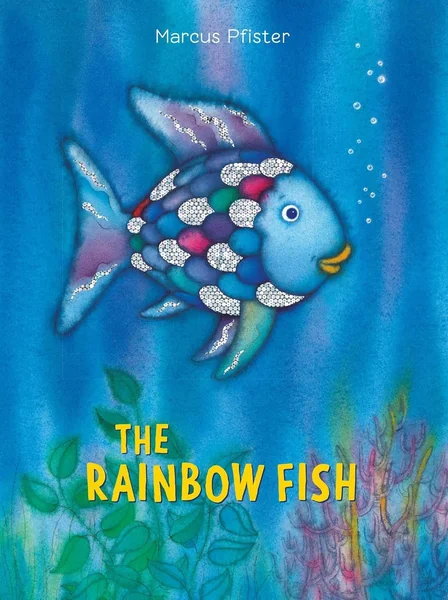
The story centers on Rainbow Fish, the most beautiful fish in the ocean, adorned with shimmering, multicolored scales. His beauty makes him proud and aloof, causing him to reject friendship with other fish who admire him. When the other sea creatures begin to avoid him, Rainbow Fish finds himself lonely and confused.
The narrative structure follows a classic arc of pride leading to isolation, followed by wisdom and redemption. A wise octopus advises Rainbow Fish that sharing his most precious possessions—his beautiful scales—will bring him the friendship he craves. Initially resistant, Rainbow Fish eventually gives away his scales one by one to other fish, discovering that generosity brings joy far greater than vanity ever could.
Pfister's storytelling is straightforward and purposeful, avoiding unnecessary complexity while delivering its message with emotional resonance. The pacing allows young readers to absorb both the visual spectacle and the moral lesson without feeling overwhelmed.
Visual Splendor Meets Meaningful Message
The book's most celebrated feature is undoubtedly its innovative use of holographic foil scales. These shimmering elements aren't merely decorative—they serve the story's central metaphor about sharing what makes us special. As Rainbow Fish gives away his scales, children can literally see his transformation from a solitary, gleaming fish to one surrounded by friends who now share in his beauty.
Pfister's underwater world feels alive and inviting, with soft blues and greens creating a peaceful oceanic setting. The contrast between Rainbow Fish's initial isolation—often depicted with empty space around him—and his later integration into a community of colorful fish provides a visual narrative that reinforces the text.
The tactile element cannot be overstated in terms of engaging young readers. Children naturally want to touch the shiny scales, making this a truly interactive reading experience that holds attention spans remarkably well.
Themes That Resonate Across Generations
The Rainbow Fish tackles complex social concepts in terms accessible to preschoolers and early elementary students. The primary theme of sharing versus selfishness forms the story's backbone, but Pfister weaves in additional lessons about loneliness, the nature of true beauty, and community belonging.
Unlike some children's books that present sharing as an unquestionable good, this story acknowledges the difficulty of giving up something precious. Rainbow Fish's initial reluctance feels authentic—most children can relate to not wanting to share their favorite toys or treats. The book's genius lies in showing how sharing multiplies rather than diminishes joy.
The wisdom figure of the octopus provides guidance without being preachy, offering advice that Rainbow Fish must choose to follow. This element of personal agency makes the moral lesson feel earned rather than imposed.
Where Critics and Parents Diverge
The Rainbow Fish has faced criticism from some educators and child development experts who argue that the fish is essentially rewarded for conformity and that his unique beauty is diminished rather than celebrated. Some interpret the story as suggesting that standing out is inherently problematic and that fitting in requires sacrificing what makes you special.
These critiques deserve consideration, particularly for parents raising children who may already feel different or special in ways that society doesn't always appreciate. The story could be interpreted as encouraging gifted children, for instance, to "dim their light" to make others more comfortable.
However, most young readers and parents find the message positive and age-appropriate. The emphasis on friendship, kindness, and community connection resonates strongly with families looking to instill values of empathy and generosity.
The book's execution occasionally feels heavy-handed, particularly in its resolution. The transformation happens relatively quickly, and some readers might wish for more nuanced exploration of Rainbow Fish's internal journey.
Perfect for the Right Age Group
The Rainbow Fish works best for children ages 3-8, hitting the sweet spot where the visual elements captivate while the themes align with developmental needs around sharing and friendship. Preschoolers enjoy the sensory experience and simple story structure, while early elementary students can engage more deeply with the moral complexities.
The book serves excellently as a conversation starter about friendship, sharing, and what makes us truly valuable. Parents and teachers often use it to address playground conflicts or discussions about material possessions versus relationships.
For bedtime reading, the book's length is ideal—substantial enough to feel like a complete story but not so long that it overwhelms tired children. The underwater setting and ultimate message of belonging create a soothing conclusion to the day.