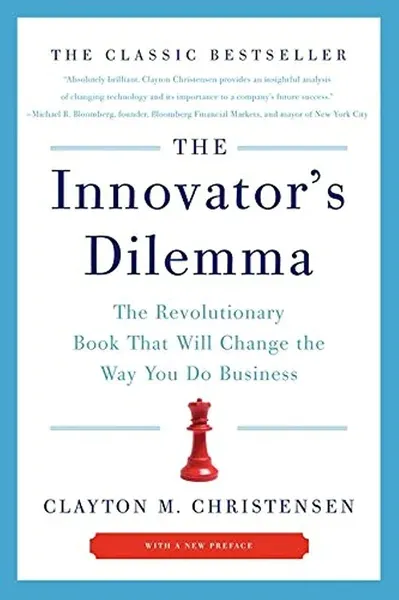
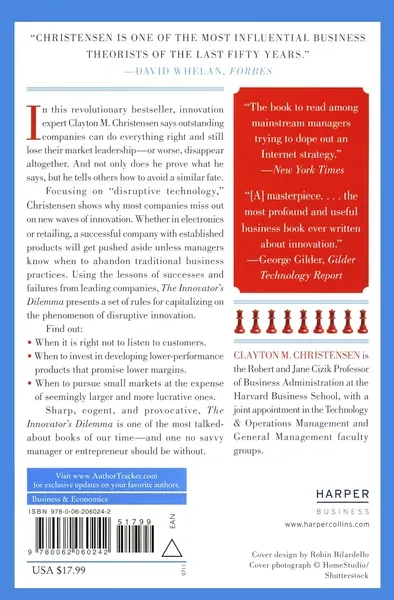
Is The Innovator's Dilemma still relevant in 2026? Nearly three decades after Clayton Christensen first published this groundbreaking work, his theory of disruptive innovation remains one of the most influential business concepts of our time. The book opens with Christensen's quest to solve "the puzzle of why the best firms can fail," a question that has only grown more urgent in our rapidly evolving digital landscape.
This isn't merely another business theory tome gathering dust on executive shelves. Christensen's framework explains why industry leaders from Kodak to Blockbuster stumbled despite having superior resources, talented management, and satisfied customers. For readers familiar with Good to Great or Built to Last, this book provides the missing piece: why excellence itself can become a trap.
The cover's chess piece imagery perfectly captures the strategic nature of Christensen's insights. Unlike books that offer quick fixes or motivational platitudes, The Innovator's Dilemma presents a rigorous analysis of how markets evolve and why conventional wisdom often leads successful companies astray.
Christensen's Revolutionary Framework
Christensen distinguishes between two types of technological change that reshape industries. Sustaining technologies improve existing products along dimensions that mainstream customers value—making hard drives faster, cars more fuel-efficient, or smartphones more powerful. Established companies excel at these improvements because they align with customer demands and profit margins.
Disruptive technologies, however, initially perform worse on traditional metrics but offer different advantages: simplicity, convenience, or affordability. The personal computer disrupted mainframes not by being more powerful, but by being accessible. Netflix disrupted Blockbuster not with better video quality, but with convenience that eliminated late fees and trips to the store.
The genius of Christensen's analysis lies in explaining why market leaders consistently miss these disruptions. It's not incompetence—it's the rational result of listening to customers, maximizing profits, and following established business practices. The best-managed companies fail precisely because they do everything right according to conventional wisdom.
This framework emerged from Christensen's exhaustive study of the disk drive industry, where he observed the same pattern recurring across multiple generations of technology. Each wave of disruption followed predictable stages, yet incumbent leaders repeatedly fell victim to the same dynamics.
Case Studies That Illuminate Business Reality
Rather than relying on anecdotal evidence, Christensen grounds his theory in detailed industry analysis spanning decades. The disk drive sector serves as his primary laboratory, where companies like Seagate and Western Digital navigated wave after wave of technological change. Some survived by recognizing disruption early; others vanished despite technical superiority.
The steel industry provides another compelling example. Minimills didn't challenge integrated steel producers by making better steel—they succeeded by serving market segments that established players ignored. Starting with construction rebar and other low-margin products, minimills gradually moved upmarket until they threatened the core business of their larger competitors.
These aren't abstract theories but documented business realities that continue playing out today. Consider how Tesla approached the automotive industry, starting with high-end sports cars before moving into mainstream markets. Or how Amazon began with books—a category established retailers dismissed—before expanding into everything else.
Christensen's methodology combines quantitative analysis with strategic insight. He doesn't just describe what happened but explains the underlying forces that made these outcomes inevitable. The research-backed approach distinguishes this from opinion-based business books that rely primarily on storytelling.
Where Theory Meets Practice
The book's most valuable contribution lies in transforming abstract concepts into actionable business intelligence. Christensen doesn't merely diagnose the problem of disruption—he provides frameworks for recognizing and responding to disruptive threats before they mature.
His concept of "value networks" helps managers understand why certain innovations appear unattractive. Each network defines its own performance metrics, customer relationships, and cost structures. What looks like inferior technology within one value network may represent the foundation of an entirely new market.
For entrepreneurs and innovation teams, these insights prove invaluable for timing market entry and positioning new products. Rather than competing directly with established players on traditional metrics, disruptive innovators succeed by redefining what customers value.
The practical applications extend beyond technology companies. Healthcare, education, and financial services all exhibit the patterns Christensen identifies. Understanding these dynamics helps leaders in any industry recognize when apparent weaknesses in new offerings actually signal disruptive potential.
However, implementing these insights requires careful judgment. Not every new technology qualifies as disruptive, and timing remains crucial. The book provides analytical tools but demands strategic thinking to apply them effectively.
Critical Limitations and Modern Context
Despite its enduring influence, The Innovator's Dilemma shows its age in certain areas. The examples primarily draw from manufacturing and technology sectors of the 1980s and 1990s, predating the internet economy that has accelerated disruption cycles dramatically.
The framework works best for explaining past disruptions rather than predicting future ones. While the patterns Christensen identifies remain relevant, their manifestation has evolved significantly. Platform businesses like Google and Facebook don't fit neatly into his categories, and software-driven disruption often moves faster than his model suggests.
Some critics argue that Christensen's definition of "disruption" has become diluted through overuse. Every new product or service gets labeled disruptive, whether or not it fits his specific criteria. This conceptual inflation has weakened the term's analytical precision.
The book also focuses heavily on technological disruption while giving less attention to business model innovation. Companies like Uber and Airbnb succeeded more through regulatory arbitrage and asset-light models than through superior technology.
Modern readers should view this as foundational theory rather than complete contemporary guidance. The core insights remain powerful, but they require updating for today's digital, platform-driven economy.
Who Should Read This Business Classic
The Innovator's Dilemma remains essential reading for anyone in leadership positions facing technological change. CEOs, product managers, and strategy consultants will find frameworks that illuminate competitive dynamics across industries.
Entrepreneurs can benefit from understanding how established companies create opportunities through their very success. Rather than trying to out-execute incumbents at their own game, smart startups identify the blind spots that disruption theory predicts.
MBA students and business faculty treat this as required reading because it fundamentally altered how we think about competitive advantage. Before Christensen, business strategy focused primarily on sustaining competitive advantages. His work revealed how advantages can become liabilities when markets shift.
The book demands serious engagement rather than casual reading. At nearly 300 pages of dense analysis, it requires patience and intellectual effort. Readers seeking quick tips or inspirational stories should look elsewhere.
Those working in rapidly changing industries—technology, media, healthcare—will find the most immediate applications. However, the underlying principles apply wherever established players face potential disruption from new market entrants.