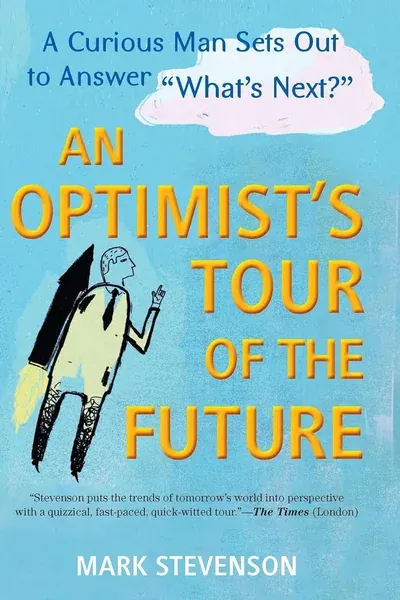
A Journalist's Quest Through Tomorrow's Laboratories
What sets this book apart from typical futurism is Stevenson's approach. He's not a tech insider or academic forecaster but a curious journalist willing to ask naive questions and admit when concepts fly over his head. This accessibility becomes the book's greatest strength. Complex topics like synthetic biology, artificial intelligence, and renewable energy systems get explained through conversations with the people actually building these technologies.
Stevenson structures his journey thematically rather than chronologically, exploring how various innovations might address food security, energy needs, environmental restoration, and human enhancement. His writing maintains a conversational tone that makes dense scientific concepts digestible without oversimplifying. Unlike most technology books that either worship at the altar of innovation or condemn it entirely, Stevenson maintains genuine curiosity about both possibilities and pitfalls.
The author's humor punctuates potentially dry technical discussions. His self-deprecating observations about struggling to understand quantum computing or feeling overwhelmed in genetics labs create connection with readers who might feel similarly intimidated by rapid technological change.
The Innovators and Visionaries
Rather than focusing on celebrity tech figures, Stevenson introduces readers to working scientists and engineers whose names rarely appear in headlines. He visits labs where researchers grow meat without animals, develop machines that can print human organs, and design systems to pull carbon dioxide from the atmosphere. These aren't fictional characters but real people solving real problems with remarkable ingenuity.
The book's strength lies in how Stevenson captures the personalities behind the innovations. A fusion researcher's passion for clean energy comes through as clearly as the technical details of their tokamak reactor. An artificial life scientist's philosophical questions about creating new forms of existence add depth beyond mere technological explanation.
However, the parade of innovators occasionally feels overwhelming. With so many different technologies and personalities to track, some important figures get less development than they deserve. The book sometimes reads more like a series of fascinating interviews than a cohesive narrative about our technological future.
Optimism Grounded in Reality
The main weakness of Stevenson's approach lies in his determined optimism. While refreshing after years of technological pessimism, his sunny outlook sometimes glosses over legitimate concerns about implementation, unintended consequences, and social disruption. He acknowledges these challenges but doesn't always grapple with their full implications.
For example, when discussing artificial intelligence, Stevenson explores fascinating research into machine consciousness but gives relatively little attention to potential job displacement or algorithmic bias. His section on genetic engineering highlights remarkable medical possibilities while spending less time on ethical complexities or regulatory challenges.
The book also shows its 2011 publication date. Some technologies Stevenson was excited about have stalled or proved more challenging than expected, while others he barely mentions—like smartphones and social media—have fundamentally reshaped society. This dating doesn't invalidate his core message about human agency in shaping the future, but it does highlight how quickly technological landscapes can shift.
Making Science Accessible and Engaging
Stevenson succeeds brilliantly at his primary goal: making complex science accessible to general readers. He translates technical jargon without condescending, uses analogies that illuminate rather than confuse, and maintains enthusiasm without losing critical thinking. For readers intimidated by science writing, this book serves as an excellent introduction to cutting-edge research across multiple fields.
The book works particularly well for readers curious about technology's potential but wary of both uncritical tech boosterism and reflexive pessimism. Stevenson's balanced approach—optimistic but not naive—offers a middle path between these extremes. He demonstrates that understanding emerging technologies empowers better decision-making about which futures we want to create.
Parents and educators will find the book valuable for sparking conversations about science careers and technological literacy. Stevenson's genuine curiosity and willingness to ask basic questions model healthy engagement with complex topics.
Worth Reading for the Right Audience
An Optimist's Tour of the Future works best for readers seeking an accessible introduction to emerging technologies rather than deep technical analysis. Science enthusiasts already familiar with these fields may find the explanations too basic, while readers seeking detailed implementation strategies might want more practical guidance.
The book's optimistic tone will appeal to readers exhausted by constant technological doom-and-gloom but may frustrate those who prefer more critical analysis of innovation's downsides. If you're curious about where technology might take us and appreciate journalistic storytelling over academic rigor, Stevenson delivers an engaging and informative tour.
Despite showing its age in some areas, the book's core message remains relevant: we shape the future through our choices, understanding, and engagement with emerging possibilities. In a time when technological change feels overwhelming and beyond individual influence, that's a genuinely hopeful perspective worth considering.