
In This Article
- What the Naked Capitalism Analysis Argues
- The Text and Its Strategic Pedigree
- Why This Analytical Lens Is Being Applied Now
- What Analysts Are Watching
Military strategists and political commentators are applying the principles of Sun Tzu's The Art of War to the ongoing Iran conflict, with a March 2026 analysis published by Naked Capitalism asking directly whether the ancient text can predict the conflict's outcome. The piece joins a cluster of commentary from analysts and writers examining how classical strategic doctrine maps onto a war being fought through proxies, missile forces, and economic leverage rather than decisive conventional battles.
What the Naked Capitalism Analysis Argues
The Naked Capitalism piece addresses the counterargument head-on, acknowledging that "some might argue that Sun Tzu's principles are outdated, given the radically different nature of modern warfare," before pushing back on that position. It also notes that Israel's apparent strategy has been to draw the United States directly into the conflict, on the assumption that American firepower would prove decisive — an approach the analysis judges, through a Sun Tzu lens, to have so far fallen short.
A separate commentary at SpencerGuard on Substack characterises Iran's posture as one built on "endurance, dispersion, and indirect power," relying on proxies, missile forces, economic coercion, and the capacity to impose costs over time — a framing that analysts in this body of commentary align closely with Sun Tzu's preference for attrition and positioning over direct confrontation.
An opinion piece at The Vibes goes further, arguing that Iran's reported seizure of control over the Strait of Hormuz — through which roughly one-fifth of global oil passes — represents "a classic Sun Tzu manoeuvre, winning without fighting any decisive battle," with the effect of spreading economic disruption internationally.
The Text and Its Strategic Pedigree
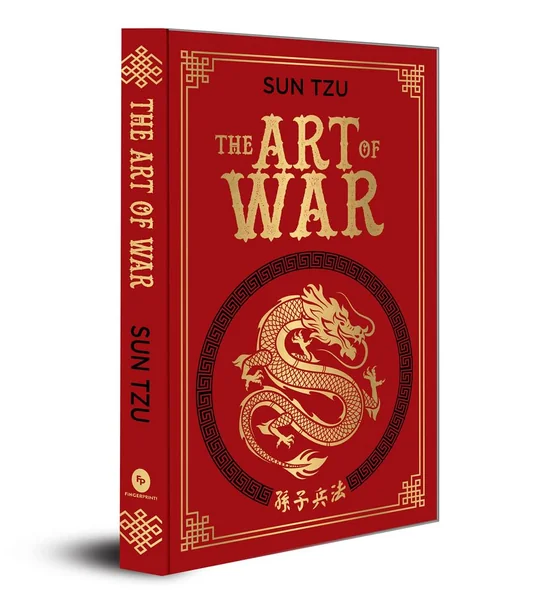
Wikipedia's entry on The Art of War describes the work as an ancient Chinese military treatise dating from the late Spring and Autumn period, roughly the 5th century BCE, composed of 13 chapters each addressing a distinct aspect of warfare, finance, and strategy. Attributed to the military strategist Sun Tzu, it portrays war as a costly last resort, arguing that prolonged conflict erodes the state more than the enemy can, and stresses the role of intelligence and espionage in both prosecuting and preventing war.
The text's reach into formal military institutions remains documented: Wikipedia notes that the United States Army's Command and General Staff College lists The Art of War as an example of a book recommended for military unit libraries. Among the historical figures cited as having drawn on the text are Mao Zedong, Vietnamese general Võ Nguyên Giáp, and American generals Douglas MacArthur and Norman Schwarzkopf Jr.
The first European translation appeared in 1772, when French Jesuit priest Jean Joseph Marie Amiot produced a French version; the first annotated English translation followed in 1910, by British scholar Lionel Giles.
Why This Analytical Lens Is Being Applied Now
The commentary applying Sun Tzu to Iran does not emerge in a vacuum. A piece by Peter Himmelman on Substack situates the conflict within a broader strategic picture, arguing that China does not need to direct events in the region to benefit from them — its doctrine, the piece contends, has long emphasised weakening adversaries indirectly, and a fragmented West is less capable of resisting Chinese influence. That framing treats Sun Tzu not merely as a lens for analysing Iranian strategy but as a description of the wider competitive environment in which the conflict is unfolding.
For those looking at The Art of War as a text rather than as a news story, LuvemBooks' full review of the book covers its content and significance in depth.
What Analysts Are Watching
The cluster of Sun Tzu-framed commentary converges on a few pressure points: whether the costs of prolonged engagement will prove more damaging to the parties drawing in external powers than to Iran itself; whether control of chokepoints like the Strait of Hormuz constitutes a durable form of strategic leverage; and whether the proxy-and-attrition model of conflict Iran has employed aligns more closely with Sun Tzu's prescriptions than the direct-force approach attributed to its opponents. None of the sources reviewed claim to resolve those questions — the Naked Capitalism analysis itself frames the Sun Tzu factors as significant but not necessarily decisive in isolation. The debate over which side's conduct most faithfully reflects the ancient text's logic — and whether that alignment translates into strategic advantage — is ongoing across the commentary examined here.
Frequently Asked Questions
Is The Art of War by Sun Tzu worth buying in 2026?
Yes, The Art of War remains highly relevant for anyone interested in strategic thinking, whether in business, politics, or personal development. Its principles of positioning, preparation, and competitive analysis continue to provide valuable insights across various fields.
What is the main message of The Art of War?
The core message is that the supreme excellence is to subdue the enemy without fighting. Sun Tzu emphasizes winning through superior strategy, intelligence, and positioning rather than direct confrontation, making victory as efficient and bloodless as possible.
Who should read The Art of War by Sun Tzu?
The book is ideal for business leaders, military professionals, political analysts, and anyone facing competitive situations. However, readers should be prepared for its compressed, aphoristic style that often requires additional interpretation to fully grasp the strategic concepts.
Should I read The Art of War or watch an adaptation?
Reading the original text is recommended as adaptations often lose the nuanced strategic thinking that makes Sun Tzu's work valuable. The book is relatively short but dense, requiring careful reading to appreciate its insights fully.
How is The Art of War relevant to modern conflicts?
Military analysts continue to apply Sun Tzu's principles to contemporary geopolitical situations, as seen in recent analyses of Middle Eastern conflicts. The text's emphasis on understanding opponents, terrain, and achieving objectives efficiently remains highly applicable to modern strategic thinking.
What are the main criticisms of The Art of War?
The primary criticism is its compressed, aphoristic writing style that offers principles without extensive elaboration. This can lead to oversimplification or misinterpretation of complex strategic concepts without additional commentary or study.

No Discussion Yet
Be the first to share your thoughts on this news article.