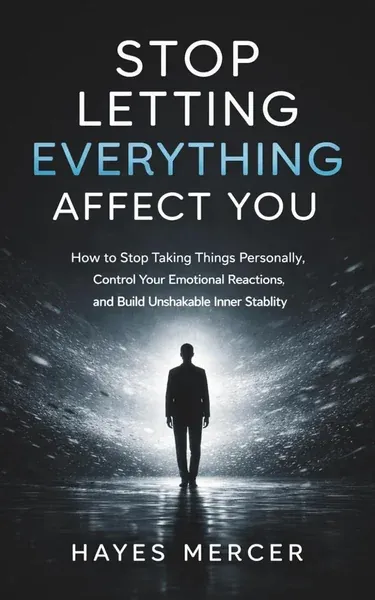
Stop Letting Everything Affect You by Hayes Mercer Review: A Direct, Tactical Self-Help Framework
Hayes Mercer's independently published self-help guide targets readers who find themselves routinely derailed by criticism, rejection, social silence, and everyday unpredictability — and promises a practical, tactical framework for interrupting emotional overreactions rather than simply urging readers to "think positive."
Tap to enlarge
LuvemBooks Verdict
Best for
Readers who repeatedly find themselves absorbing other people's behaviour — criticism, silence, mixed signals, rejection — and losing time, energy, and peace of mind to emotional overreaction, and who want a structured, scenario-specific intervention guide rather than broad motivational encouragement.
Worth it if
You recognise a concrete, recurring pattern of taking things personally or seeking external approval and want a direct, tactical framework organised around five specific emotional challenges you can work through at your own pace.
Skip if
You're looking for clinically grounded, credentials-backed psychological depth or academic research into emotional regulation — the independently published, action-first format is unlikely to satisfy that need.
Tackles five specific, concrete emotional challenges rather than offering abstract motivational advice
Designed to function as a practical, tactical framework readers can return to across different situations
Part of The Modern Mind Survival series, providing consistent thematic continuity for readers who engage with the broader collection
Publisher description explicitly positions it against vague self-help clichés, signaling a deliberate focus on actionable content
What Doesn't
Independently published without traditional editorial or peer-review vetting, which may concern readers seeking clinically grounded frameworks
The tactical, action-oriented approach is unlikely to satisfy readers seeking deep psychological research or clinical nuance on emotional regulation
A functional self-help guide designed to replace vague emotional advice with a direct, structured approach to inner stability — reviewed here on the basis of its stated content, design intent, and publisher description, not hands-on application.
What the Book Is and What It Sets Out to Do
Stop Letting Everything Affect You is a self-help paperback by Hayes Mercer, independently published and part of The Modern Mind Survival series. Its full subtitle maps its territory precisely: the book addresses how to stop taking things personally, control emotional reactions, and build what Mercer calls "unshakable inner stability." Rather than offering broad motivational encouragement, the publisher description frames it as a tactical resource — one designed to help readers interrupt emotional overreactions, establish clearer internal boundaries, and reduce dependence on external reassurance or approval. The book's scope spans the most common daily friction points: dismissiveness, criticism, social distance, mixed signals, rejection, and setbacks that would otherwise dictate a person's inner state.
“strips away vague advice and empty self-help clichés”
The Central Argument and Structure
The book's organizing premise is that emotional reactivity is a correctable pattern, not a fixed personality trait. According to the publisher's description, Mercer structures the content around five concrete outcomes: stopping the habit of personalizing other people's behavior, learning to respond with clarity rather than impulse, building internal boundaries that do not hinge on others' approval, protecting peace of mind when circumstances don't align with expectations, and developing the composure to remain steady under pressure. The publisher describes this as a "direct, tactical framework" — signaling that the book is organized around repeatable methods rather than inspirational narrative. This structure positions it as a workable reference guide rather than a cover-to-cover memoir or theory text.
What Distinguishes It from Generic Self-Help
The publisher description explicitly states that Mercer "strips away vague advice and empty self-help clichés" in favor of something more actionable. That positioning matters in a crowded genre where titles frequently recycle the same broadly worded guidance about mindset and gratitude. The book's five stated focus areas are specific enough to function as a practical checklist — readers can identify which of those pain points is most pressing and navigate accordingly. The inclusion of emotionally precise scenarios (silence, mixed signals, unpredictability) rather than abstract concepts suggests the content is designed to meet readers inside recognizable, real-life situations rather than at a theoretical remove. The Modern Mind Survival series context further indicates this is part of a sustained, thematically consistent body of work by Mercer rather than a standalone title.
Back cover with synopsis, key learning points, and barcode.
Genuine Limitations to Consider
Because Stop Letting Everything Affect You is independently published, it has not passed through a traditional editorial and peer-review pipeline, which means readers seeking credentials-backed psychological frameworks — the kind associated with licensed therapists or academic researchers — will not find that validation here. The book's self-described "tactical" approach also signals a pragmatic, action-oriented voice over a deeply exploratory or clinically nuanced one; readers who want extended exploration of the psychological research underlying emotional regulation may find the depth falls short of their expectations. The verified sources available at the time of this review do not include critical assessments from major trade publications, so the book's reception outside its retail listing and series context cannot be characterized here.
Who This Book Is Genuinely For
Stop Letting Everything Affect You is aimed squarely at readers who recognize a specific, recurring problem in their own lives: the tendency to absorb and react to other people's behavior in ways that cost them time, energy, and peace of mind. It is not pitched as a deep psychological excavation or a trauma-focused recovery text — it is designed as a direct intervention guide for emotional reactivity in everyday situations. Readers dealing with overthinking, approval-seeking, sensitivity to perceived criticism, or difficulty disengaging from toxic interpersonal patterns are the audience the publisher describes most directly. Those who already have a strong grounding in emotional intelligence literature and are looking for advanced clinical depth may find this entry-level in scope, but for readers encountering these ideas in a structured format for the first time, the book's focused, scenario-specific design is its clearest selling point.
Reader Comments
0
No comments yet
Be the first to share your thoughts!
Frequently Asked Questions
Who is this book best suited for?
Stop Letting Everything Affect You is aimed at readers who recognize a recurring problem in their own lives: the tendency to absorb and react to other people's behavior in ways that cost them time, energy, and peace of mind. The publisher specifically describes the target audience as those dealing with overthinking, approval-seeking, sensitivity to perceived criticism, or difficulty disengaging from toxic interpersonal patterns.
Is this book worth buying at the price?
For readers encountering these ideas in a structured format for the first time, the book's focused, scenario-specific design is its clearest selling point at that price point. Those who already have a strong grounding in emotional intelligence literature and are looking for advanced clinical depth may find the scope entry-level, making the value proposition more dependent on where the reader is starting from.
What is the central argument of the book?
The book's organizing premise is that emotional reactivity is a correctable pattern, not a fixed personality trait. Mercer structures the content around five concrete outcomes: stopping the habit of personalizing others' behavior, learning to respond with clarity rather than impulse, building internal boundaries, protecting peace of mind when circumstances don't align with expectations, and developing composure under pressure.
What are the five focus areas the book is structured around?
According to the publisher's description, the five concrete outcomes are: stopping the habit of personalizing other people's behavior, learning to respond with clarity rather than impulse, building internal boundaries that do not hinge on others' approval, protecting peace of mind when circumstances don't align with expectations, and developing the composure to remain steady under pressure.
How does this book differ from generic self-help titles?
The publisher description explicitly states that Mercer strips away vague advice and empty self-help clichés in favor of something more actionable. The book's inclusion of emotionally precise scenarios — such as silence, mixed signals, and unpredictability — rather than abstract concepts suggests the content is designed to meet readers inside recognizable, real-life situations rather than at a theoretical remove.
What kinds of everyday situations does the book address?
The book's scope spans the most common daily friction points, including dismissiveness, criticism, social distance, mixed signals, rejection, and setbacks that would otherwise dictate a person's inner state. These scenario-specific examples are described as a deliberate design choice to meet readers inside recognizable situations.
What is the book's tone and writing style like?
The book's self-described tactical approach signals a pragmatic, action-oriented voice over a deeply exploratory or clinically nuanced one. The publisher frames it as a direct, tactical framework organized around repeatable methods rather than inspirational narrative, positioning it as a workable reference guide rather than a cover-to-cover memoir or theory text.
Can this book be used as a reference guide rather than read cover to cover?
Yes, the review notes that the five stated focus areas are specific enough to function as a practical checklist, allowing readers to identify which pain points are most pressing and navigate accordingly. This structure positions the book as a workable reference guide rather than a cover-to-cover memoir or theory text.
Does the book draw on clinical psychology or peer-reviewed research?
Because the book is independently published, it has not passed through a traditional editorial and peer-review pipeline, meaning readers seeking credentials-backed psychological frameworks associated with licensed therapists or academic researchers will not find that validation here. Readers who want extended exploration of the psychological research underlying emotional regulation may find the depth falls short of their expectations.
What are the main limitations of this book?
The two key limitations identified in the review are its independent publishing status — which means it lacks traditional peer-review validation — and its pragmatic, action-oriented depth, which may not satisfy readers seeking clinical nuance or extended psychological research. Additionally, no critical assessments from major trade publications were available at the time of the review, so broader reception could not be characterized.
Sources & Further Reading
The key facts and claims in this review are grounded in the retrieved, verified sources listed below.

 Tap to enlarge



Reader Comments
No comments yet
Be the first to share your thoughts!