BOOKS
Published

Read Time

3 min read

Curated & edited by

LuvemBooks Editorial

How we create our reviews →
Share This Review

Master Your Emotions by Thibaut Meurisse Review: A Practical Self-Help Guide to Negativity

Master Your Emotions: A Practical Guide to Overcome Negativity by Thibaut Meurisse is a compact self-help workbook — the first in his seven-volume Mastery Series — designed to help readers identify, understand, and redirect negative emotions. With over 500,000 readers and an aggregate rating of 4.14 out of 5 across more than 18,000 reviews on Goodreads and Amazon, it has found a wide audience among those seeking structured, accessible guidance on emotional self-awareness.

LuvemBooks Verdict

Best for

Readers new to emotional self-awareness who want a short, structured, immediately actionable workbook for tackling persistent self-doubt, rumination, or resentment.

Worth it if

You want a low-barrier, step-by-step entry point into reframing negative emotions as informational signals rather than fixed personality traits — and you're comfortable with a slim, practically focused guide over a theoretically dense one.

Skip if

You already have a solid grounding in cognitive behavioural or mindfulness frameworks, or you need clinical depth, research citations, and extensive psychological theory behind the methods — at 84 pages, this isn't built for that.

What readers & critics say

Per sobrief.com, the book holds an average rating of 4.14/5 across more than 18,000 combined Goodreads and Amazon ratings, though the site characterises the overall reception as mixed — positive readers specifically praise its practical advice, exercises, and accessible writing style. Readers on amazon.co.uk similarly highlight the writing as well-crafted and empathetic, noting it avoids psychological jargon.

Sources: sobrief.com, amazon.co.uk, readersfavorite.com, heartsaysalot.com
In This Review
  • What Works & What Doesn't
  • What the Book Is and What It Sets Out to Do
  • The Book's Central Framework and Argument
  • Reception and Reach
  • Genuine Limitations and Who May Find It Thin
  • Who This Book Is Designed For

What Works & What Doesn't

What Works
  • Has reached over 500,000 readers, demonstrating unusually wide reach for an independently published self-help title
  • Holds an aggregate rating of 4.14/5 across more than 18,000 Goodreads and Amazon reviews, reflecting a strongly positive majority response
  • Reviewers on sobrief.com specifically praise the practical exercises and accessible writing style as strengths
  • Structured as a step-by-step workbook, making it a low-barrier entry point for readers new to emotional self-awareness
  • Positions negative emotions as informative signals rather than threats, offering a reframing designed to be actionable
What Doesn't
  • At 84 pages, the format may leave readers seeking deep psychological theory or clinical research citations wanting more substance
  • Reception is mixed per sobrief.com — despite the strong average, a notable portion of reviewers do not share the majority's enthusiasm
A compact but widely embraced entry in the self-help genre, Master Your Emotions has reached over 500,000 readers and holds an aggregate rating of 4.14/5 across more than 18,000 reviews on Goodreads and Amazon.

What the Book Is and What It Sets Out to Do

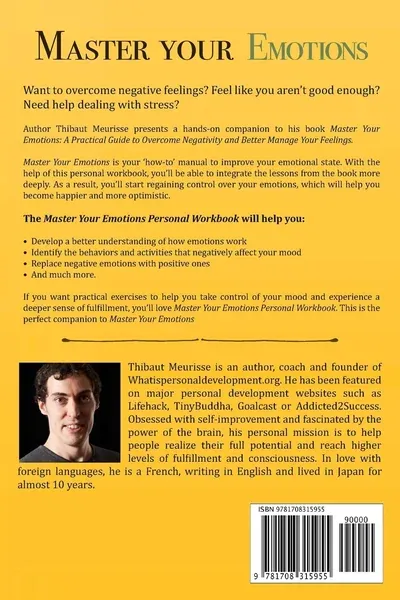
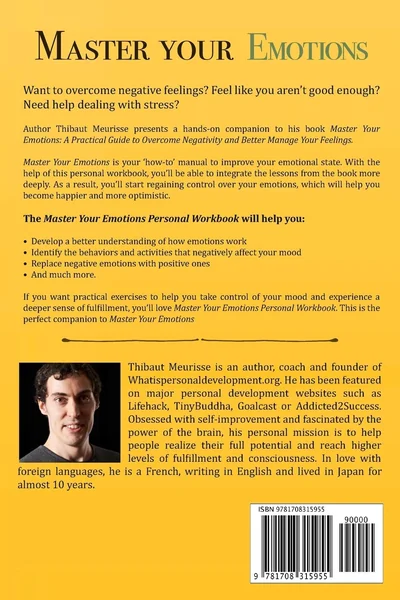
Back cover with synopsis, author bio, and barcode displaying emotional regulation workbook details.
Master Your Emotions: A Practical Guide to Overcome Negativity is a self-help workbook by French productivity and mindset author Thibaut Meurisse, independently published and positioned as the first title in his seven-volume Mastery Series. The book's central premise, as described in its own promotional copy, is that the solution to dealing with negative emotions lies in understanding how those emotions work — and that understanding is the prerequisite to reprogramming them. It opens by posing direct, relatable questions to its reader: Do you feel like you aren't good enough? Do you blame yourself for something you did in the past? Do you resent someone for what they did to you? These prompts frame the book's core argument: that emotions are not fixed features of a person's identity, and that recognizing them as separate from one's core self is the first step toward gaining objective power over them.

The Book's Central Framework and Argument

The guide's architecture is built around a step-by-step model. First, it asks readers to examine how negative feelings and emotions function — to think about their own thoughts and recognize whether they carry a bias toward the negative. From there, it moves into strategies for reprogramming those emotional patterns. According to summary sources, the book advances the idea that negative emotions are not enemies to be suppressed but informational signals: clues about inner issues that deserve attention and resolution. This reframing — from emotional avoidance to emotional investigation — is the through-line that runs across the workbook's chapters. The design intent is to give readers a repeatable process, not a one-time insight, which is consistent with the workbook format of the broader Mastery Series.

Reception and Reach

The book's reach is significant for an independently published title. The revised and expanded edition — noted in Barnes & Noble's listing as a version that builds on the original — has accumulated a readership that crosses into the hundreds of thousands, a substantial figure in the self-help category. The aggregate rating of 4.14/5 across more than 18,000 combined reviews reflects a strongly positive majority response. Per the review aggregator sobrief.com, positive readers single out the book's practical advice, included exercises, and accessible writing style as its primary strengths, crediting it with being genuinely useful for managing emotions and building self-awareness. That said, sobrief.com also characterizes the overall reception as mixed, meaning a meaningful portion of readers do not share that enthusiasm — a point worth weighing alongside the strong average score.

Genuine Limitations and Who May Find It Thin

The book's brevity — 84 pages in its independently published paperback edition — is both a feature and a potential friction point, depending on the reader. For those who want a fast, focused read they can act on immediately, the slim format suits the workbook's practical aims. For readers seeking deep psychological theory, clinical nuance, or extensive research citations behind the methods, the length and independent-publishing context mean this is not that kind of book. The mixed-review contingent documented by sobrief.com likely includes readers who arrived expecting more rigorous grounding or greater depth of coverage. It is worth noting that as Book 1 of 7 in the Mastery Series, the title is explicitly designed as an entry point — readers who want more from Meurisse's framework are pointed toward the series as a whole rather than finding everything within this single volume.

Who This Book Is Designed For

Master Your Emotions is most directly aimed at readers who are new to emotional self-awareness work and want a structured, low-barrier starting point. The step-by-step format, the direct conversational framing of its core questions, and the accessible writing style noted by reviewers all signal a book written for general readers rather than specialists. It suits someone dealing with persistent self-doubt, a tendency toward rumination, or difficulty moving past resentment — precisely the experiences the book's opening questions name. Readers who already have a strong grounding in cognitive behavioral frameworks or mindfulness literature may find the material familiar, while those encountering these ideas for the first time are the audience the book most clearly addresses.

Sources & Further Reading

The key facts and claims in this review are grounded in the retrieved, verified sources listed below.

  1. Cited in this review
  2. 1
  3. 2
  4. 3
  5. Further reading
  6. 4