BOOKS
Published

Read Time

8 min read

Reader rating

4.6

· 275 Amazon ratings
reader ratings, not a LuvemBooks score
Curated & edited by

LuvemBooks Editorial

How we create our reviews →
Share This Review

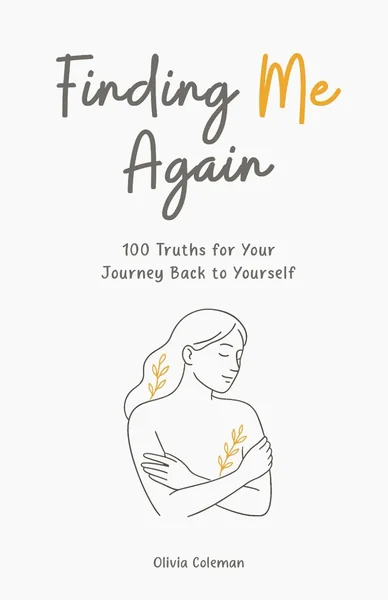
Finding Me Again by Olivia Coleman Review: A Compact Daily Reflection Companion

Finding Me Again: 100 Truths for Your Journey Back to Yourself by Olivia Coleman is an independently published collection of one hundred short reflections on burnout, self-neglect, and reclaiming your identity. At 105 pages it is built for one-page-a-day reading — a gentle companion for readers who feel lost, not a structured therapeutic program.
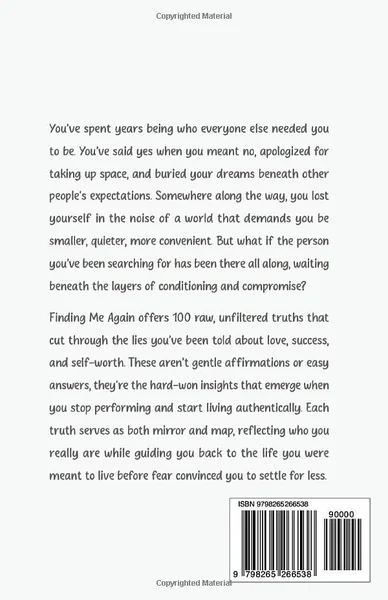
Back cover with synopsis text and barcode.Tap to enlarge

LuvemBooks Verdict

Best for

A reader in the thick of burnout — depleted from giving to work, family, and the world — who wants a gentle one-page-a-day prompt back toward themselves, or someone looking for that exact book to gift.

Worth it if

Worth it if a low-demand format is exactly the point: one self-contained page a day, readable in any order, as an inexpensive and portable entry point into self-reflection.

Skip if

Skip it if you want depth — psychological frameworks, exercises, case studies, or a structured program — or if you need clinical support for depression, trauma, or crisis rather than a reflective companion.

Formal critical coverage is essentially absent for this independently published title; its reception is reader-driven. Screenwiseapp.com's commentary notes that despite Teen & Young Adult marketing, its burnout and self-discovery themes land for adults too, while customer reviews on Amazon.co.uk's listing are warm, crediting it with prompting genuine self-examination.

Sources: Screenwiseapp.com, Amazon.co.uk
4.6from 275 Amazon ratings— reader ratings, not a LuvemBooks score
Buy on Amazon

Age & Reading Level

Recommended age

Ages 12–18

Reading level

Young adult

Content to know about

burnout and emotional depletion
self-neglect and loss of identity

Best for: Ages 12+ — short, accessible reflections whose ideas about burnout, self-neglect, and identity are most relevant to teens and adults.

Skip if Skip it if you want a structured therapeutic program with exercises, psychological frameworks, or clinical guidance.

In This Review
  • What Works & What Doesn't
  • What the Book Is
  • Scope of This Review
  • Format and Design Intent
  • Early Reader Reception
  • Who It's For — and Who It Isn't

What Works & What Doesn't

What Works
  • A clear, low-demand format: 100 self-contained one-page truths that can be read in any order, one at a time.
  • Compact, portable paperback (5.5 x 8.5 inches, 5.6 ounces) matched to its daily-companion design.
  • Early customer reviews are positive, with readers crediting it for prompting genuine self-examination and repeat reading.
  • Directly addresses burnout and self-neglect — the experience of giving everything to others and losing yourself — in an accessible, gentle register.
  • Themes resonate beyond its Teen & Young Adult marketing, per reader commentary, making it suitable for adults as well.
What Doesn't
  • At roughly a page per entry, the truths are prompts rather than deep explorations — readers wanting frameworks, exercises, or a structured program will find it thin.
  • It is a reflective companion, not a clinical resource — not a substitute for professional support or substantive therapeutic literature.
  • Reception so far rests on a small number of customer reviews rather than any established critical record.
Finding Me Again is a short, affirmational self-help book best suited to readers who want brief daily reflections on burnout and self-reclamation rather than a structured therapeutic program.

What the Book Is

Finding Me Again: 100 Truths for Your Journey Back to Yourself by Olivia Coleman is a collection of one hundred short reflective passages, independently published in paperback on September 16, 2025. The publisher's synopsis frames the book around a recognizable experience: giving so much to work, family, and the world that a person loses track of themselves — smiling, showing up, carrying the weight, while feeling lost inside. The hundred entries are described as "powerful truths, gentle reminders, raw insights, and soul-stirring reflections," each aimed at helping the reader reclaim their voice, strength, and sense of self. At 105 pages, the math is simple: each truth occupies roughly a page, making this a book of single-sitting readings rather than chapters.
powerful truths, gentle reminders, raw insights, and soul-stirring reflections
It belongs squarely to the affirmation-and-reflection tradition of self-help — the shelf of compact, giftable volumes meant to be opened at random or read one entry a day — rather than to the research-driven or workbook end of the genre. The synopsis positions it as an "invitation to return home" and a starting point for readers "longing for healing, clarity, and the courage to begin again."

Scope of This Review

This is a functional book: its value lies in whether its reflections actually land for the person reading them, and that is something an editorial desk cannot test on a reader's behalf. What follows is therefore an account of what the book contains and how it is designed, based on the publisher's description and early reader responses from retail listings — not a hands-on assessment of its effect. Readers should treat it accordingly: the question of whether a given "truth" moves them is one only they can answer, and the most useful thing a review can do is describe the container honestly.

Format and Design Intent

The book's structure is its clearest feature. One hundred self-contained entries means there is no required order, no building argument, and no homework — a reader can open it anywhere. The synopsis itself makes this pitch explicitly, describing it as "the kind of book you don't just read once," but a companion to reach for "in quiet moments and chaotic days alike." That is a deliberate design choice with real consequences. For someone in the thick of burnout — the book's stated audience — a low-demand format is the point: no long chapters to push through, no program to keep up with, just a page at a time.
The physical edition supports that use. It is a compact paperback, 5.5 by 8.5 inches and 5.6 ounces, small enough to keep on a nightstand or carry in a bag. Whether the writing inside earns that daily-companion role is a matter of individual response, but the format is thoughtfully matched to the purpose the publisher claims for it.
Back cover with synopsis text and barcode.

Early Reader Reception

Formal critical coverage has not been the channel for this book; its reception to date is reader-driven, through customer reviews on retail sites. The early responses available are warm. One Amazon UK reviewer called it "a great little book" that "made me stop and look at myself," adding that they expect to keep referencing it for years. Another described it as a book that builds awareness of how to find yourself, with "great truths" that helped them immensely. These are a small number of early customer reviews rather than a broad critical record, but they are consistent in what they praise: the book prompts pause and self-examination, and readers treat it as something to return to rather than finish and shelve.
One piece of reader commentary also notes that while the book has been marketed toward a Teen & Young Adult audience, its themes of burnout and self-discovery are pitched as relevant to adults well beyond that bracket — an observation that tracks with the synopsis, which addresses anyone who has "given so much to the world."

Who It's For — and Who It Isn't

The honest limitation is built into the format. At roughly a page per entry, the truths are prompts for reflection, not explorations. A reader working through grief, burnout, or identity questions who wants depth — case studies, psychological frameworks, exercises, or a sustained argument — will find this book shallow by design. It offers reminders rather than methods. It is also a reflective companion, not a clinical resource; readers dealing with depression, trauma, or crisis should look to professional support and more substantive therapeutic literature, using a book like this, at most, as a supplement.
For the right reader, though, the brevity is the feature. Someone who feels depleted and unseen, who wants a page each morning that names what they are carrying and nudges them back toward themselves, is exactly who the synopsis addresses. As an inexpensive, portable, low-pressure entry point into self-reflection — or a gift for someone in that place — Finding Me Again is built precisely for its stated purpose.

Sources & Further Reading

The key facts and claims in this review are grounded in the retrieved, verified sources listed below.

  1. Cited in this review
  2. 1
  3. 2
  4. 3
  5. Further reading
  6. 4
  7. 5
  8. 6
  9. 7