BOOKS
Published

Read Time

8 min read

Reader rating

4.6

· 18,051 Amazon ratings
reader ratings, not a LuvemBooks score
Curated & edited by

LuvemBooks Editorial

How we create our reviews →
Share This Review

Think Again by Adam Grant Review: A Persuasive Case for Intellectual Humility

Adam Grant's Think Again (Penguin Books paperback, 2023) argues that rethinking and unlearning matter more than raw intelligence, mixing psychology research with stories of debate champions, vaccine persuaders, and a musician who turns white supremacists away from hate. A #1 New York Times bestseller, it's a polished synthesis rather than new ground.

LuvemBooks Verdict

Best for

Managers, educators, and anyone whose work runs on persuasion or group decisions — plus general readers who want a structured, Gladwell-style prompt to audit their own convictions and argue more productively.

Worth it if

Worth reading if you want a memorable, actionable framework — scientist mode versus preacher, prosecutor, and politician — for catching your own certainty and changing other people's minds, and you're willing to actually apply the techniques.

Skip if

Skip it if you already follow the psychology of reasoning closely or want methodological rigor — the motivated-reasoning and intellectual-humility material here is a skilled repackaging of familiar research, carried by anecdotes rather than academic depth.

Critical response was broadly warm but not uncritical: Kirkus Reviews found Grant's synthesis engaging while noting he "breaks little" new ground and flagging that activist readers may push back on some persuasion case studies, and Penguin Random House's page relays Newsweek naming it among its favorite books of 2021 and the Financial Times calling it "a refreshing mandate for humble open-mindedness." Reader-side reviewers were more effusive — QRCA Views praised its "refreshing look" at avoiding confirmation bias, and bloggers at Forward Fitness STL and Kerry Siggins reported loving it and immediately applying its conflict-resolution advice.

Grant breaks little new ground, and activist readers involved in anti-racism work will likely disagree with parts of his approach.

Kirkus Reviews
Sources: Kirkus Reviews, QRCA Views, Bookmarks, Forward Fitness STL, Kerry Siggins, Penguin Random House
4.6from 18,051 Amazon ratings— reader ratings, not a LuvemBooks score
Buy on Amazon

Age & Reading Level

Recommended age

Adult

Reading level

Adult

Content to know about

discussion of white supremacist hate groups (in the context of Daryl Davis persuading members to leave)
vaccine hesitancy and persuasion

Skip if you want a rigorous, citation-dense academic treatment of cognitive bias rather than an anecdote-driven popular-science read.

Trending Now
Trending

Think Again: The Power of Knowing What You Don't Know by Adam Grant is Trending

Updated Sep 19, 2026
In This Review
  • What Works & What Doesn't
  • What the Book Argues
  • The Evidence: Storytelling Over Theory
  • Reception and Standing
  • Where It May Frustrate
  • Who It's For

What Works & What Doesn't

What Works
  • Clear three-part arc: rethink your own views, open other people's minds, build learning communities
  • Memorable frameworks, including preacher/prosecutor/politician modes versus 'scientist mode'
  • Vivid real-world case studies, from a debate champion to Daryl Davis persuading white supremacists to leave hate groups
  • A #1 New York Times bestseller named a best nonfiction book of 2021 by The Washington Post
  • Practical persuasion techniques such as motivational interviewing and question-led dialogue
What Doesn't
  • Core ideas about motivated reasoning and intellectual humility are a synthesis of familiar psychology rather than new research
  • Anecdote-driven popular-science register may frustrate readers seeking academic depth
  • Its practical value depends on the reader applying its techniques — something this review has not tested
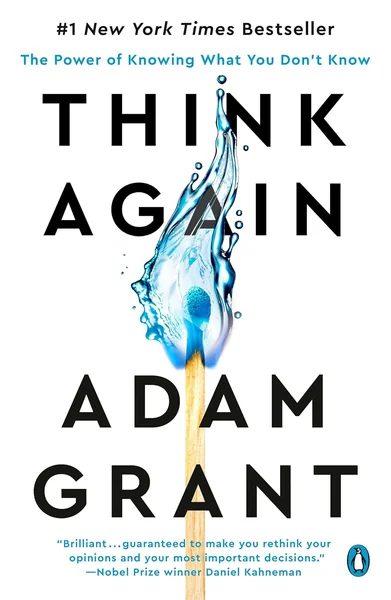
Think Again is a well-structured, widely praised argument for treating your own opinions as hypotheses — persuasive in its framing and rich in real-world examples, even if its core message is more a skillful synthesis than a revelation.
Think Again: The Power of Knowing What You Don't Know by Adam Grant front cover

What the Book Argues

Adam Grant, an organizational psychologist at Wharton and the bestselling author of Give and Take, Originals, and Hidden Potential, opens Think Again with a counterintuitive premise: in a rapidly changing world, intelligence as conventionally defined — the ability to think and learn — may matter less than the ability to rethink and unlearn. The book's central argument is that people fall into habitual modes of defending what they already believe: preaching to protect their own views, prosecuting to attack other people's reasoning, and politicking to campaign for support. Against these, Grant sets what he calls "scientist mode" — treating opinions as experiments to be tested, actively seeking out reasons you might be wrong, and updating when the evidence shifts.
we don't have to believe everything we think or internalize everything we feel
The book is organized around three escalating challenges, as outlined in summaries of its structure: first, opening your own mind; second, persuading other people to think again; third, building communities — workplaces, schools, relationships — in which lifelong learning and productive disagreement are the norm rather than the exception. That architecture gives the book a clear arc from individual habit to collective culture, and it means the later chapters are less about self-correction than about how arguments, negotiations, and institutions can be designed to reward rethinking.

The Evidence: Storytelling Over Theory

Grant's method throughout is to anchor each idea in research from psychology and then dramatize it through an extended real-world case. The publisher's synopsis names the marquee examples directly: an international debate champion who wins arguments by conceding ground strategically; Daryl Davis, the Black musician who has persuaded white supremacists to abandon hate; a "vaccine whisperer" who convinces hesitant parents to immunize their children; and Grant's own efforts to coax Yankees fans into rooting for the Red Sox. These stories carry the book's practical payload — techniques like motivational interviewing, finding common ground before contesting it, and asking questions rather than making assertions.
The through-line, per the publisher's framing, is that "we don't have to believe everything we think or internalize everything we feel" — that mental flexibility, humility, and curiosity beat "foolish consistency." Readers who enjoy Malcolm Gladwell-style narrative nonfiction will recognize the register: counterintuitive findings, memorable characters, and frameworks compact enough to repeat in a meeting. That is the book's design, and it executes it deliberately.

Reception and Standing

Think Again arrived with substantial institutional momentum. It was a #1 New York Times bestseller, and critics named it a best nonfiction book of 2021, the year of its original publication. The publisher's materials quote the Financial Times calling it "a refreshing mandate for humble open-mindedness" and carry endorsements from figures including Brené Brown, who describes Grant weaving together research and storytelling to build "the intellectual and emotional muscle" for staying curious. This edition is the Penguin Books paperback, published December 26, 2023, following the 2021 hardcover.
Within Grant's body of work, the book occupies a natural slot: where Give and Take examined generosity and Originals examined nonconformity, Think Again examines cognitive flexibility — arguably the most inward-facing of his major titles, since its first target is the reader's own certainty rather than other people's behavior.

Where It May Frustrate

The book's strengths and limitations come from the same source. Because Grant writes for a general audience, the argument is carried by anecdotes and digestible studies rather than deep engagement with the underlying academic literature; readers who want methodological rigor, or who already follow the psychology of reasoning closely, will find much of the territory familiar. The preacher-prosecutor-politician-versus-scientist framework is memorable, but it is also a repackaging of ideas about motivated reasoning and intellectual humility that have circulated for years — the value here is in the packaging and application, not conceptual novelty.
It is also worth stating this review's scope plainly: Think Again is, functionally, a how-to book, and its real test is whether its techniques change how a reader argues, hires, or decides. This review is based on the published record — the book's stated contents and its documented reception — not on applying its methods in practice.

Who It's For

Think Again suits managers, educators, and anyone whose work involves persuasion or group decision-making, as well as general readers who want a structured prompt to audit their own convictions. It reads quickly, its advice is framed to be acted on, and its central provocation — that knowing what you don't know is a form of wisdom — lands with particular force in a polarized moment. Readers seeking a rigorous scholarly treatment of cognitive bias should look elsewhere; readers seeking an engaging, research-grounded brief for changing their minds more often will find exactly that here.

Sources & Further Reading

The key facts and claims in this review are grounded in the retrieved, verified sources listed below.

  1. Cited in this review
  2. 1
  3. 2
  4. 3
  5. Further reading
  6. 4
  7. 5
  8. 6
  9. 7
  10. 8
  11. 9
  12. 10
  13. 11
  14. 12