BOOKS
Published

Read Time

3 min read

Reader rating

4.8

· 37 Amazon ratings
reader ratings, not a LuvemBooks score
Curated & edited by

LuvemBooks Editorial

How we create our reviews →
Share This Review

101 Reasons Women Get Better With Age by Jeanne Phares Review: A Spirited Celebration of Female Aging

Jeanne Phares's 101 Reasons Women Get Better With Age: And Why We Finally Don't Give a Damn is a punchy, list-driven nonfiction work that pushes back against the cultural narrative that aging diminishes women, offering instead 101 distinct reasons why growing older is a source of freedom, wisdom, and self-possession.

LuvemBooks Verdict

Best for

Women approaching or moving through midlife who want a brisk, affirming counterpoint to cultural narratives about aging as decline — and anyone looking for a good-humoured gift book whose purpose is immediately legible from its title.

Worth it if

You want an accessible, mood-lifting read that reframes midlife as liberation rather than loss, and are happy to engage with 101 short, self-contained entries rather than a single sustained argument.

Skip if

You're looking for a work that rigorously interrogates aging's real difficulties — physical, economic, or social — or that builds a sustained narrative arc with reported research and extended analysis; the 131-page, list-driven format isn't designed for that depth.

No dedicated critical reviews of this title were among the retrieved sources. Bargainbooksy describes the book as celebrating "101 reasons why women over 40 are finally free to stop performing, start living, and never apologize for it" with "laugh-out-loud humor and hard-won wisdom," reflecting the book's own promotional framing rather than independent critique.

Sources: Bargainbooksy
4.8from 37 Amazon ratings— reader ratings, not a LuvemBooks score
In This Review
  • What Works & What Doesn't
  • What the Book Actually Is
  • The Central Argument and Its Cultural Context
  • Strengths: Scope, Tone, and Accessibility
  • Genuine Limitations and Who May Be Frustrated
  • Who This Book Is For and How It Reads Today

What Works & What Doesn't

What Works
  • Clear, affirmative thesis that directly challenges cultural narratives about women's decline with age
  • Numbered 101-entry structure keeps the pacing varied and allows readers to engage in short sessions or all at once
  • Accessible, brisk format at 131 pages makes it a low-barrier entry point into the subject
  • Arrives at a culturally relevant moment when conversations about women's visibility and aging are actively expanding
  • Well-suited as a gift book, with a title that immediately communicates its purpose and audience
What Doesn't
  • The list-driven format necessarily limits how deeply any individual reason can be explored or substantiated
  • Readers seeking a sustained narrative arc or rigorous engagement with aging's real challenges may find the episodic structure insufficient
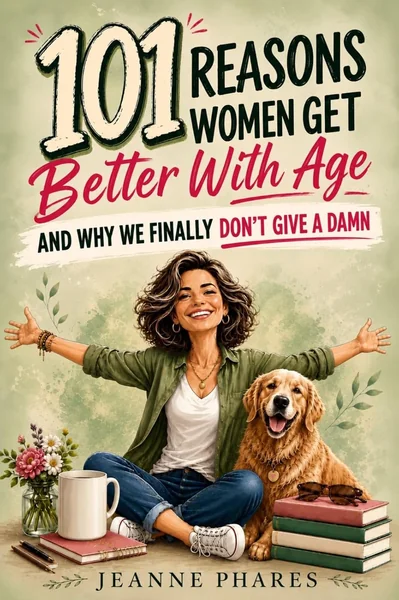
A compact nonfiction work that turns conventional wisdom about women and aging squarely on its head, Jeanne Phares's book makes its thesis plain from the first word of its title.
101 Reasons Women Get Better With Age: And Why We Finally Don't Give a Damn by Jeanne Phares front cover

What the Book Actually Is

101 Reasons Women Get Better With Age is a nonfiction celebration structured around its central conceit: 101 discrete reasons why women flourish as they grow older, paired with the subtitle's assertion — And Why We Finally Don't Give a Damn — that liberation from others' expectations is itself one of aging's great rewards. The book is not a memoir, a self-help manual with worksheets, or a clinical wellness guide. It is a deliberately accessible, affirming read organized around a numbered framework, designed to be encountered in short bursts or straight through. At 131 pages in its Kindle edition, the format keeps the pace brisk and each entry self-contained.

The Central Argument and Its Cultural Context

The book's animating premise — that midlife and beyond represent a gain rather than a loss for women — sits within a broader cultural conversation that has gained genuine momentum in recent years. Psychologists and researchers have noted that many women report discovering greater authenticity and freedom from insecurity as they move out of their twenties and thirties. Phares channels that same current, translating it into an enumerated, conversational form meant to feel less like a lecture and more like a knowing exchange between women who have been through it. The "don't give a damn" framing is pointed: it positions the erosion of self-consciousness not as resignation but as hard-won confidence, a reframing that sits at the heart of the book's argument.

Strengths: Scope, Tone, and Accessibility

The numbered format is the book's most deliberate structural choice, and it serves the premise well. By committing to 101 distinct reasons rather than a handful of extended chapters, Phares keeps the material varied and prevents any single theme from overstaying its welcome. The wide range implied by that count — touching on wisdom, relationships, self-knowledge, freedom from approval-seeking, and the body itself — allows the book to function as both a quick mood-lifter and a cumulative argument. The Kindle edition supports enhanced typesetting and Word Wise, reflecting a production designed for comfortable digital reading, and the file size keeps it lightweight for any device. For readers who have grown tired of aging narratives that center loss, the book's insistently affirmative stance is the core offering.

Genuine Limitations and Who May Be Frustrated

The book's greatest strength is inseparable from its primary limitation: the list-driven, relatively short format that makes it breezy and accessible also means that individual entries cannot go deep. Readers seeking sustained analysis, reported research, or the kind of narrative arc that builds toward a larger reckoning may find the episodic structure unsatisfying. The 131-page count places a hard ceiling on how much any single "reason" can be examined, and a book structured as an enumerated celebration is, by design, more interested in affirmation than interrogation. Readers who want a work that grapples seriously with the real difficulties of aging — physical, economic, social — alongside its freedoms will need to supplement Phares with other titles.

Who This Book Is For and How It Reads Today

101 Reasons Women Get Better With Age is calibrated for women approaching or moving through midlife who are looking for a bracing, good-humored counterpoint to cultural messaging about decline. It is also a natural gift book — the kind of title whose title alone signals its purpose and whose format makes it easy to dip into on a difficult day. Published in 2026, the book arrives at a moment when the conversation about women, aging, and visibility has been growing louder across fashion, media, and popular culture alike, giving Phares's argument a current of contemporary relevance. Readers who come to it for encouragement and a sense of solidarity will find the book delivers exactly what it promises; those who come seeking a comprehensive philosophical treatise will want to calibrate their expectations accordingly.

Sources & Further Reading

The key facts and claims in this review are grounded in the retrieved, verified sources listed below.

  1. 1
  2. 2
  3. 3
  4. 4
  5. 5
  6. 6
  7. 7
  8. 8
  9. 9
Related Reviews

Reviews of books we picked for readers who enjoyed 101 Reasons Women Get Better With Age.