How Space Works by DK Review: A Visual Beginner's Astronomy Guide
How Space Works: The Facts Visually Explained is DK's illustrated, jargon-free tour of the Universe — from the Big Bang and white dwarfs to the Mars Rover — built on bold graphics and step-by-step artworks. A starred Booklist review backs its browsable, beginner-first design.
Tap to enlarge
LuvemBooks Verdict
Best for
A curious teen (14+) or adult newcomer who wants an attractive, browseable first reference that answers concrete space questions without assuming any science background.
Worth it if
It is worth buying if you want a shelf-ready visual starting map for dipping into topics like the Big Bang, exoplanets, dark matter, and Mars rovers in ten-minute or two-hour chunks.
Skip if
Skip it if you already know introductory astronomy or need mathematical depth, current discoveries beyond a 2021 print snapshot, or a portable read rather than a heavy illustrated hardcover.
What readers & critics say
Booklist gave the book a starred review and, in the BooklistOnline listing, praised how a breadth of information is covered in a browsable format for exploration in small or large chunks of time. The retrieved publisher and retailer pages position it as a jargon-free visual guide for beginners, but the strongest independent notice in the retrieved set is Booklist’s.
“Praised for covering a breadth of information in a browsable format, suited to exploring space in small or large chunks of time.”
Best for: Ages 14+ — the publisher's stated reading age; no science background is assumed, but the reference format expects a confident teen reader.
Skip if you already know your pulsars from your quasars — this breadth-first visual survey is a starting map, and anyone past the beginner stage will find little new in it.
In This Review
What Works & What Doesn't
What This Book Actually Is
The Visual, Step-by-Step Approach
Reception and Critical Standing
Honest Limitations
Who It Is Genuinely For
What Works & What Doesn't
What Works
Earned a starred Booklist review praising its breadth and browsable format
Bold graphics and step-by-step artworks explain concepts without jargon
Wide scope: Solar System, stars, galaxies, dark matter, exoplanets, and space technology like the Mars Rover
Spread-based structure suits dipping in for small or large chunks of time
Accessible entry point for teens (14+) and adults with no science background
What Doesn't
Breadth-first design means limited depth — too introductory for readers already versed in astronomy
2021 print reference will date as space science advances quickly
Heavy illustrated hardcover format suits a shelf, not portable reading
A brightly organized, genuinely beginner-friendly visual reference that earns its starred review — provided you want an entry point, not an advanced text.
What This Book Actually Is
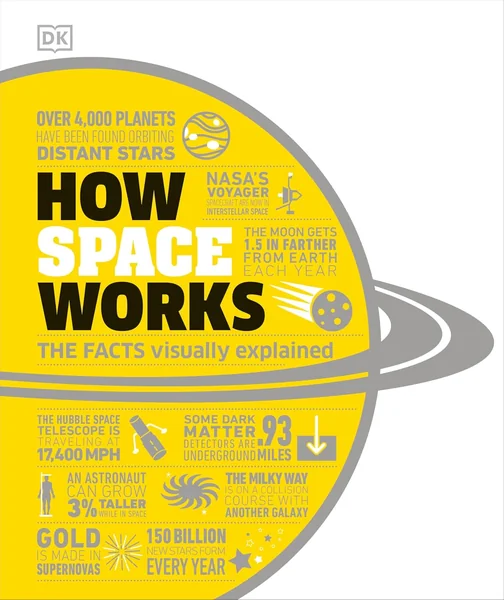
How Space Works: The Facts Visually Explained is a hardcover visual reference from DK, published in July 2021 as part of the DK How Stuff Works series. It is not a narrative popular-science book and not a textbook; it is a page-by-page explainer in DK's signature format, built to answer concrete questions a curious newcomer actually asks: how big is the Universe, how far away is the nearest star, what came before the Big Bang? The publisher describes it as answering questions "from ancient white dwarf stars to the Mars Rover," and that range is accurate to the book's stated scope — it moves from the Solar System outward to galaxy clusters, dark matter, pulsars, quasars, and the technology humans use to study all of it.
“a breadth of information is covered in a browsable format, giving readers the opportunity to explore space in small or large chunks of time.”
A glance at the book's index (visible in preview excerpts) confirms the breadth: asteroids, the Big Bang, carbon, comets, dark matter, dwarf galaxies, exoplanets, fusion, the Kuiper Belt, Jupiter — the entries run the full length of introductory astronomy and planetary science. The reading age is listed as 14 and up, which fits the book's positioning as an accessible guide for teens and adults rather than a children's picture book.
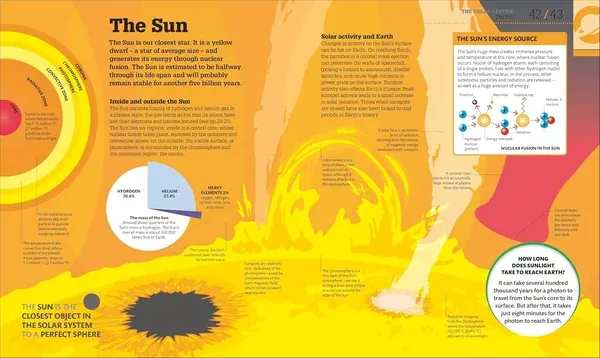
Interior spread with illustrated diagrams and circular charts explaining the Sun's composition, energy source, and role in the solar system.
The Visual, Step-by-Step Approach
The defining design choice is the one in the subtitle: the facts are visually explained. DK describes the book as working through "bold graphics and step-by-step artworks," with dynamic graphics paired to jargon-free text — the same formula the wider How Stuff Works series applies to other subjects. In practice, that means the book is structured as discrete visual spreads rather than long chapters, so a reader can open to a single topic — how fusion powers a star, how a rover lands on Mars — and get a self-contained explanation built around an annotated diagram or sequence.
This structure is the book's clearest strength and its clearest statement of intent. It is designed for dipping in and out, not reading cover to cover, and it is pitched explicitly at "armchair astronomers and space-technology enthusiasts," in the publisher's words — people who want reliable, current facts without a physics prerequisite. One reader review excerpted on Google Books captures the intended experience, calling it a fascinating book "laid out in a pictorial illustrated manner with captions" and "easy to follow." That is individual reader testimony rather than a critical consensus, but it matches exactly what the format is engineered to deliver.
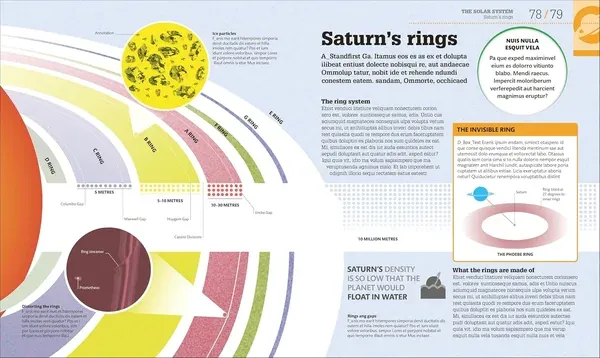
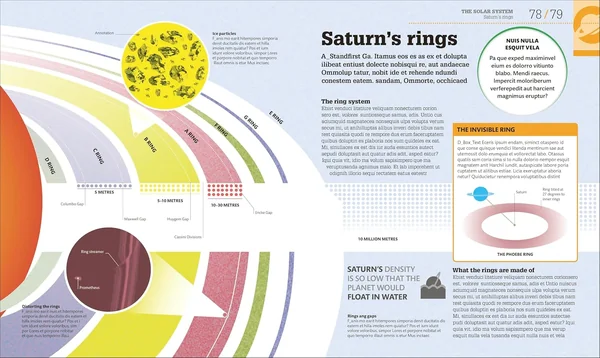
Interior spread with diagrams and illustrations explaining a planet's ring system, composition, and properties.
Reception and Critical Standing
The strongest documented reception comes from Booklist, which gave the book a starred review. The review, as quoted in retailer and publisher listings, praises how "a breadth of information is covered in a browsable format, giving readers the opportunity to explore space in small or large chunks of time." That assessment is notable because it comes from a publication that reviews reference and library material professionally, and it singles out precisely the quality — browsability without loss of coverage — that a visual explainer lives or dies on.
Beyond that starred notice, the book circulates in the ecosystem you would expect for a DK reference title: it is stocked by major booksellers in hardcover and ebook editions and positioned as a series anchor alongside DK's other "facts visually explained" volumes. It is worth being plain about scope here: this review is drawn from the published record — publisher materials, the Booklist notice, and reader commentary — not from hands-on use. For a functional reference book, the relevant question is whether it works at the page level as a teaching tool, and the available sources speak to its design and reception rather than to any independent verification of every fact inside it.
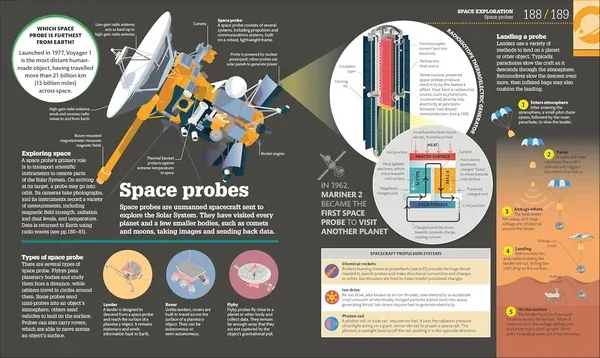
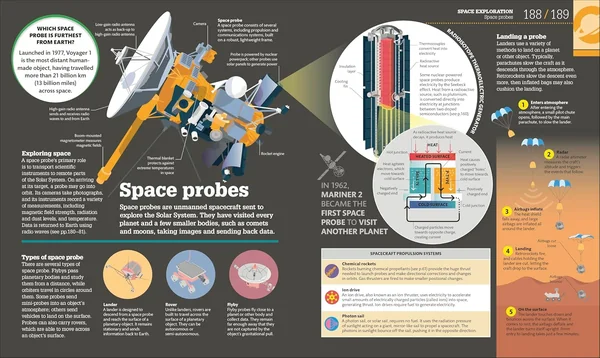
Interior spread showing annotated diagrams of space probes, their components, and planetary exploration systems with labeled illustrations and explanatory text.
Honest Limitations
The same choices that make the book approachable define its ceiling. A visually explained, spread-by-spread format covering the entire Universe in a single volume is a breadth-first undertaking by construction. Readers who already know their pulsars from their quasars — the publisher's own framing of what the book teaches — will find little here they have not encountered elsewhere, and anyone seeking mathematical treatment, astrophysical depth, or extended argument should look to a different kind of book entirely. This is a starting map, not a deep dive.
The 2021 publication date also matters in a fast-moving field. The book bills itself as up to date, and at release it covered contemporary subjects like the Mars Rover, but space science generates headline discoveries on a near-monthly basis, and a fixed print reference will inevitably fall behind the news cycle even as its fundamentals — stellar life cycles, orbital mechanics, galaxy types — remain stable. Finally, buyers should note the format reality: this is a heavily illustrated DK hardcover of around two pounds, designed as an at-home reference to be pored over, which is a feature for a shelf and a drawback for a bag.
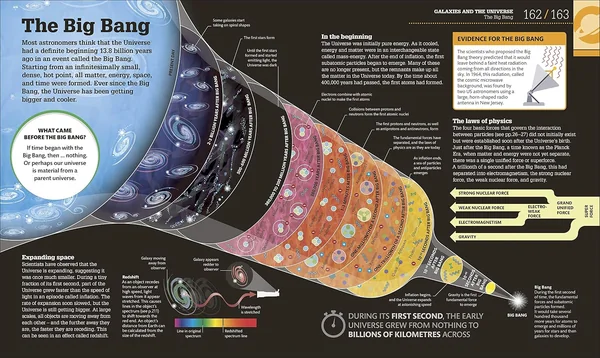
Interior spread diagram showing the Big Bang and expanding universe with concentric colored rings and timeline annotations.
Who It Is Genuinely For
How Space Works is for the curious beginner, and it does not pretend otherwise. It is well matched to a teenager developing an interest in astronomy, an adult who watches rocket launches and wants the background science explained plainly, or a household that wants one reliable, attractive reference for the questions space documentaries raise. It also works as a gift book in the best sense — substantial, browseable, and pitched so that no prior knowledge is assumed.
For those readers, the package is coherent: a starred-review-backed, visually driven survey from a publisher with decades of reference experience, organized so that ten minutes or two hours both yield something. What it will not do is satisfy anyone past the beginner stage, and it should be bought with that understanding. Judged on its own terms — as the clearest possible first visual guide to how space works — it is a confident, well-received execution of a familiar DK formula.
Reader Comments
0
No comments yet
Be the first to share your thoughts!
Frequently Asked Questions
Is How Space Works worth buying for a complete beginner?
The review gives a clear yes for beginners, noting it earns its starred review from Booklist as an entry point into astronomy. LuvemBooks describes it as a coherent package — visually driven, jargon-free, and backed by a publisher with decades of reference experience — provided the buyer understands it is a starting map, not a deep dive.
Who is the target audience for this book?
The review identifies the ideal reader as a curious beginner: a teenager developing an interest in astronomy, an adult who watches rocket launches and wants the background science explained plainly, or a household that wants one reliable reference for questions space documentaries raise. The publisher lists the reading age as 14 and up, which LuvemBooks notes fits the book's positioning as an accessible guide for teens and adults rather than a children's picture book.
What topics does How Space Works actually cover?
The review confirms the book moves from the Solar System outward to galaxy clusters, dark matter, pulsars, quasars, and the technology humans use to study space. The index visible in preview excerpts includes asteroids, the Big Bang, carbon, comets, dwarf galaxies, exoplanets, fusion, the Kuiper Belt, and Jupiter, running the full length of introductory astronomy and planetary science.
What is the book's visual format like?
The review describes the book as structured around discrete visual spreads rather than long chapters, pairing bold graphics and step-by-step artworks with jargon-free text. A reader can open to a single topic — such as how fusion powers a star or how a rover lands on Mars — and get a self-contained explanation built around an annotated diagram or sequence.
Is this book meant to be read cover to cover?
No — the review is explicit that the structure is designed for dipping in and out, not reading cover to cover. Booklist's starred notice specifically praises the browsable format, noting it gives readers the opportunity to explore space in small or large chunks of time.
What did Booklist say about How Space Works?
Booklist gave the book a starred review, praising how a breadth of information is covered in a browsable format, giving readers the opportunity to explore space in small or large chunks of time. The review notes this is significant because Booklist reviews reference and library material professionally and singled out precisely the quality — browsability without loss of coverage — that a visual explainer lives or dies on.
Is this book suitable for someone who already knows astronomy well?
The review is candid that it is not: readers who already know their pulsars from their quasars will find little here they have not encountered elsewhere. Anyone seeking mathematical treatment, astrophysical depth, or extended argument is advised to look to a different kind of book entirely.
How accessible is the writing style?
LuvemBooks describes the text as jargon-free and pitched so that no prior knowledge is assumed. A reader review quoted in the assessment calls the book easy to follow, laid out in a pictorial illustrated manner with captions — a description the review notes matches exactly what the format is engineered to deliver.
Is the 2021 publication date a problem given how fast space science moves?
The review flags this as a genuine limitation: space science generates headline discoveries on a near-monthly basis, and a fixed print reference will inevitably fall behind the news cycle. That said, LuvemBooks notes that the fundamentals — stellar life cycles, orbital mechanics, galaxy types — remain stable, so the core content does not date as quickly as cutting-edge discoveries do.
What are the honest limitations of this book?
The review identifies three main caveats: the spread-by-spread format is breadth-first by construction and offers little depth for experienced readers; the 2021 publication date means it will fall behind fast-moving discoveries; and the heavily illustrated hardcover format, at around two pounds, is designed as an at-home reference rather than something portable. These are described as the natural consequences of the book's design choices rather than flaws.
Sources & Further Reading
The key facts and claims in this review are grounded in the retrieved, verified sources listed below.

 Tap to enlarge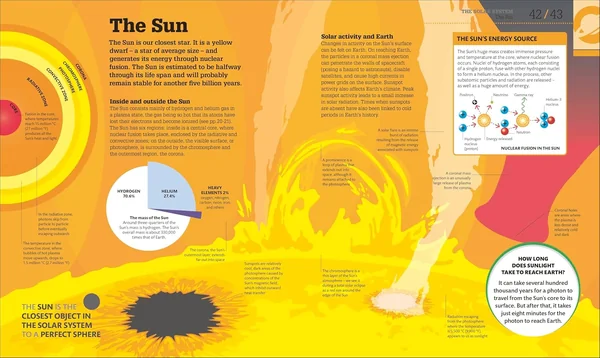
Reader Comments
No comments yet
Be the first to share your thoughts!