

Share This Review

The Book of Joy by Dalai Lama, Desmond Tutu & Douglas Carlton Abrams Review: Two Nobel Laureates on Lasting Happiness

The Book of Joy distills a historic week-long conversation between the Dalai Lama and Archbishop Desmond Tutu into a structured spiritual guide built around the Eight Pillars of Joy, blending personal wisdom, storytelling, and scientific perspectives into a framework designed to make lasting happiness genuinely accessible. Winner of the 2016 Books for a Better Life Award in Spirituality, it stands as one of the most celebrated works in contemporary spiritual self-help.

Trending Now
Cultural Resurgence

The Book of Joy: Lasting Happiness in a Changing World by Dalai Lama, Desmond Tutu, Douglas Carlton Abrams is Trending

The Book of Joy Is Resonating Again as Readers Seek Grounded, Lasting Happiness

With so much noise and uncertainty in the world right now, readers are returning to The Book of Joy for its practical, no-fluff approach to happiness. This award-winning conversation between two of the world's most beloved spiritual leaders holds up remarkably well as a guide for tough times.

The Book of Joy keeps finding new readers, and it's not hard to see why. In a moment when a lot of people feel stretched thin — by news cycles, economic stress, and the general exhaustion of modern life — this book offers something genuinely useful: a real, structured way to think about happiness that doesn't feel naive or preachy. The Eight Pillars of Joy framework gives readers something to actually work with, not just feel good about for an afternoon.

What makes it stick is the source material. This wasn't a ghostwritten celebrity wellness book — it was a week-long in-person conversation between the Dalai Lama and Archbishop Desmond Tutu, two people who lived through some of the hardest circumstances imaginable and came out on the other side with warmth and humor intact. That combination of lived experience and practical wisdom is exactly what resonates when people are looking for something more grounded than the typical self-help fare.

If you haven't picked this one up yet, it's worth knowing it won the Books for a Better Life Award in Spirituality back in 2016 — so it has real credibility behind it. It reads quickly, mixes storytelling with science, and doesn't ask you to overhaul your life. It just gives you a better lens to look through.

Read more
Updated Sep 7, 2026
In This Review
  • What Works & What Doesn't
  • What the Book Actually Is
  • The Stakes and Setting of the Dialogue
  • What the Book Does Well
  • The Audiobook Format and Its Fit
  • Who It's For and Where It Falls Short

What Works & What Doesn't

What Works
  • Structured around the Eight Pillars of Joy, giving it a clear, practical framework rather than leaving wisdom as pure abstraction
  • Winner of the 2016 Books for a Better Life Award in Spirituality, with strong praise from Publishers Weekly and Shelf Awareness
  • Unusually integrates spiritual wisdom from two distinct traditions — Tibetan Buddhism and Christianity — alongside scientific perspectives
  • The audiobook format, with three narrators and Whispersync for Voice compatibility, suits content that originated as spoken dialogue
  • The historic, mortality-aware context of the week-long meeting gives the conversations a candor and urgency rarely found in spiritual guides
What Doesn't
  • Readers seeking rigorous academic or philosophical analysis of happiness, rather than personal narrative and wisdom-tradition storytelling, may find the conversational register a poor fit
  • The book's deliberately non-doctrinal breadth means those looking for deep immersion in either Buddhist or Christian theology specifically will find it touches both traditions without exhausting either
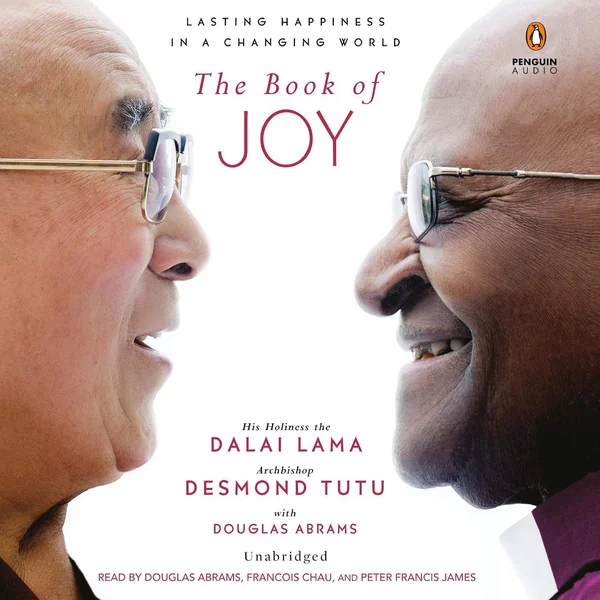
Two Nobel Peace Prize laureates sat together for one week to answer one of humanity's oldest questions — and the resulting book became a landmark in spiritual non-fiction.
The Book of Joy: Lasting Happiness in a Changing World by Dalai Lama, Desmond Tutu, Douglas Carlton Abrams front cover

What the Book Actually Is

The Book of Joy is a work of spiritual non-fiction structured around a week-long dialogue between His Holiness the Dalai Lama and Archbishop Desmond Tutu, conducted in Dharamsala, India, and captured by co-author and longtime editor Douglas Carlton Abrams. The book's central ambition is explicitly practical: not, as the text itself frames it, to "create a recipe for a joyful life but to offer some of the techniques and traditions that have served the Dalai Lama and the Archbishop and countless others over the millennia." From those conversations, the two men identify what the book calls the Eight Pillars of Joy — the conceptual foundation around which its teachings are organized — and close with daily Joy Practices that anchor their own emotional and spiritual lives. The audiobook edition, published by Penguin Audio and released on September 20, 2016, runs ten hours and twelve minutes in its unabridged form, narrated by Abrams alongside Francois Chau and Peter Francis James.
hope that joy is possible for everyone even in the most difficult circumstances

The Stakes and Setting of the Dialogue

Part of what gives the book its particular gravity is the weight of circumstance surrounding the week it documents. The Dalai Lama and Archbishop Tutu — two of the twentieth century's most consequential moral voices — met with the full awareness that it might be their last time together. The trip itinerary had to be reworked twice so that Tutu could attend funerals for peers, and both men were contending with the encroachments of age and global politics that had kept them increasingly apart. That context — mortality hovering just offstage — lends the conversations an urgency that distinguishes the book from more abstract treatments of happiness. The Archbishop, the sources note, has never claimed sainthood, and the Dalai Lama considers himself a simple monk: the book is grounded in that self-aware humility rather than in the pronouncements of untouchable icons.

What the Book Does Well

A recurring strength, as multiple sources indicate, is the book's unusual integration of spiritual wisdom and scientific evidence. Archbishop Tutu articulates what he calls "self-corroborating truth" — the idea that when many different fields of knowledge converge on the same conclusion, that convergence is itself meaningful. The Dalai Lama shares a comparable orientation. The result is a book that moves between Tibetan Buddhist teaching, Christian theology, and contemporary research rather than treating them as adversarial. Critics called it "sparkling, wise, and immediately useful," describing it as offering "hope that joy is possible for everyone even in the most difficult circumstances" with "a clear path for attaining it." Shelf Awareness characterized it as providing "an intimate glimpse into the minds of two of the world's spiritual guides, and their foundation for an attainable and practical approach to experiencing a more enriching and sustainable life of abundant joy." The book also won the 2016 Books for a Better Life Award in Spirituality.

The Audiobook Format and Its Fit

For listeners drawn to the spoken word, the audiobook format carries a distinctive logic for this particular title: the book's content originated as conversation, and hearing it narrated restores some of that dialogic texture. Penguin Audio's production features three narrators — Abrams, Francois Chau, and Peter Francis James — and is Whispersync for Voice-ready, allowing readers to move fluidly between listening and reading. At just over ten hours, the unabridged recording is substantial enough to carry the full arc of the Eight Pillars and the Joy Practices without compression. The book ranks among the top titles in Buddhism on Audible, reflecting strong and sustained listener engagement with the format.

Who It's For and Where It Falls Short

The Book of Joy is directed at readers who want philosophical depth grounded in lived experience rather than motivational abstraction — those who are drawn to wisdom traditions but want them in dialogue with modern thinking. Time Magazine noted that while the question the book addresses "may be timeless," its answer carries "urgent significance," suggesting it speaks directly to readers navigating genuinely difficult circumstances rather than readers seeking simple affirmation. The book's most natural audience spans spiritual seekers across traditions, readers interested in the intersection of Buddhism and Christianity, and anyone drawn to the life stories and thinking of two towering historical figures. That breadth, however, can also be its limitation: readers seeking a rigorous academic treatment of joy, or those with little patience for personal anecdote and spiritual storytelling, will find its register — warm, conversational, and largely non-doctrinal — a mismatch for their expectations.

Sources & Further Reading

The key facts and claims in this review are grounded in the retrieved, verified sources listed below.

  1. 1

    ia600500.us.archive.org

  2. 2
  3. 3
  4. 4
  5. 5
  6. 6
  7. 7
  8. 8
  9. 9
  10. 10