
BOOKS
Published
Read Time
10 min read
Share This Review
Our review
The Golden Dawn by Israel Regardie Review: The Definitive Compendium of Western Occultism
First published in 1937 and now in its seventh edition, Israel Regardie's The Golden Dawn is widely regarded as the most influential modern handbook of magical theory and practice — a foundational text for anyone serious about Western occultism, ceremonial magic, or the esoteric traditions of the Hermetic Order of the Golden Dawn. This review covers the book's content and published reception; whether its teachings work in practice is a matter for the practitioner, not the page.


 Tap to enlarge
In This Review
- What Works & What Doesn't
- What the Book Is and Contains
- Historical Significance and Place in the Field
- Editorial Scholarship in the Seventh Edition
- Scope, Density, and the Reader It Demands
- Who This Edition Is For
What Works & What Doesn't
What Works
- The most comprehensive primary-source documentation of the Hermetic Order of the Golden Dawn's teachings, rites, and ceremonies available in a single volume
- Seventh-edition editorial scholarship by John Michael Greer brings rigour and contextualisation to Regardie's original text
- Forewords by Chic and Sandra Tabatha Cicero, Chief Adepts of the restored Golden Dawn, provide authoritative practitioner context
- Widely regarded as the foundational text of the modern occult revival, with nearly ninety years of continuous influence
- Synthesises Kabbalah, Tarot, geomancy, Enochian magic, and Theosophy into one organised, cross-referenced curriculum
What Doesn't
- The density and volume of technical material — nearly 960 pages of interlocking symbol systems — makes this a demanding text that presupposes prior esoteric study rather than serving as a first introduction
- Its weight and scope mean it functions best as a sustained reference work, not a book that yields quick or casual insights
This review is based on the book's content, structure, and published critical reception — not hands-on application of its teachings.
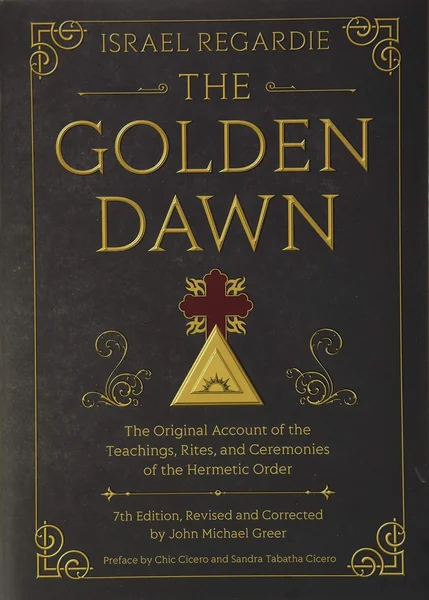
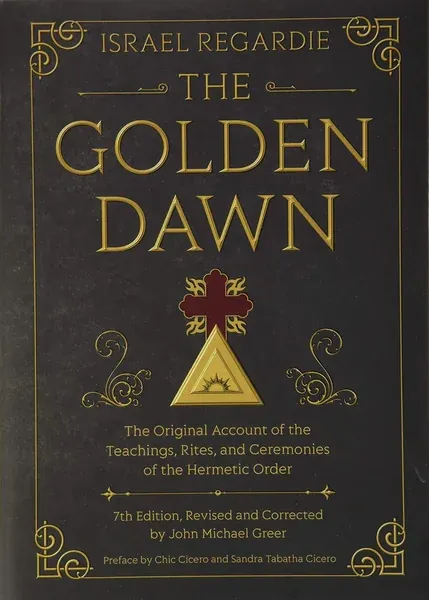
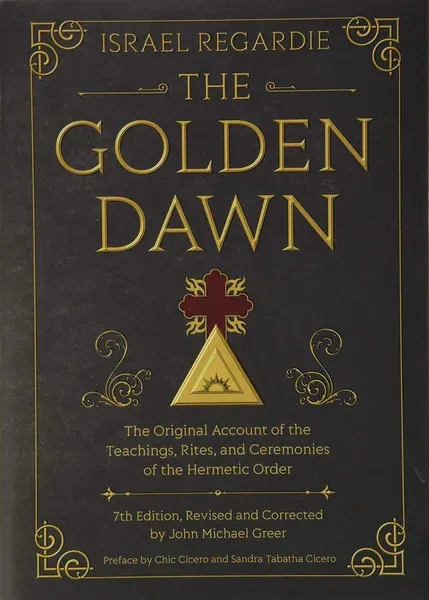
The Golden Dawn: The Original Account of the Teachings, Rites, and Ceremonies of the Hermetic Order by Israel Regardie front cover
What the Book Is and Contains
Israel Regardie's The Golden Dawn is a comprehensive reference and instructional text that documents the full body of teachings, rites, and ceremonies of the Hermetic Order of the Golden Dawn, the late-nineteenth-century magical society that drew together Kabbalah, Tarot, geomancy, Enochian magic, and Theosophy into a single coherent system. The book is organised in three major sections: knowledge lectures covering the basics of Kabbalah, symbolism, meditation, and geomancy; the rituals of the Outer Order, comprising five initiation rituals into the degrees of the Golden Dawn; and the rituals of the Inner Order, including two initiation rituals, equinox ceremonies, and related material. One passage from the knowledge lectures illustrates the book's characteristic synthesis of symbol systems: "These Twelve Signs are distributed among the Four Triplicities, or sets of three Signs, each being attributed to one of the Four Elements, and they represent the operation of the elements in the Zodiac." This density of cross-referenced correspondence is characteristic of the entire volume.
Historical Significance and Place in the Field
Originally published by The Aries Press in Chicago in 1937, The Golden Dawn arrived as an act of deliberate disclosure: Regardie — born in London in 1907, who had studied with Aleister Crowley in Europe before returning to the United States — chose to publish the Order's closely guarded secrets rather than allow them to be lost. According to the publisher's account, the book is considered by many to be the text that launched the modern occult movement. Its influence has been enormous: the original Hermetic Order drew on an unusually wide range of traditions, and Regardie's compilation made that synthesis available to generations of students and practitioners who had no access to the Order's original documents. The seventh edition, published by Llewellyn Publications, represents the continuation of a long editorial lineage that has kept the work in print and in active use for nearly ninety years.

Front cover with title text and a gold triangular symbol on dark background.
Editorial Scholarship in the Seventh Edition
What distinguishes this seventh edition from earlier printings is the editorial work of John Michael Greer, described by the publisher as a noted scholar and an initiate in Druidic, Hermetic, and Masonic lineages who served for twelve years as Grand Archdruid of the Ancient Order of Druids in America. Greer's involvement positions this edition as a definitive scholarly recension rather than a simple reprint. The volume also carries forewords by Chic Cicero and Sandra Tabatha Cicero, both described as Chief Adepts of the Golden Dawn as reestablished by Israel Regardie — practitioners with direct institutional continuity to the tradition Regardie documented. The Ciceros have authored numerous titles on the Golden Dawn, including Self-Initiation into the Golden Dawn Tradition and The Essential Golden Dawn, and have provided updates and annotations to other Regardie texts, lending their forewords a contextual authority that goes beyond ceremonial endorsement.

Back cover with synopsis, review quotes, and publisher barcode.
Scope, Density, and the Reader It Demands
At approximately 960 pages in hardcover — a volume weighing 4.7 pounds — The Golden Dawn is not designed as an introductory survey. It is a primary-source compendium: exhaustive, technical, and heavily cross-referenced across multiple esoteric disciplines. Readers approaching the material without prior familiarity with Kabbalah, Tarot symbolism, or ceremonial ritual structure are likely to find the density formidable. The book's structure presupposes a certain willingness to work through layered, interlocking symbol systems before the full architecture of the Golden Dawn curriculum becomes legible. For the general reader with a passing curiosity about occultism, the sheer scope of the material can be overwhelming; the book rewards sustained, serious study rather than casual browsing.
Front cover of a brown leather-bound book with a gold emblem and decorative spine.
Who This Edition Is For
For students of Western esotericism, ceremonial magicians, historians of the occult revival, and practitioners working within or adjacent to the Golden Dawn tradition, this seventh edition is the standard reference. The combination of Regardie's original compilation, Greer's scholarly editorial hand, and the Ciceros' authoritative forewords makes it the most thoroughly annotated and contextualised version of a text that has no real competitor in its field. Those seeking a more accessible entry point into Golden Dawn material may find companion volumes by the Ciceros — such as The Essential Golden Dawn — a more manageable starting place, with Regardie's full compilation serving as the advanced resource it was designed to be.
Frequently Asked Questions
Who is this book actually written for?
The review identifies the primary audience as students of Western esotericism, ceremonial magicians, historians of the occult revival, and practitioners working within or adjacent to the Golden Dawn tradition. It is not designed as an introductory survey, and readers without prior familiarity with Kabbalah, Tarot symbolism, or ceremonial ritual structure are likely to find the density formidable. Casual readers with a passing curiosity about occultism may be better served by a companion volume first.
Is The Golden Dawn worth buying at its current price?
The review positions this seventh edition as the standard reference in its field, with no real competitor, making it a strong value for serious students and practitioners. The combination of Regardie's original compilation, John Michael Greer's scholarly editorial work, and the authoritative forewords by Chic Cicero and Sandra Tabatha Cicero makes it the most thoroughly annotated version of the text available. For the right reader, the investment is clearly justified; for the casual browser, the scope may outpace the need.
What big ideas does the book engage with?
The book documents the full synthesis of Kabbalah, Tarot, geomancy, Enochian magic, and Theosophy as unified into a single coherent system by the Hermetic Order of the Golden Dawn. A quoted passage from the knowledge lectures illustrates this cross-referencing approach, linking the Twelve Signs of the Zodiac to the Four Triplicities and the Four Elements. The review notes that this density of interlocking symbol systems is characteristic of the entire volume.
How is the book structured?
The review describes three major sections: knowledge lectures covering Kabbalah, symbolism, meditation, and geomancy; the rituals of the Outer Order, comprising five initiation rituals; and the rituals of the Inner Order, including two initiation rituals, equinox ceremonies, and related material. The structure presupposes a willingness to work through layered, interlocking symbol systems before the full architecture of the curriculum becomes legible. It functions as a primary-source compendium rather than a narrative or argumentative text.
What does the book teach readers about Kabbalah?
Kabbalah is covered in the knowledge lectures section alongside symbolism, meditation, and geomancy, forming the foundational layer of the Golden Dawn curriculum. The review notes that the book's cross-referenced correspondence system draws Kabbalah into relationship with Tarot, Enochian magic, and other traditions, rather than treating it in isolation. Readers without prior familiarity with Kabbalah are cautioned that the density of the material may be formidable.
What is the historical significance of this book?
Originally published by The Aries Press in Chicago in 1937, the book is considered by many to be the text that launched the modern occult movement, according to the publisher's account cited in the review. Regardie chose to publish the Order's closely guarded secrets rather than allow them to be lost, making the Golden Dawn's synthesis available to generations of students and practitioners who had no access to the original documents. The seventh edition has kept the work in active use for nearly ninety years.
Why did Regardie publish the Order's secret teachings?
According to the review, Regardie's decision to publish was a deliberate act of disclosure — he chose to release the Order's closely guarded secrets rather than allow them to be lost. Regardie, born in London in 1907, had studied with Aleister Crowley in Europe before returning to the United States, and brought that insider knowledge to his compilation. The review frames this as a consequential editorial choice that shaped the entire modern occult revival.
Who is Israel Regardie?
The review describes Regardie as born in London in 1907, who studied with Aleister Crowley in Europe before returning to the United States. He compiled the full body of teachings, rites, and ceremonies of the Hermetic Order of the Golden Dawn and published them in 1937, an act the review characterises as deliberate disclosure to preserve the tradition. His compilation is described as having had enormous influence on subsequent generations of students and practitioners.
What makes the seventh edition different from earlier printings?
The review highlights the editorial work of John Michael Greer as the key distinguishing feature, describing him as a noted scholar and initiate in Druidic, Hermetic, and Masonic lineages who served for twelve years as Grand Archdruid of the Ancient Order of Druids in America. His involvement positions this edition as a definitive scholarly recension rather than a simple reprint. The volume also carries forewords by Chic Cicero and Sandra Tabatha Cicero, both described as Chief Adepts of the Golden Dawn as reestablished by Israel Regardie.
Who are Chic Cicero and Sandra Tabatha Cicero, and why do their forewords matter?
The review describes both as Chief Adepts of the Golden Dawn as reestablished by Israel Regardie, giving them direct institutional continuity to the tradition Regardie documented. They have authored numerous titles on the Golden Dawn, including Self-Initiation into the Golden Dawn Tradition and The Essential Golden Dawn, and have provided updates and annotations to other Regardie texts. The review notes this lends their forewords a contextual authority that goes beyond ceremonial endorsement.
Related Reviews
Reviews of books we picked for readers who enjoyed The Golden Dawn.

Reader Comments
No comments yet
Be the first to share your thoughts!