
At a glance
About the Author
Adam Grant1 book reviewed
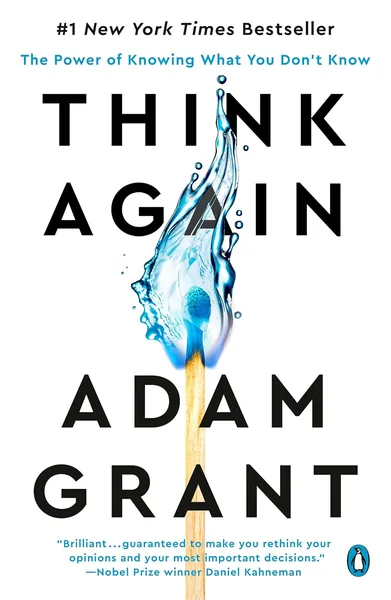
Think Again
The Power of Knowing What You Don't Know
by Adam Grant
LuvemBooks Verdict
Best for: Managers, educators, and anyone whose work runs on persuasion or group decisions — plus general readers who want a structured, Gladwell-style prompt to audit their own convictions and argue more productively.
Worth it? Skip it? Read the full verdict →Ask LuvemBooks
Was this helpful?
- Is it worth reading?
- Yes, with one clear caveat. LuvemBooks calls it a well-structured, widely praised argument for treating your own opinions as hypotheses — persuasive in its framing and rich in real-world examples, and backed by substantial institutional momentum as a #1 New York Times bestseller named a best nonfiction book of 2021. The caveat: readers who already follow the psychology of reasoning closely will find much of the territory familiar, and those wanting methodological rigor should look elsewhere. It is also functionally a how-to book whose real test — whether its techniques change how you argue, hire, or decide — depends on the reader applying them, which this review has not tested.
- Who should read this?
- LuvemBooks' verdict points to managers, educators, and anyone whose work involves persuasion or group decision-making, plus general readers who want a structured prompt to audit their own convictions. The book's later chapters — on arguments, negotiations, and institutions designed to reward rethinking — speak directly to workplace and classroom settings. Readers who enjoy Malcolm Gladwell-style narrative nonfiction will recognize the register: counterintuitive findings, memorable characters, and frameworks compact enough to repeat in a meeting.
- Similar books
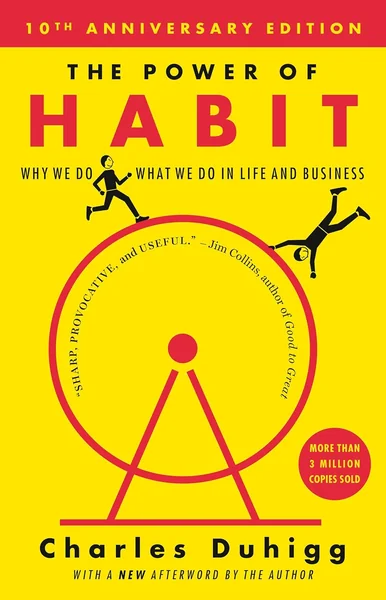
- LuvemBooks pairs it with Charles Duhigg's The Power of Habit, another research-grounded bestseller about rewiring entrenched behavior. For readers who want to go deeper on the same psychology, Julia Galef's The Scout Mindset covers motivated reasoning head-on, and Carol Tavris and Elliot Aronson's Mistakes Were Made (but Not by Me) is the classic on self-justification. Grant's own Give and Take (on generosity) and Originals (on nonconformity) are natural companions from the same author.
- What are the main themes?
- The unifying theme is intellectual humility: knowing what you don't know as a form of wisdom. Around it, the book develops themes of motivated reasoning (the preacher/prosecutor/politician modes that protect our existing beliefs), the value of productive disagreement, persuasion through listening rather than assertion, and the design of learning cultures — workplaces, schools, and relationships where changing your mind is rewarded rather than punished. Per the publisher's framing, the through-line is that 'we don't have to believe everything we think or internalize everything we feel.'
- How does it compare to Grant's other books?
- Think Again occupies a natural slot in Grant's catalogue: where Give and Take examined generosity and Originals examined nonconformity, this book examines cognitive flexibility — and LuvemBooks calls it arguably the most inward-facing of his major titles, since its first target is the reader's own certainty. Stylistically it's the same formula — Wharton research translated into memorable frameworks and stories — applied to how we think rather than how we treat others or champion new ideas.
- Is this a good book club pick?
- Yes — it's an unusually strong pick for workplace and professional book clubs. The three-part structure (rethink your own views, open other people's minds, build learning communities) gives a group a natural discussion arc, and the frameworks — preacher/prosecutor/politician versus scientist mode, motivational interviewing, question-led dialogue — are compact enough to test against the group's own decision-making habits. The polarized-era provocation that knowing what you don't know is a form of wisdom practically guarantees debate.
- What practical techniques does it teach?
- It teaches persuasion through listening rather than assertion. Named techniques include motivational interviewing (used by the 'vaccine whisperer' who convinces hesitant parents to immunize their children), finding common ground before contesting it, asking questions instead of making assertions, and conceding ground strategically — the tactic of the international debate champion Grant profiles. One honest caveat from LuvemBooks: this is functionally a how-to book, and its real test is whether readers apply the techniques in their own arguments, hiring, and decisions — something this review, based on the published record, has not tested.
Summarize this book
Follow up
Synthesized from verified book data & published reviews · How we review
Press Enter to ask. Answers come from our editorial Q&A — start typing to see related questions.
Age & Reading Level
Recommended age
Adult
Reading level
Adult
2 content notes · who it suits
Content to know about
Skip if you want a rigorous, citation-dense academic treatment of cognitive bias rather than an anecdote-driven popular-science read.
Editorial Review
Adam Grant's Think Again (Penguin Books paperback, 2023) argues that rethinking and unlearning matter more than raw intelligence, mixing psychology research with stories of debate champions, vaccine persuaders, and a musician who turns white supremacists away from hate. A #1 New York Times bestseller, it's a polished synthesis rather than new ground.
Read the Full ReviewBooks like Think Again
Curated picks for readers who enjoyed Think Again, with our reasoning for each match.
Why It’s Trending