Exaggerated title versus realistic work
Aaron Chen notes that the four-hour promise is overly sensationalized and practically impossible for scaling an enterprise, though the core lesson is learning to work more efficiently.

8 min read
Our review
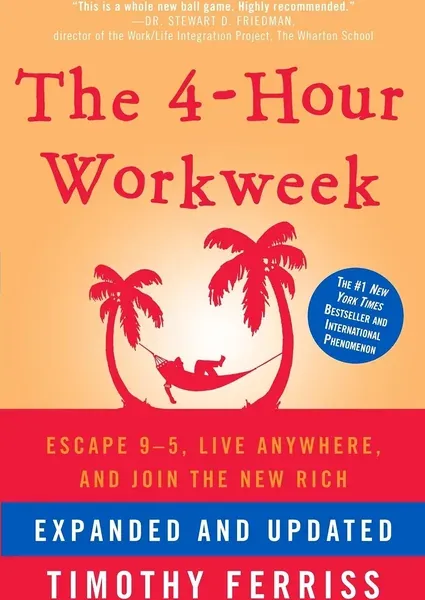
The 4-Hour Workweek by Timothy Ferriss Review: A Prescient Blueprint for Lifestyle Design
The 4-Hour Workweek is a self-help book by Timothy Ferriss that challenges the conventional "deferred life plan" — work hard now, enjoy life later — and proposes a radical alternative centered on what Ferriss calls "lifestyle design." This review covers the book's content, structure, and published reception; it does not reflect hands-on application of its methods.
Best for
Entrepreneurs, freelancers, and early-career professionals who are genuinely questioning whether conventional full-time employment is the only viable structure for a working life and are open to redesigning how they earn, work, and spend their time.
Worth it if
Worth reading if you are a knowledge worker, freelancer, or aspiring entrepreneur curious about restructuring your working life around time and mobility — and willing to engage critically with an ideological framework, not just a step-by-step manual.
Skip if
Skip it if you are in fixed-location or hourly employment where location-independent restructuring isn't feasible, or if Ferriss's evangelical entrepreneurial tone and the ethical questions around labor arbitrage are likely to be dealbreakers for you.
Where reviewers agree and split
Readers rate it 4.5 on Amazon. The reviews we read that discuss it in depth split on some points:
The New Yorker · Press review: book's predictions about work have proven prescient and relevant (from its headline)
Jose Casanova · Book blog: enthusiastic review praising the book's core premise (from its headline)
Write On Creative · Book blog: praised for wit and originality as a business book (from its headline)
Krooonal · Book blog: skeptical of the book's premise and somewhat misleading title (from its headline)
What readers & critics say
The New Yorker revisited the book at length, framing it as essential context for the current national conversation about professional autonomy and noting how prescient its arguments about remote work and email overload proved to be. Wikipedia's overview of its reception documents that the book spent four years on the New York Times Best Seller List, was translated into 40 languages, and sold around 2.1 million copies, while also noting criticism of Ferriss's practice of paying virtual assistants meagerly and the ethical questions that raised.
“Revisiting it reveals a prophecy many were not yet receptive to — his identification of remote work and email overload as central to worker autonomy proved strikingly prescient.”
— The New YorkerAaron Chen reviews Timothy Ferriss's The 4-Hour Workweek, discussing its key lessons on automation and mini-retirements.
A BookTube review by Internet Marketing Reviews, 2022 · 17.3K views · 87.8K subscribers · Watch on YouTube ·
Their views, not ours. The points are our AI summary of what they say, each playing from where they say it.
Aaron Chen notes that the four-hour promise is overly sensationalized and practically impossible for scaling an enterprise, though the core lesson is learning to work more efficiently.
The book completely shifts the conventional mindset of waiting until old age to enjoy life, instead advocating for taking periodic multi-month mini-retirements while young.
Unlike typical business books, it functions as a practical guide that names specific websites, outsourcing platforms, and strategies to implement immediately.
Even though the book was released back in 2007, Aaron Chen explains that its principles of leverage and automation remain entirely applicable today.
Was this helpful?
Summarize this book
Follow up
Synthesized from verified book data & published reviews · How we review
Answers come from our editorial notes on this book. If we haven't covered something, we'll say so.
Readers often ask
We review the evidence: reader verdicts, gathered and weighed with AI assistance and edited by LuvemBooks, rather than one reader's first-hand take.
The key facts and claims in this review are grounded in the retrieved, verified sources listed below.
Timothy Ferriss, LuvemBooks
en.wikipedia.org
newyorker.com
sistem42.com
krooonal.com
Our age band
Adult
Our age band groups books for browsing; it isn't an age a review gave.
1 content note · who it suits
Content to know about
Skip if you want a straightforward personal-finance or career-management guide rather than an ideological rethinking of work structure
Timothy Ferriss joins hosts Robert Scoble and Shel Israel on WorkFast.TV to discuss the principles and productivity strategies from 'The 4-Hour Workweek'.
Uploaded by Fast Company, 2009 · Watch on YouTube ·
Ferriss explains that in early 2004 he worked grueling 14-hour days across time zones until his girlfriend broke up with him, leaving behind a photo holder that read "work hours end at 5:00 p.m." This parting gift triggered his realization that income has no practical lifestyle output value without time.
To escape reactive work habits, Ferriss set a strict rule to check email only once a week on Mondays for no more than two hours during a four-week trip to London. Because the automation and filtering worked seamlessly, he stayed abroad for 18 months, which eventually inspired the book.
Ferriss states the book is founded on two core premises: that busyness without defined targets is merely laziness, and that the traditional deferred-life retirement model is fundamentally flawed.
No LuvemBooks readers have answered yet.
Read it? Was it right for you?
Curated picks for readers who enjoyed The 4-Hour Workweek, with our reasoning for each match.
More by Timothy Ferriss
If you liked The 4-Hour Workweek