BOOKS
Published

Read Time

3 min read

Curated & edited by

LuvemBooks Editorial

How we create our reviews →
Share This Review

The Origins of Political Order by Francis Fukuyama Review: A Sweeping Cross-Disciplinary Account of Political Development

Francis Fukuyama's The Origins of Political Order: From Prehuman Times to the French Revolution is an ambitious work of political science and comparative history that traces the development of political institutions from prehuman social behavior through to the eve of the French Revolution, arguing that stable political order rests on three interdependent pillars: a modern and capable state, the rule of law, and political accountability.

LuvemBooks Verdict

Best for

Readers with an appetite for grand-scale political science — particularly those interested in comparative history, state-building theory, or the structural roots of contemporary state failure in places like Iraq, Afghanistan, and Somalia.

Worth it if

The cross-disciplinary sweep — yoking evolutionary biology, archaeology, economics, and political history into a single unified framework — is exactly what you're looking for in a work of serious, ambitious political thought.

Skip if

You're a specialist historian of any single region or era covered (medieval Hungary, Tang Dynasty China, and so on) and expect depth rather than the compressed, argument-driven treatment the panoramic scope demands.

What readers & critics say

Kirkus Reviews called it "endlessly interesting" and a "sweeping, provocative big-picture study of humankind's political impulses," praising Fukuyama's breadth and noting he "defied easy categorization." Foreign Affairs described it as a "landmark study," noting it incorporates both traditional accounts of state formation and those focused on transformative ideas about law, justice, and religion.

Endlessly interesting — sweeping, provocative big-picture study of humankind's political impulses.

Kirkus Reviews
Sources: Kirkus Reviews, Foreign Affairs
In This Review
  • What Works & What Doesn't
  • What the Book Is and What It Argues
  • Scope and Structure
  • Strengths and Intellectual Contribution
  • Genuine Limitations and Who May Be Frustrated
  • Who This Book Is For

What Works & What Doesn't

What Works
  • Advances a clear, testable three-part thesis — state capacity, rule of law, and accountability — grounded in comparative historical evidence across multiple civilizations
  • Draws on an unusually wide range of disciplines, including evolutionary biology, archaeology, economics, and political history, to build its argument
  • Engages concrete case studies across China, India, the Middle East, Papua New Guinea, and both Western and Eastern Europe, avoiding Eurocentric tunnel vision
  • Addresses the real-world stakes of the argument explicitly, connecting ancient and early-modern history to contemporary state-building failures in Iraq, Afghanistan, and elsewhere
  • The first volume of a complete two-part project, with the sequel carrying the analysis through to the present day
What Doesn't
  • The panoramic scope means individual regions and periods receive compressed treatment, which may frustrate historians or area specialists seeking depth over breadth
  • The universal framework for political development is not universally accepted among political scientists, and the book's grand synthetic ambitions invite substantive scholarly debate and criticism
A landmark work of political science, The Origins of Political Order sets out to explain how humanity moved from primate social behavior to the complex governing institutions that underpin modern states — and why so many contemporary societies have failed to make that journey.

What the Book Is and What It Argues

The Origins of Political Order: From Prehuman Times to the French Revolution By Francis Fukuyama by aa front cover
Published in 2011, The Origins of Political Order is the first volume of a major two-part project by political economist Francis Fukuyama. Its central thesis is that stable political order in any state requires three components working in concert: a strong, modern state; a rule of law that governs it; and mechanisms of political accountability to its citizens. Fukuyama develops this framework not through abstract theory alone but through comparative political history, drawing on evolutionary biology, archaeology, economics, and historical case studies across a vast geographic and temporal range. The book is, in Fukuyama's own framing, about "getting to Denmark" — that is, understanding how societies become stable, peaceful, prosperous, inclusive, and honest. The intellectual ambition is explicit from the outset: to account for why institution-building in countries like Afghanistan, Iraq, Somalia, Haiti, and Liberia has so persistently fallen short of expectations.

Scope and Structure

The narrative arc begins before recorded history, examining politics among primate ancestors and the structure of tribal societies, before moving forward through the growth of what Fukuyama identifies as the first modern state in China, the emergence of the rule of law in India and the Middle East, and the development of political accountability across Europe. Hungary's political culture in the thirteenth and fourteenth centuries, the English constitutional crises culminating in the Glorious Revolution of 1688, and the dynamics of Eastern and Western European development are among the concrete case studies the book engages. The cross-disciplinary method — yoking together history, evolutionary biology, archaeology, and economics — is what distinguishes the work from conventional political philosophy. Virtually all human societies were once organized tribally, and Fukuyama's project is to trace the specific, contingent paths by which some developed centralized states with uniform laws and accountable governments, while others did not.

Strengths and Intellectual Contribution

The publisher's synopsis describes the book as "a brilliant, provocative work that offers fresh insights on the origins of democratic societies and raises essential questions about the nature of politics." The breadth of the evidentiary base is a genuine strength: Fukuyama moves fluently across regions — China, India, Papua New Guinea, Western and Eastern Europe — and across millennia, making the case that political development cannot be understood through any single civilization's experience. The book also engages seriously with contemporary political philosophy: Fukuyama draws on Amartya Sen's view that democracy represents a kind of default political aspiration, while simultaneously complicating that view by noting that even autocratic leaders have historically maintained the semblance of democratic legitimacy. The recognition that there is no automatic "reset to democracy" once a government is removed — a lesson the book draws from the post-2003 situation in Iraq — gives the historical argument immediate and pointed relevance.

Genuine Limitations and Who May Be Frustrated

The very breadth that makes the book significant also creates real friction for some readers. Covering prehuman social organization through early-modern European constitutionalism in a single volume means that individual case studies receive treatment proportional to the overarching argument rather than in the depth a specialist in any one region or era might prefer. Readers approaching the book as historians of, say, medieval Hungary or Tang Dynasty China may find the comparative framework too telescoped. The thesis — that stable order requires state capacity, rule of law, and accountability — is a three-part schema that not all political scientists have accepted without qualification, and the book's ambition to produce a universal account of political development invites exactly the kind of empirical and theoretical pushback that comparative politics scholars have directed at grand unified theories. Some readers have also noted that Fukuyama's engagement with the Iraq and Afghanistan cases, while intellectually honest, raises questions the first volume's pre-modern frame cannot fully resolve.

Who This Book Is For

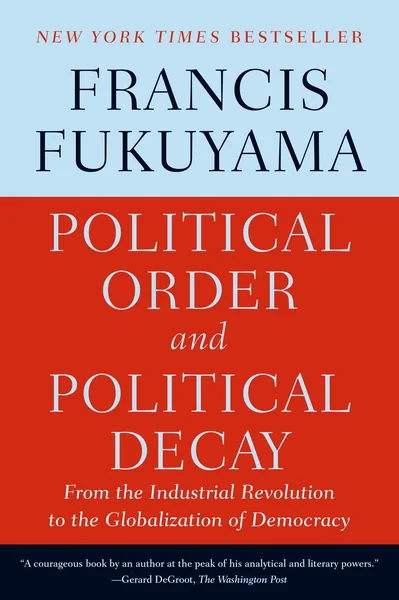
The Origins of Political Order is designed for readers prepared to engage with a work of serious, sustained political science that operates at the scale of civilizations rather than individual events or elections. It is the first of two volumes — the sequel, Political Order and Political Decay: From the Industrial Revolution to the Present Day, published in September 2014, carries the analysis forward from the French Revolution to the contemporary world. Readers interested in political philosophy, comparative history, or the structural conditions behind state failure and state success will find Fukuyama's framework directly useful. Those looking for a narrowly focused account of any single era or region will need to read the book for what it is: a panoramic, cross-disciplinary synthesis oriented toward understanding why some societies achieved stable self-governance and others have not.

Sources & Further Reading

The key facts and claims in this review are grounded in the retrieved, verified sources listed below.

  1. Cited in this review
  2. 1
  3. 2
  4. Further reading
  5. 3
  6. 4
  7. 5
  8. 6
  9. 7
  10. 8