BOOKS
Published
Read Time
7 min read
Our Rating
3.5
Reviewed by
LuvemBooks
Share This Review
Greatest Greek Philosophers Fingerprint Classics Edition Review: Worth It?
Our Rating
3.5
A well-produced anthology that successfully introduces readers to the Greek philosophical tradition, though variable translation quality and the inevitable limitations of excerpting prevent it from replacing dedicated editions of individual works.
In This Review
- What Works & What Doesn't
- The Philosophers Represented
- Prose, Translation, and Accessibility
- The Physical Edition as an Object
- What the Collection Does Well
- Where It Falls Short
- Reading Level and Ideal Audience
- The Bottom Line
What Works & What Doesn't
What Works
- Thoughtful editorial selection that includes Epicurus and the Stoics alongside the expected Plato and Aristotle
- High-quality physical production makes it a genuinely appealing object to own and display
- Convenient single-volume format covers the tradition's foundations at a reasonable value
- Texts are varied enough to convey each thinker's distinct intellectual personality
What Doesn't
- Relies on public domain translations that vary in readability and feel dated in places
- Anthology format compresses extended arguments, losing the cumulative logic of works like *The Republic*
- Introductory or contextual framing may be insufficient for readers with no prior philosophy background
- Scope is firmly canonical — no engagement with traditions outside the standard Western Greek lineage
The Philosophers Represented

This anthology — compiled by various authors and editors for the Fingerprint Classics series — draws on the tradition's most influential voices. Socrates, Plato, and Aristotle form the expected core: the philosophical triumvirate that shaped Western thought for two millennia. But the volume also reaches toward figures like Epicurus, whose writings on pleasure and the good life remain startlingly practical, and the Stoics, whose ideas about fate, reason, and emotional resilience have enjoyed a remarkable modern revival.
Each thinker is given enough space to register as a distinct intellectual presence. Plato's dialogues, with their dramatic exchanges and probing questions, feel fundamentally different from Aristotle's more methodical, classificatory prose. The anthology — assembled from various sources — respects these differences rather than smoothing them into a uniform philosophical voice.
For readers with no prior background, this variety can feel disorienting at first. The jump between styles — from Socratic irony to Aristotelian taxonomy — requires some adjustment. But that friction is arguably part of the point. Philosophy at its best resists easy assimilation.
Prose, Translation, and Accessibility
Any anthology drawing on ancient Greek texts is, necessarily, a collection of translations. The quality and character of those translations matter enormously, and this is an area where the Fingerprint Classics edition deserves honest scrutiny. The volume does not appear to commission new translations; it draws on established public domain versions, which are widely available and serviceable but vary in their readability.
Some passages read with admirable clarity. Others carry the stiffness characteristic of nineteenth-century translation conventions — correct, but not always alive on the page. Readers who have encountered more recent scholarly translations of Plato may notice the tonal difference immediately. The translations here are workable, but they are not the collection's strongest asset.
That said, for a general reader approaching these texts for the first time, the older translations are rarely an obstacle. The ideas cut through regardless of stylistic polish.
The Physical Edition as an Object
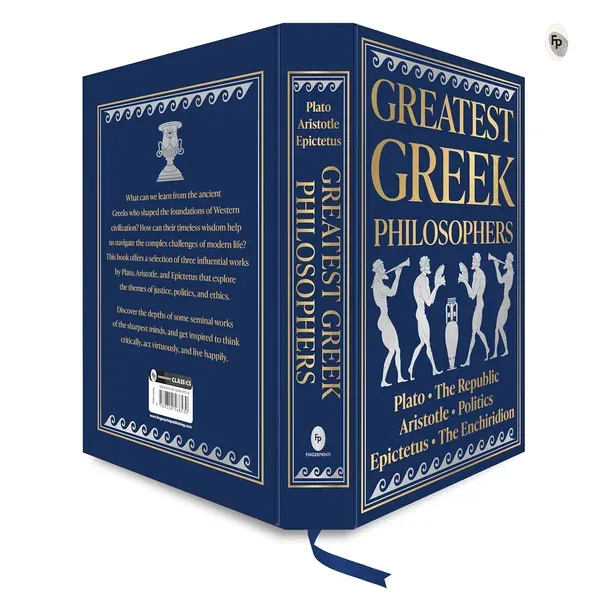
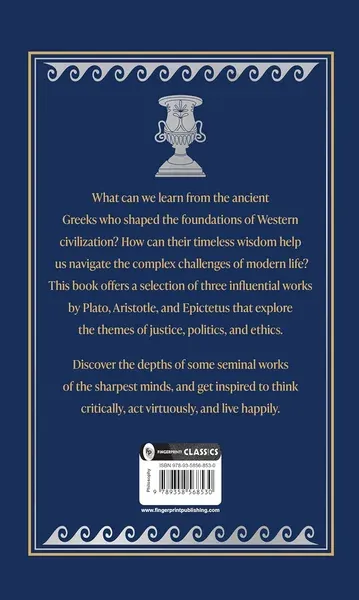
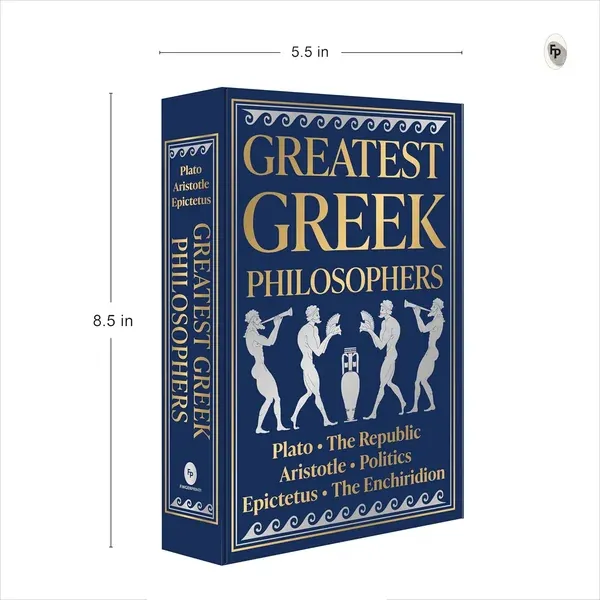
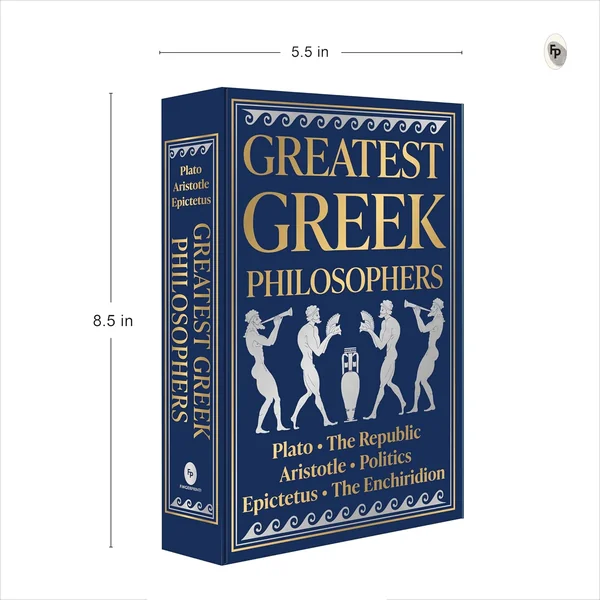
The "Deluxe Hardbound Edition" designation is more than marketing. The Fingerprint Classics line has built a reputation for producing books that feel worth owning — thick boards, quality paper, and designs that lean into classical aesthetics. This volume fits that profile. The cover design signals its content through visual language that evokes antiquity without being kitschy: clean lines, restrained ornamentation, a palette drawn from stone and parchment.
For readers who care about their bookshelves, this is a volume that sits well alongside other reference works and classics. It has the weight — physical and intellectual — of a book meant to be consulted, annotated, and returned to. That materiality is part of what distinguishes it from simply downloading the same public domain texts for free.
What the Collection Does Well
The editorial selection reflects genuine judgment rather than mere name recognition. The inclusion of Epicurus alongside the more commonly anthologized Plato and Aristotle is a thoughtful choice. Epicurean philosophy — frequently mischaracterized as mere hedonism — gets a fair hearing here, and its arguments about friendship, simplicity, and the avoidance of pain stand in productive tension with Stoic ideas elsewhere in the volume.
The Stoic thinkers represented in this various-authored collection are given enough depth to convey the system's internal logic. This matters. Stoicism without its metaphysical scaffolding is just motivational advice. When the anthology preserves the framework, the ethical conclusions carry genuine weight.
There is also something to be said for the convenience of a single-volume collection. Assembling equivalent reading from individual editions would be more expensive and logistically cumbersome. For students, gift-givers, or curious readers who want a reliable starting point, the format serves a real need.
Where It Falls Short
The anthology's primary limitation is one endemic to the format: compression. Philosophy of this depth resists excerpting. Plato's Republic, for instance, is an extended, carefully structured argument — pulling selections from it inevitably loses the cumulative logic that makes the whole greater than its parts. A reader encountering a few dialogues here may leave with a vivid but incomplete sense of what Plato was actually arguing.
The introductory material, if present, would need to work hard to compensate for this. Without strong contextual framing — explaining each thinker's historical moment, their relationship to predecessors, and the debates they were entering — readers risk encountering these texts as isolated aphorisms rather than live philosophical arguments. Whether this Fingerprint Classics edition provides that scaffolding adequately is a legitimate question for prospective buyers to consider.
There is also the matter of scope. The collection focuses on the "greatest" figures, which means it is inevitably a canon-affirming exercise. Thinkers who fall outside the traditional Western philosophical core — including figures whose work intersects with or challenges the Greek tradition — are absent. That is a defensible editorial choice, but readers should understand what they are getting: a beautifully packaged introduction to a specific, well-worn tradition.
Reading Level and Ideal Audience
This Greek philosophy book review would be incomplete without addressing audience. This collection is best suited for adult readers with some tolerance for abstract reasoning. The texts themselves range from moderately accessible (Epicurus's letters, some Stoic passages) to genuinely demanding (Aristotle's metaphysical and logical works). A curious teenager with strong reading habits could engage with parts of it productively, but the full collection assumes a reader willing to slow down and re-read.
It makes an excellent gift for someone who has expressed interest in philosophy but hasn't known where to begin. It also works well as a reference volume for readers who want a single-shelf source covering the tradition's foundations — comparable in intent, if not in scope, to Will Durant's narrative approach in The Story of Philosophy.
The Bottom Line
The Fingerprint Classics Greatest Greek Philosophers — this various-compiled anthology — is a handsome, well-intentioned collection that delivers genuine value as an entry point to the tradition. Its limitations — variable translation quality, the inherent compression of anthologizing, and modest contextual scaffolding — are real but not disqualifying. For the right reader, this is a reliable and elegant starting place for a philosophical education that could last a lifetime.
Product Gallery


Frequently Asked Questions
Is the Greatest Greek Philosophers Deluxe Hardbound Edition worth buying at $24.99?
The reviewer rates it 3.5 out of 5 and considers it a reasonable value, particularly because assembling equivalent reading from individual editions would be more expensive and logistically cumbersome. The physical quality of the Fingerprint Classics edition also distinguishes it from simply downloading the same public domain texts for free.
Who is the ideal audience for this anthology?
The collection is best suited for adult readers with some tolerance for abstract reasoning, and it makes an excellent gift for someone who has expressed interest in philosophy but hasn't known where to begin. A curious teenager with strong reading habits could engage with parts of it productively, but the full collection assumes a reader willing to slow down and re-read.
Which philosophers are included in this collection?
The anthology covers Socrates, Plato, and Aristotle as its core philosophical triumvirate, but also includes Epicurus and representatives of Stoic thought. The reviewer notes that the editorial selection reflects genuine judgment rather than mere name recognition, particularly praising the inclusion of Epicurus alongside the more commonly anthologized figures.
How does the anthology handle the differences in writing style between philosophers?
The reviewer notes that Plato's dialogues, with their dramatic exchanges and probing questions, feel fundamentally different from Aristotle's more methodical, classificatory prose. The collection respects these differences rather than smoothing them into a uniform philosophical voice, though for readers with no prior background, the variety can feel disorienting at first.
What big ideas does this collection engage with?
The anthology covers major themes including pleasure and the good life through Epicurus, and fate, reason, and emotional resilience through the Stoics, whose ideas have enjoyed a remarkable modern revival. It also engages with Platonic dialogues and Aristotelian classification, spanning ethical, metaphysical, and logical domains of Greek philosophical thought.
How is Epicurean philosophy treated in this anthology?
The reviewer is positive about the treatment of Epicurus, noting that Epicurean philosophy, frequently mischaracterized as mere hedonism, gets a fair hearing here. Its arguments about friendship, simplicity, and the avoidance of pain are presented in productive tension with Stoic ideas elsewhere in the volume.
How does the anthology handle Stoic philosophy?
The reviewer emphasizes that the Stoic thinkers are given enough depth to convey the system's internal logic, which matters because Stoicism without its metaphysical scaffolding is just motivational advice. When the anthology preserves that framework, the ethical conclusions carry genuine weight.
What is the quality of the translations in this edition?
The volume draws on established public domain versions rather than commissioning new translations, which means the quality varies. Some passages read with admirable clarity, while others carry the stiffness characteristic of nineteenth-century translation conventions — correct, but not always alive on the page.
Are the older translations an obstacle for first-time readers of Greek philosophy?
The reviewer says that for a general reader approaching these texts for the first time, the older translations are rarely an obstacle. The ideas cut through regardless of stylistic polish, though readers who have encountered more recent scholarly translations of Plato may notice the tonal difference immediately.
What is the physical quality of the Fingerprint Classics Deluxe Hardbound Edition like?
The reviewer describes thick boards, quality paper, and designs that lean into classical aesthetics, with a cover that evokes antiquity without being kitschy through clean lines, restrained ornamentation, and a palette drawn from stone and parchment. The volume has the physical and intellectual weight of a book meant to be consulted, annotated, and returned to.
What is the main structural limitation of this anthology?
The anthology's primary limitation is compression, as philosophy of this depth resists excerpting. For example, pulling selections from Plato's Republic inevitably loses the cumulative logic that makes the whole greater than its parts, and a reader may leave with a vivid but incomplete sense of what Plato was actually arguing.
Does the anthology provide enough context and introductory material for each philosopher?
The reviewer raises this as a legitimate question for prospective buyers, noting that without strong contextual framing explaining each thinker's historical moment, their relationship to predecessors, and the debates they were entering, readers risk encountering these texts as isolated aphorisms rather than live philosophical arguments. Whether the Fingerprint Classics edition provides that scaffolding adequately is left as a concern to investigate before purchasing.
Does this anthology include diverse or non-Western philosophical perspectives?
The reviewer notes that the collection is a canon-affirming exercise, and thinkers who fall outside the traditional Western philosophical core, including figures whose work intersects with or challenges the Greek tradition, are absent. The reviewer considers this a defensible editorial choice but cautions that readers should understand they are getting an introduction to a specific, well-worn tradition.
How does this anthology compare to Will Durant's approach to philosophy?
The reviewer describes this anthology as comparable in intent, if not in scope, to Will Durant's narrative approach in The Story of Philosophy. Both serve as single-shelf sources covering the tradition's foundations, though Durant's work takes a narrative rather than primary-text approach.
Is this collection accessible for someone with no background in philosophy?
The texts range from moderately accessible, such as Epicurus's letters and some Stoic passages, to genuinely demanding, such as Aristotle's metaphysical and logical works. The reviewer notes that the jump between styles, from Socratic irony to Aristotelian taxonomy, requires some adjustment, and that friction is arguably part of the point since philosophy at its best resists easy assimilation.
Would this book work well as a gift for someone interested in philosophy?
The reviewer explicitly recommends it as an excellent gift for someone who has expressed interest in philosophy but hasn't known where to begin. Its high-quality physical design also makes it a volume that sits well alongside other reference works and classics on a bookshelf.
Can this anthology serve as a standalone reference for Greek philosophy?
The reviewer suggests it works well as a reference volume for readers who want a single-shelf source covering the tradition's foundations. However, due to the compression inherent in anthology format, it is better understood as a starting point than as a comprehensive treatment of any individual philosopher's work.
What does the reviewer think about Plato's representation in this collection?
The reviewer is somewhat cautious, noting that Plato's Republic is an extended, carefully structured argument, and pulling selections from it inevitably loses the cumulative logic that makes the whole greater than its parts. The dialogues are acknowledged as dramatically distinct, with their probing questions and Socratic irony, but the excerpting format is seen as a genuine limitation.
Why would a reader buy this physical edition instead of accessing the texts online for free?
The reviewer points out that the same public domain texts are freely available online, but argues that the materiality of the Fingerprint Classics edition is part of what distinguishes it. The thick boards, quality paper, and classical design make it a book meant to be owned, consulted, annotated, and returned to in a way a digital download is not.
BEST DEAL
Reader Comments
No comments yet
Be the first to share your thoughts!