
BOOKS
Published
Read Time
8 min read
Share This Review
50 Philosophy Classics by Tom Butler-Bowdon Review: An Accessible Gateway to Philosophy's Greatest Minds
50 Philosophy Classics by Tom Butler-Bowdon is a reference and companion guide designed to make two millennia of philosophical thought accessible to general readers, covering fifty landmark works from thinkers including Aristotle, Plato, Descartes, Kant, Sartre, Foucault, and Wittgenstein. This review is based on the book's documented contents and published reception — not hands-on use or application.
In This Review
- What Works & What Doesn't
- What the Book Is and How It Is Structured
- Scope and Ambition: Two Thousand Years in One Volume
- Strengths: Lucidity and Sympathetic Engagement
- Genuine Limitations: A Survey Is Not a Deep Dive
- Who This Book Is For
What Works & What Doesn't
What Works
- Covers fifty landmark philosophical works spanning ancient to contemporary thought within a clear, four-part thematic framework
- Published commentary describes the writing as remarkably lucid, making complex ideas accessible to general readers without sacrificing the excitement of the ideas
- Each entry is designed to offer a sympathetic and engaging account of a thinker's core insights, rather than a dry summary
- Part of a well-established series, giving readers a consistent, proven format for navigating a demanding discipline
- Functions as a curated reading list, pointing engaged readers toward original works for deeper study
What Doesn't
- The survey format, by design, gives each of fifty thinkers only condensed treatment — unsuitable for readers seeking scholarly depth or rigorous close analysis
- The broad, accessible approach means advanced students or academic readers will quickly outgrow the book's scope
A purposeful and wide-ranging philosophical companion, 50 Philosophy Classics is designed to bring the discipline's most essential works within reach of curious non-specialists — and, by most published accounts, succeeds admirably at that mission.
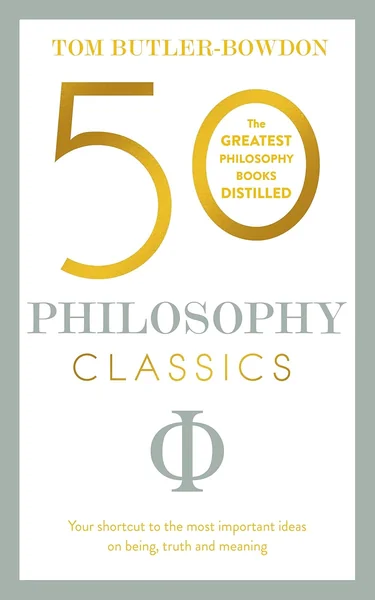
50 Philosophy Classics: Thinking, Being, Acting, Seeing: Profound Insights and Powerful Thinking from Fifty Key Books by Tom Butler-Bowdon front cover
What the Book Is and How It Is Structured
Published by John Murray Business, 50 Philosophy Classics is the sixth volume in Tom Butler-Bowdon's long-running "50 Classics" series, which also spans politics, economics, spirituality, self-help, and business. The book is organised around four animating questions that Butler-Bowdon argues define philosophy's enduring project: how to think, how to be, how to act, and how to see. Under each of these headings, the book profiles fifty key philosophical works, drawing on thinkers from ancient times to the present day. The "how to think" strand covers figures such as Descartes, Foucault, and Wittgenstein; "how to be" reaches from Aristotle and Spinoza to Sartre; "how to act" engages Bentham, Kant, and Peter Singer; and "how to see" examines Baudrillard, Hegel, and others. Each entry is designed to introduce a philosopher's core ideas and situate them within the broader sweep of the discipline.
“complex views on a whole range of important and enduring issues are made accessible to the general reader.”
Scope and Ambition: Two Thousand Years in One Volume
The book's central premise, as the publisher states, is that philosophy has served as humanity's best guide to "the experience of being human and the true nature of reality" for over two thousand years — and that this tradition deserves a lively, welcoming entry point rather than an academic barricade. Butler-Bowdon, a graduate of the London School of Economics and the University of Sydney, brings that conviction to a deliberately broad canvas. The fifty works surveyed span from classical antiquity through contemporary thought, meaning the volume functions as both a historical survey and a practical orientation for readers who want to understand why philosophy still matters. It is worth noting that revised and updated editions of the book have appeared since the original publication, with the publisher positioning newer versions as particularly relevant to contemporary questions of how to think, be, and see.
Strengths: Lucidity and Sympathetic Engagement
Published commentary on the book consistently highlights its clarity as a primary virtue. A notice carried by AbeBooks describes the entries as explaining and discussing philosophical ideas "briefly, but with remarkable lucidity," adding that "complex views on a whole range of important and enduring issues are made accessible to the general reader." The same source notes that Butler-Bowdon gives "a sympathetic account of each thinker and his or her thoughts, conveying the insights and capturing some of the excitement of seeing the world and human life from novel, distinctive, or unusual perspectives." Reader commentary aggregated at allbookstores.com echoes this warmly, with one respondent describing it as "like holding a philosophical library in your hand" and another praising the commentary as "wonderful and insightful." The book is not structured as a dry encyclopedia but as what one source calls "a stunning survey of the 'king of disciplines'" — written to enlighten and explain, rather than merely instruct.
Genuine Limitations: A Survey Is Not a Deep Dive
The very qualities that make 50 Philosophy Classics so approachable are also the source of its clearest limitation. Covering fifty major works across twenty-plus centuries in a single volume means that each thinker receives, by definition, a condensed treatment. Readers who arrive hoping for sustained philosophical argument, close textual analysis, or rigorous engagement with secondary literature will find the format insufficient for those purposes. The book is transparent about this: it is explicitly designed as an entry point, not an end point. Academic philosophers or advanced students looking for scholarly depth are not the intended audience, and the series format — replicated across politics, economics, and other fields — prioritises breadth and accessibility over specialisation. That is a deliberate editorial choice, but readers should calibrate their expectations accordingly.
Who This Book Is For
50 Philosophy Classics is most squarely aimed at intellectually curious readers who want a structured, readable orientation to philosophy without committing to a university curriculum. It functions well as a guided reading list: each entry can direct readers toward the original work if a thinker sparks genuine interest. The four-part framework — thinking, being, acting, seeing — gives the volume a coherent shape that a simple A-to-Z list of philosophers would lack, helping readers understand not just who the major figures are, but what questions their work addresses. For book clubs, self-directed learners, or anyone who has found standard philosophy textbooks forbidding, the book's design intent is clearly to lower the threshold of entry without condescending to the reader.
Frequently Asked Questions
Is 50 Philosophy Classics worth reading for someone new to philosophy?
The review finds it well-suited to intellectually curious readers who want a structured, readable orientation to philosophy without committing to a university curriculum. LuvemBooks notes that the book's design intent is clearly to lower the threshold of entry without condescending to the reader, making it a strong choice for self-directed learners or anyone who has found standard philosophy textbooks forbidding.
Who is the target audience for this book?
According to the review, the book is most squarely aimed at curious non-specialists, self-directed learners, and book clubs seeking a guided entry point into philosophy. Academic philosophers or advanced students looking for scholarly depth are explicitly noted as not the intended audience.
What are the four main themes the book is organised around?
Butler-Bowdon structures the book around four animating questions he argues define philosophy's enduring project: how to think, how to be, how to act, and how to see. The review notes that this four-part framework gives the volume a coherent shape that a simple A-to-Z list of philosophers would lack.
Which philosophers and thinkers are covered in the book?
The review highlights a broad range spanning ancient times to the present day, naming figures such as Descartes, Foucault, and Wittgenstein under how to think; Aristotle, Spinoza, and Sartre under how to be; Bentham, Kant, and Peter Singer under how to act; and Baudrillard and Hegel under how to see. The fifty works surveyed stretch from classical antiquity through contemporary thought.
How does the book handle such a wide range of philosophical traditions in one volume?
Each entry is designed to introduce a philosopher's core ideas and situate them within the broader sweep of the discipline, covering over two thousand years of thought. The review acknowledges this means each thinker receives a condensed treatment by definition, which is a deliberate editorial choice prioritising breadth and accessibility over specialisation.
What is the writing style like in 50 Philosophy Classics?
The review consistently highlights clarity as a primary virtue, citing published commentary that describes the entries as explaining philosophical ideas briefly but with remarkable lucidity. It is characterised not as a dry encyclopedia but as a stunning survey written to enlighten and explain rather than merely instruct.
How accessible is this book for a general reader with no philosophy background?
According to the review, complex views on a whole range of important and enduring issues are made accessible to the general reader, with Butler-Bowdon giving a sympathetic account of each thinker's thoughts. Reader commentary described it as like holding a philosophical library in your hand, suggesting it successfully bridges the gap between academic philosophy and general readership.
What are the main limitations or drawbacks of this book?
The review is clear that covering fifty major works across twenty-plus centuries in a single volume means each thinker receives only a condensed treatment, making the format insufficient for sustained philosophical argument, close textual analysis, or rigorous engagement with secondary literature. Readers should calibrate their expectations accordingly, as the book is explicitly designed as an entry point, not an end point.
Is this book too shallow for readers who already know philosophy?
The review suggests it would be, noting that academic philosophers or advanced students looking for scholarly depth are not the intended audience. The series format prioritises breadth and accessibility over specialisation, which is a deliberate editorial choice rather than an oversight.
How does 50 Philosophy Classics compare to Butler-Bowdon's other books in the series?
The review identifies this as the sixth volume in Butler-Bowdon's long-running 50 Classics series, which also spans politics, economics, spirituality, self-help, and business. The same series format — prioritising breadth and accessibility over specialisation — is replicated across all volumes in the collection.
Sources & Further Reading
The key facts and claims in this review are grounded in the retrieved, verified sources listed below.
- 1
- 2
- 3
butler-bowdon.com
- 4
- 5
- 6
Reader Comments
No comments yet
Be the first to share your thoughts!