
BOOKS
Published
Read Time
8 min read
Share This Review
The Miracle of Mindfulness by Thich Nhat Hanh Review: A Timeless Gateway to Meditative Practice
Thich Nhat Hanh's The Miracle of Mindfulness is a foundational guide to meditation and mindful awareness, teaching readers to find presence in the simplest acts of daily life — from washing dishes to peeling an orange — through gentle anecdotes, practical exercises, and grounding in Buddhist tradition. This review covers the book's content and published reception; it does not reflect hands-on practice of the exercises.

 Tap to enlarge
In This Review
- What Works & What Doesn't
- What the Book Is and What It Contains
- The Central Argument: Presence in Ordinary Moments
- Reception and Significance
- Genuine Strengths: Clarity, Accessibility, and Breadth of Appeal
- Limitations and Who May Want More
What Works & What Doesn't
What Works
- Praised by the New Age Journal as 'one of the best available introductions to the wisdom and beauty of meditation practice'
- Structured accessibly for complete beginners — the translator's preface notes any reader can begin a practice immediately
- Bridges Buddhist tradition and secular daily life, making it relevant to readers of many religious backgrounds, not only Buddhists
- Covers a coherent range of foundational topics — from breath practice and the five aggregates to a full day of mindfulness — in a logical, layered sequence
- Supplemented with Buddhist sutras, exercises, a biographical essay, and a chronology, giving readers context beyond the core chapters
What Doesn't
- At 140 pages, the scope is intentionally narrow — readers seeking a comprehensive meditation curriculum or deep philosophical treatment will need additional texts
- Advanced practitioners already familiar with Zen or Theravāda traditions may find the material more introductory than challenging
A slim but enduring introduction to meditation, The Miracle of Mindfulness remains one of the most widely recommended entry points into mindful living decades after its original publication.

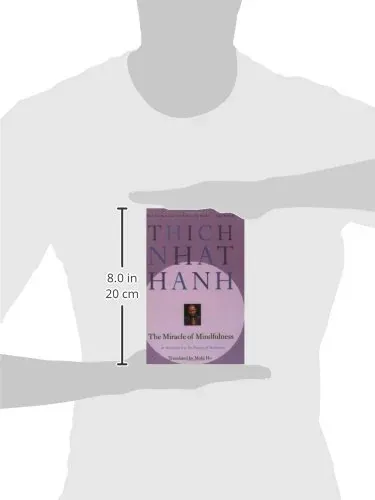
The Miracle of Mindfulness: An Introduction to the Practice of Meditation by Thich Nhat Hanh front cover
What the Book Is and What It Contains
Published by Beacon Press, The Miracle of Mindfulness is a practical guide to meditation written by Vietnamese Zen master, poet, and peace activist Thich Nhat Hanh, translated into English by Mobi Ho, and illustrated by Vo-Dinh Mai. Structured in seven chapters — from "The Essential Discipline" and "The Miracle Is to Walk on Earth" through "A Day of Mindfulness," "The Pebble," and "One Is All, All Is One: The Five Aggregates" — the book builds a coherent framework for understanding mindfulness as it is practiced within the Zen Buddhist tradition. Supplementary material includes a translator's preface, exercises in mindfulness, a biographical essay on Thich Nhat Hanh by Jim Forest, a selection of Buddhist sutras, and a chronology of the author's life. The book is designed not as abstract philosophy but as a direct invitation: the exercises are written with step-by-step instruction, grounded in everyday situations accessible to readers of any background.
“clear and simple emphasis on basic practice enables any reader to begin a practice of his or her own immediately.”
The Central Argument: Presence in Ordinary Moments
The guiding premise of the book is that mindfulness — being awake and fully aware — is not reserved for the meditation cushion but is available in every mundane act. Thich Nhat Hanh uses the ordinary rhythms of daily life, washing the dishes, answering the phone, peeling an orange, as the very terrain of practice, arguing that each moment holds within it an opportunity to work toward greater self-understanding and peacefulness. This approach reflects the broader Vietnamese Zen (Thiền) tradition, in which engaged, moment-to-moment awareness is inseparable from spiritual cultivation. The book's emphasis on breath as the anchor of practice is notably non-sectarian: as the translator's preface makes clear, one's breath is not attached to any particular creed, which has allowed the book to find a home with readers from many different religious traditions, not only Buddhists.
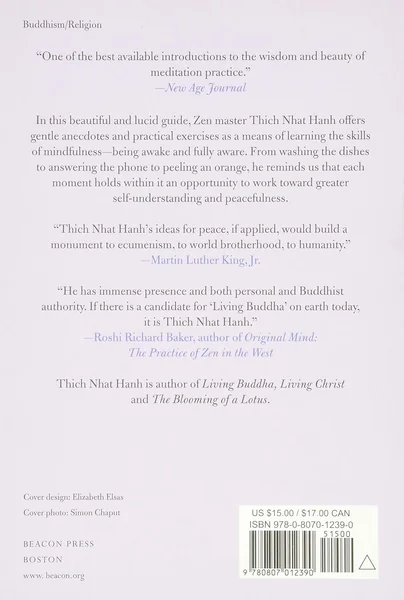
Back cover with book synopsis, review quotes from publications and authors, publisher information, and barcode.
Reception and Significance
The Miracle of Mindfulness has introduced generations of readers to what Beacon Press describes as "the life-changing beauty of mindful awareness," and its reception across decades reflects unusual durability. The New Age Journal called it "one of the best available introductions to the wisdom and beauty of meditation practice." Sogyal Rinpoche, as quoted by the publisher, wrote that "Thich Nhat Hanh writes with the voice of the Buddha." Martin Luther King Jr., who nominated Thich Nhat Hanh for the Nobel Peace Prize in 1967, stated that his "ideas for peace, if applied, would build a monument to ecumenism, to world brotherhood, to humanity." The book's reach is also notable in that interest has never been limited to practitioners: readers seeking stress reduction, emotional grounding, or simply a more deliberate pace of life have turned to it in equal measure.

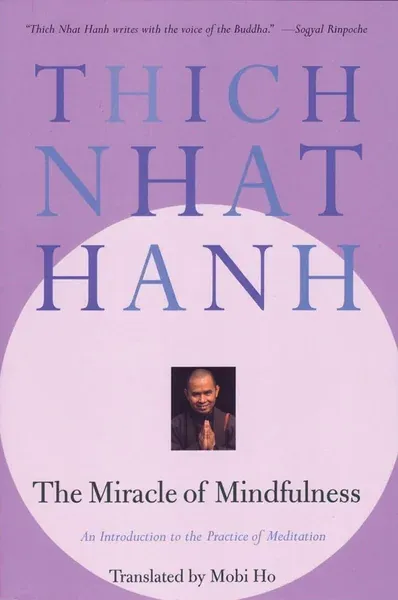
Front cover of a meditation guide with large blue title text and a portrait photograph on a lavender background.
Genuine Strengths: Clarity, Accessibility, and Breadth of Appeal
The book's most consistently praised quality, across published commentary, is the clarity and gentleness of its approach. The New Age Journal's characterisation of the guide as "eloquent and lucid" aligns with the translator's framing of the work as one whose "clear and simple emphasis on basic practice enables any reader to begin a practice of his or her own immediately." Where some meditation literature assumes prior familiarity with Buddhist doctrine, this text does not — it introduces concepts such as the five aggregates, the four foundations of mindfulness, and the factors of enlightenment organically, through lived example rather than doctrinal exposition. The result is a guide designed to be genuinely welcoming to newcomers without being reductive for readers who already engage with Buddhist thought.

Back cover with purple background, body text passages, and barcode label.
Limitations and Who May Want More
At 140 pages, the book is deliberately brief, and readers seeking an in-depth examination of Buddhist philosophy or a comprehensive meditation curriculum may find its scope intentionally narrow. Because the text was originally written as a teaching letter — personal in tone, modest in scale — it does not attempt systematic coverage of the full range of meditation traditions or techniques. Practitioners already versed in Zen or Theravāda practice, or those looking for a more rigorous engagement with the sutras (which appear here only in selection), will find the book more of a starting point than a destination. Its brevity is both its gift to beginners and its natural ceiling for advanced students.
Frequently Asked Questions
Who is this book best suited for?
The review identifies The Miracle of Mindfulness as an ideal entry point for newcomers to meditation and mindful living, noting that its clear, step-by-step exercises are grounded in everyday situations accessible to readers of any background. It is also described as welcoming to those from different religious traditions, not only Buddhists, since its emphasis on breath as an anchor of practice is notably non-sectarian.
Is The Miracle of Mindfulness worth reading?
The review presents it as one of the most widely recommended introductions to mindful living, with unusual durability across decades of readership. At its current price, the review suggests it offers strong value, particularly for beginners seeking clarity and accessibility rather than an advanced curriculum.
What is the central argument of the book?
The guiding premise, as the review explains, is that mindfulness is not reserved for the meditation cushion but is available in every mundane act — washing the dishes, answering the phone, peeling an orange. Thich Nhat Hanh argues that each ordinary moment holds an opportunity to work toward greater self-understanding and peacefulness.
How is the book structured?
The review notes that the book is organized into seven chapters, moving from 'The Essential Discipline' and 'The Miracle Is to Walk on Earth' through 'A Day of Mindfulness,' 'The Pebble,' and 'One Is All, All Is One: The Five Aggregates.' Supplementary material includes a translator's preface, mindfulness exercises, a biographical essay on Thich Nhat Hanh by Jim Forest, a selection of Buddhist sutras, and a chronology of the author's life.
What big ideas does the book engage with?
The review highlights mindfulness as moment-to-moment awareness inseparable from spiritual cultivation, rooted in the Vietnamese Zen (Thien) tradition. The book also introduces concepts such as the five aggregates, the four foundations of mindfulness, and the factors of enlightenment, presenting them organically through lived example rather than doctrinal exposition.
What is the writing style like?
The review describes the book's tone as personal, modest in scale, and originally written as a teaching letter. Published commentary cited in the review characterizes it as 'eloquent and lucid,' and the translator's framing emphasizes a 'clear and simple emphasis on basic practice' that enables any reader to begin immediately.
How accessible is this book to someone with no meditation background?
The review is clear that the book does not assume prior familiarity with Buddhist doctrine, making it genuinely welcoming to newcomers without being reductive. The exercises are written with step-by-step instruction grounded in everyday situations, and concepts are introduced through lived example rather than abstract philosophy.
What are the book's main limitations?
At 140 pages, the review notes the book is deliberately brief and does not attempt systematic coverage of the full range of meditation traditions or techniques. Practitioners already versed in Zen or Theravada practice, or those seeking a rigorous engagement with the sutras, will find it more of a starting point than a destination.
Is this book appropriate for advanced meditation practitioners?
According to the review, readers already versed in Zen or Theravada practice will find the book's scope intentionally narrow. Its brevity is described as both its gift to beginners and its natural ceiling for advanced students.
What practical takeaways does the book offer?
The review emphasizes that the book is designed as a direct invitation to practice, with exercises written in step-by-step instruction applicable to everyday situations. Readers can expect guidance on using the breath as an anchor of awareness and applying mindfulness to ordinary activities such as washing dishes or peeling an orange.
Sources & Further Reading
The key facts and claims in this review are grounded in the retrieved, verified sources listed below.
- 1
beacon.org
- 2
truthbrary.mpaq.org
- 3
parallax.org
- 4
lifeclub.org
- 5
- 6
- 7
godofsilicon.com
- 8
plumvillage.org
- 9
- 10
- 11
Reader Comments
No comments yet
Be the first to share your thoughts!