9 min read
4.8
· 9,710 Amazon ratingsShare This Review
Our review
Profit First by Mike Michalowicz Review: A Bold Cash-Management System for Entrepreneurs
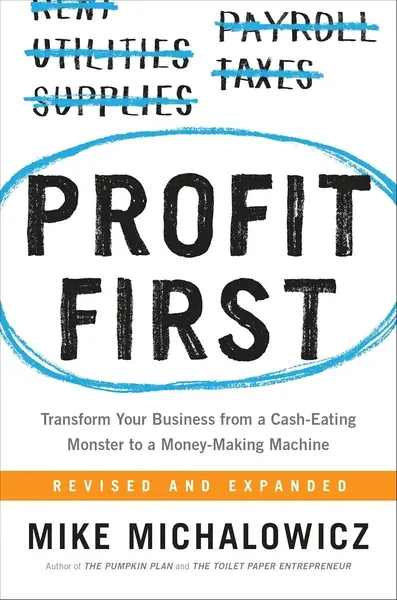
Profit First, reissued by Portfolio in 2017, presents Mike Michalowicz's counter-intuitive financial framework for small-business owners: take profit out first, then operate on what remains. Drawing on case studies, step-by-step guidance, and Michalowicz's characteristic humor, the book is designed to replace the conventional revenue-minus-expenses accounting model with a behaviorally driven system built around predetermined profit percentages. This review is based on published sources and the book's documented contents — not hands-on application of the method.
LuvemBooks Verdict
Best for
Small-business owners and entrepreneurs who are generating revenue but consistently ending up cash-poor — and want a behaviorally grounded, step-by-step system to build profitability from day one.
Worth it if
You run your own business, struggle to retain profit despite steady sales, and want a concrete, immediately deployable cash-management framework written in plain, engaging language rather than dense financial theory.
Skip if
You operate in a corporate, nonprofit, or salaried context, or run a complex multi-entity structure that demands more granular financial modeling than a single simplified framework can provide.
What readers & critics say
Reader commentary retrieved from mikemichalowicz.com describes the system as a "brilliant smack-upside-the-head revelation for entrepreneurs," with one reader reporting a move from break-even to profitable within a month of implementation. Retailer and book-summary pages on abebooks.com and credroo.com consistently highlight the book's practical, step-by-step design and its argument that the traditional accounting formula is itself the structural culprit behind chronic small-business cash scarcity.
Sources: mikemichalowicz.com, abebooks.com, credroo.comAsk LuvemBooks
Was this helpful?
- Is it worth reading?
- For the target reader — a small-business owner generating revenue but consistently ending up with little to show for it — Profit First is precisely targeted and immediately actionable. The combination of a concrete, step-by-step system, accessible humor, and real-world validation through more than 175,000 adopting companies makes it a standout in the small-business finance space. Readers who are persuaded early may find sections of the book revisit the central argument across different scenarios in ways that feel repetitive, but that is a pacing critique rather than a structural flaw. Those in corporate, nonprofit, or salaried contexts will find limited direct applicability.
- Similar books
- Readers who connect with Profit First's behavioral approach to money will likely find Morgan Housel's The Psychology of Money equally compelling — it unpacks the emotional and psychological drivers behind financial decisions with similar accessibility. Gino Wickman's Traction offers a complementary operational framework for small-business owners who want to systematize not just cash flow but the entire business. For a broader view of wealth and leverage, The Almanack of Naval Ravikant by Eric Jorgenson covers entrepreneurial thinking and financial philosophy in a similarly digestible format. Within Michalowicz's own catalog, Fix This Next and Clockwork extend his small-business systems thinking into business priorities and operational efficiency, respectively.
- Who should read this?
- Profit First is purpose-built for entrepreneurs and small-business owners who are generating revenue but chronically ending up with little or no cash reserves — what Michalowicz calls running a 'cash-eating monster rather than a money-making machine.' The book is especially well-suited to non-accountants who need a behaviorally grounded system rather than abstract financial theory. It is less applicable to readers in salaried roles, large corporate environments, or nonprofit management, where the specific mechanics of the Profit First system do not translate directly.
- What do endorsers say?
- The book carries endorsements from several respected business authors. Greg Crabtree, author of Simple Numbers, Straight Talk, Big Profits!, describes the Profit First system as making profitability 'so radically simple that you no longer have an excuse not to be profitable AND have cash flow.' Chris Guillebeau, author of The $100 Startup, calls it 'arguably one of the greatest hacks of all time.' Sally Hogshead, author of Fascinate, captures the book's promised transformation: it shows 'how to remove your nose from the grindstone, climb out of the quicksand, and build a business that loves you back.' These endorsements consistently highlight simplicity and behavioral insight as the method's distinguishing strengths.
- What's the psychology behind it?
- The Profit First method is explicitly framed as a behavioral intervention, not merely an accounting adjustment. It exploits the same psychological principle behind personal 'pay yourself first' savings advice — by removing profit before expenses are considered, the owner is never tempted to spend it. Michalowicz argues that the traditional formula (Sales − Expenses = Profit) fails not because business owners lack discipline, but because the system itself invites spending whatever is available and encourages mistaking revenue activity for financial health. The behavioral reframe is what endorsers like Chris Guillebeau have described as the book's central 'hack.'
- What are the book's weaknesses?
- Three limitations are worth flagging. First, the system's deliberate simplicity may frustrate entrepreneurs with complex, multi-entity operations who require more granular financial modeling — elegance comes at the cost of nuance. Second, some readers who absorb the core concept early find that the book revisits its central argument across different scenarios in ways that feel repetitive. Third, the book is squarely aimed at small-business owners and entrepreneurs; readers in corporate finance, nonprofit management, or salaried roles will find the prescriptions largely inapplicable to their context.
Summarize this book
Follow up
Synthesized from verified book data & published reviews · How we review
Press Enter to ask. Answers come from our editorial Q&A — start typing to see related questions.
Age & Reading Level
Recommended age
Adult
Reading level
Adult
who it suits
Skip if You're a corporate finance professional, nonprofit manager, or salaried employee looking for financial frameworks applicable to your context.
Our Review
What the Book Actually Argues
Premise, Context, and the Problem It Addresses
Strengths: Clarity, Wit, and Practical Structure
Limitations and Who May Find It Wanting
Who This Book Is Genuinely For
Sources & Further Reading
The key facts and claims in this review are grounded in the retrieved, verified sources listed below.
- Cited in this review
- 1
- 2
- 3
- Further reading
- 4
mikemichalowicz.com
- 5
- 6
Books like Profit First
Curated picks for readers who enjoyed Profit First, with our reasoning for each match.
If you liked Profit First