8 min read
4.7
· 1,609 Amazon ratingsShare This Review
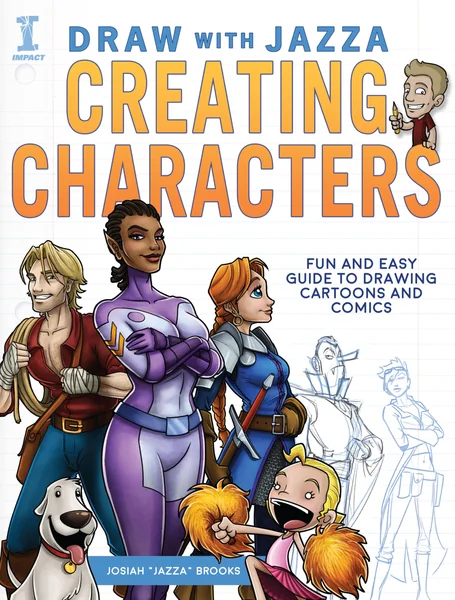
Draw With Jazza - Creating Characters by Josiah Brooks Review: A Structured, Genre-Spanning Character Design Guide
Published by IMPACT Books in November 2016, Draw With Jazza – Creating Characters is a how-to instructional guide by YouTube artist and animator Josiah "Jazza" Brooks, designed to walk aspiring cartoonists and comic artists through a repeatable, four-stage process for inventing and drawing original characters across genres — from sci-fi and steampunk to comic book heroes and alien races.
LuvemBooks Verdict
Best for
Self-taught artists, hobbyists, and students with little formal training who want a clear, genre-flexible, repeatable system for designing original characters across comics, cartoons, and video games.
Worth it if
You want an end-to-end character design pipeline — from brainstorm sketching through finished turnarounds and expression sheets — grounded in an accessible, structured framework rather than scattered technique tips.
Skip if
Readers who already have significant character design experience or formal illustration training are unlikely to be challenged, and those seeking advanced anatomy or rendering depth will need to look elsewhere.
What readers & critics say
Retailer and library listings retrieved from sources including Barnes & Noble and AbeBooks consistently describe the book as breaking down "an easy-to-follow method that will help you to invent and draw original characters time and time again," with broad genre scope spanning sci-fi, steampunk, comic book heroines, and alien races highlighted as a core selling point.
Sources: Barnes & Noble, AbeBooksAsk LuvemBooks
Was this helpful?
- Is it worth reading?
- For self-taught artists, hobbyists, and students who want a clear, repeatable system for character design, the book offers genuine value: its four-stage framework gives coherence that purely technique-focused cartooning books can lack, and its genre range — from steampunk and sci-fi to comic heroines and alien races — makes it relevant across comics, games, and animation. The worked example of Quaid the Space Captain grounds the abstract design process in a concrete walkthrough that beginner-to-intermediate readers can follow and replicate. Readers who already have significant character design experience or formal training, however, are unlikely to be challenged by the foundational framing, and those seeking advanced anatomy or rendering instruction will need supplementary resources.
- Similar books
- Readers who enjoy Draw With Jazza – Creating Characters may also find value in several related titles. Mark Kistler's You Can Draw in 30 Days shares the same accessible, step-by-step instructional philosophy for beginners. Ivan Brunetti's Cartooning: Philosophy and Practice takes a more conceptual approach to sequential art and cartooning craft. Betty Edwards's Drawing on the Right Side of the Brain is a foundational drawing guide with a strong process-driven methodology. Carl Potts's The DC Comics Guide to Creating Comics offers a more industry-oriented perspective on character and storytelling for comics specifically. Frederik L. Schodt's Manga! Manga! The World of Japanese Comics broadens the context for readers interested in character design across comic traditions.
- Who should read this?
- The book is best suited to self-taught artists, hobbyists, and students who want a genre-flexible, repeatable system for inventing original characters and have little or no formal training in character design or illustration. Aspiring comic book artists, indie game developers building visual assets, and animation students sketching out original casts are all squarely within its target audience. Fans of Brooks's YouTube channel will find the guide a natural companion — one that formalizes his accessible instructional voice into a print format that supports repeated, exercise-driven use. Those seeking deep technical instruction in anatomy or advanced rendering techniques will need to supplement it with other resources.
- What age is it for?
- Best for ages 12 and up. The guide's beginner-friendly, step-by-step structure is well suited to teen artists interested in comics, cartooning, game design, or animation, and it works equally well for adult hobbyists and students. The reading level and conceptual demands are accessible to motivated middle-schoolers, while the genre range — sci-fi, steampunk, fantasy, comic book heroes — aligns naturally with the interests of younger aspiring creators.
- About Josiah Brooks
- Josiah Brooks is an Australian illustrator, YouTuber, and entrepreneur known online as "Draw With Jazza." He is the author of Draw With Jazza – Creating Characters: Fun and Easy Guide to Drawing Cartoons and Comics, in which he breaks down an easy-to-follow method for inventing and drawing original characters across genres such as sci-fi, steampunk, and comics.
- What is the four-stage design process?
- Brooks structures the book around a four-stage process he calls the "four Ds": Discover (exploring ideas, themes, and visual styles), Design, Develop, and Deliver. The framework moves readers through brainstorm sketching, body refinement, color work, genre and setting decisions, character archetypes, and the use of stereotypes as a design shorthand, culminating in production-ready outputs — head turnarounds, full-body turnarounds, expression sheets, pose sheets, and character variants. A worked example, Quaid the Space Captain, carries readers through the entire pipeline, grounding the abstract method in a concrete, follow-along walkthrough.
- What are its limitations?
- The book's primary limitation is scope rather than quality: its positioning as "fun and easy" signals that it prioritizes accessibility and a welcoming entry point over advanced technical depth, which is the right call for its beginner-to-intermediate audience but means it is not a resource for sophisticated anatomy study or advanced rendering techniques. Readers with significant prior character design experience or formal illustration training are unlikely to be challenged by the foundational framing. For those seeking discipline-specific depth — detailed figure construction, complex lighting, or industry-specific production pipelines — supplementary resources will be necessary.
Summarize this book
Follow up
Synthesized from verified book data & published reviews · How we review
Press Enter to ask. Answers come from our editorial Q&A — start typing to see related questions.
Age & Reading Level
Recommended age
Ages 12–18
Reading level
Young adult
who it suits
Best for: Ages 12+ — reading level and conceptual demands suit motivated middle-schoolers and teen artists; equally accessible to adult beginners.
Skip if you're looking for advanced technical instruction in anatomy, figure construction, or professional-level rendering.
Our Review
What the Book Is and What It Covers
Significance and Context
Strengths: Process and Range
Practical Scope and Honest Limitations
Who This Book Is For
Sources & Further Reading
The key facts and claims in this review are grounded in the retrieved, verified sources listed below.
- Cited in this review
- 1
- 2
- 3
- Further reading
- 4
- 5