BOOKS
Published

Read Time

3 min read

Curated & edited by

LuvemBooks Editorial

How we create our reviews →
Share This Review

Carried Away: A Memoir of Rescue by Ross Meador Review: A Raw, Historic Account of Operation Babylift

Ross Meador's self-published memoir delivers a firsthand account of one of the most dramatic humanitarian evacuations of the twentieth century — the 1975 Operation Babylift — told through the eyes of a nineteen-year-old who arrived in Saigon with a one-way ticket, $500, and no formal training, long before the official mission began.

LuvemBooks Verdict

Best for

Readers drawn to eyewitness Vietnam War history — particularly those who want the ground-level human texture of Operation Babylift rather than a policy-level or journalistic overview.

Worth it if

You value granular, emotionally direct testimony from someone who was genuinely embedded in the crisis before it became a headline event, and you're willing to let vignettes accumulate rather than chase a propulsive narrative arc.

Skip if

You're expecting a tightly plotted, conventionally structured memoir — or you're already deeply familiar with Operation Babylift and are looking primarily for new documentary revelations rather than personal register.

What readers & critics say

Novels Alive awarded the book a five-star review, noting that Meador's tone is "raw and full of emotion" and that the memoir "offers a rare, deeply human view of the mission," while also observing that the domestic opposition Meador recounts echoes contemporary debates about international adoption. Storey Book Reviews highlights that Meador had already built relationships with orphanage staff and committed himself fully to the work long before the official mission began, underscoring the exceptional proximity of his vantage point.

Sources: Novels Alive, Storey Book Reviews
4.5from 31 Amazon ratings— reader ratings, not a LuvemBooks score
In This Review
  • What Works & What Doesn't
  • What the Book Is and What It Covers
  • Historical Significance and Context
  • Emotional Register and Narrative Voice
  • Strengths Grounded in the Source Record
  • Limitations and Who May Be Challenged

What Works & What Doesn't

What Works
  • Exceptionally rare firsthand vantage point: Meador was embedded with orphanage staff in Saigon before Operation Babylift's official launch
  • Addresses the domestic U.S. opposition to Operation Babylift, connecting personal experience to a still-relevant ethical debate
  • The vignette structure gives individual children and orphanage workers distinct presence rather than reducing them to background
  • Emotionally direct narrative voice that, per Novels Alive, captures how the orphans shaped Meador as much as he aided them
What Doesn't
  • The episodic, vignette-driven structure may feel loosely plotted to readers expecting a conventional memoir narrative arc
  • As an independently published work, it lacks the editorial backing of a traditional house, which some readers may notice
A memoir that earns its emotional weight through lived proximity to one of the Vietnam War's most extraordinary and contested chapters.

What the Book Is and What It Covers

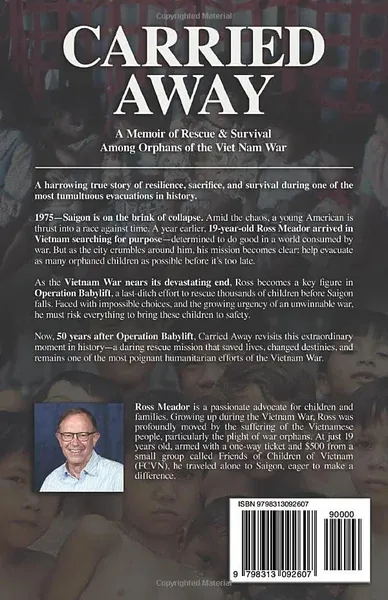
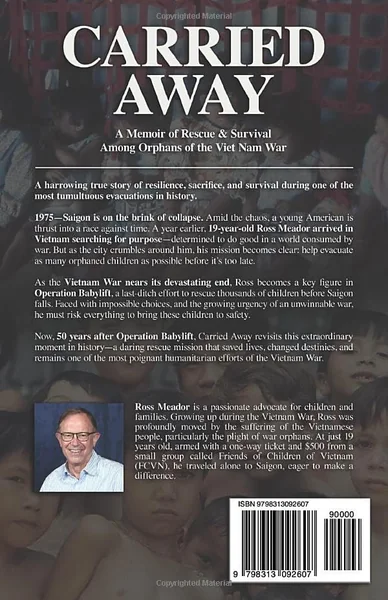
Back cover with title, synopsis, author photo, and barcode.
Carried Away: A Memoir of Rescue and Survival Among the Orphans of the Viet Nam War is Ross Meador's firsthand account of Operation Babylift, the large-scale emergency evacuation of Vietnamese war orphans that took place as Saigon neared collapse in 1975. Meador was nineteen years old when he traveled to Vietnam under the auspices of a small organization called Friends of Children, carrying a one-way ticket and $500 and possessing no diplomatic credentials or formal humanitarian training. The memoir recounts how he had already embedded himself with orphanage staff and navigated a crumbling city before the official operation commenced, situating him as an on-the-ground participant rather than an outside observer. The book's structure draws on vignettes — individual people and specific situations — that accumulate into a larger portrait of what it meant to care for orphans in a war zone, facilitate their adoptions, and work toward removing them safely before Saigon fell.

Historical Significance and Context

The events at the center of this memoir occupy a contested and emotionally charged place in American and Vietnamese history. Operation Babylift drew both widespread sympathy and sharp domestic opposition in the United States, and Meador's account addresses that opposition directly. According to a review at Novels Alive, the memoir recounts the rising resistance to the mission from within the United States, a debate the reviewer notes carries strong echoes of contemporary arguments about international adoption and humanitarian intervention. By placing a single nineteen-year-old's perspective at the center of that history, Meador offers something that policy histories and journalistic retrospectives cannot: the texture of daily improvisation inside orphanages as the political situation deteriorated. The book's full subtitle — A Memoir of Rescue and Survival Among the Orphans of the Viet Nam War — signals that the scope extends beyond logistics into the human stakes for the children themselves and for those who cared for them.

Emotional Register and Narrative Voice

Novels Alive notes that Meador's tone when recounting his experiences with the war orphans is often raw and full of emotion, and that the memoir captures how the children affected him as profoundly as he affected them. That reciprocal dynamic — a young American shaped by the very people he came to help — is described as one of the memoir's defining qualities. Rather than positioning Meador as a detached rescuer, the account reflects a narrator whose worldview was formed by these relationships. The vignette-driven structure supports this register, allowing individual children and orphanage workers to emerge as distinct presences within the larger evacuation narrative, rather than remaining an undifferentiated mass of crisis.

Strengths Grounded in the Source Record

The memoir's most evident strength, based on what reviewers and the author's background establish, is the rarity and directness of its vantage point. Storey Book Reviews describes Meador as someone who had built genuine relationships with orphanage staff and committed himself fully to the mission before it carried any official sanction — a distinction that sets this account apart from memoirs written by later arrivals or policy-level participants. The book's engagement with the domestic American controversy surrounding Operation Babylift also gives it a dimension beyond personal narrative, connecting individual experience to a broader political and ethical argument that remains unresolved. Meador's biography as a long-standing children's and family advocate lends the account a coherence of purpose across the decades between the events and their telling.

Limitations and Who May Be Challenged

Readers approaching Carried Away as a work of traditional literary memoir may find the vignette-based structure episodic rather than propulsive — a form that prioritizes accumulation of experience over a tightly plotted narrative arc. That structural choice reflects the nature of the subject matter, but it does mean the book rewards patience and an interest in granular, human-scale testimony over dramatic momentum. Additionally, as an independently published title, the book enters the market without the editorial infrastructure of a major house, which some readers may factor into their expectations around production and presentation. Those already familiar with Operation Babylift from journalistic or historical sources will find the value here in the personal register rather than in new documentary revelations, making the book best suited to readers for whom eyewitness texture matters as much as comprehensive historical coverage.

Sources & Further Reading

The key facts and claims in this review are grounded in the retrieved, verified sources listed below.

  1. Cited in this review
  2. 1
  3. 2
  4. 3
  5. Further reading
  6. 4

    carriedawaybook.com

  7. 5